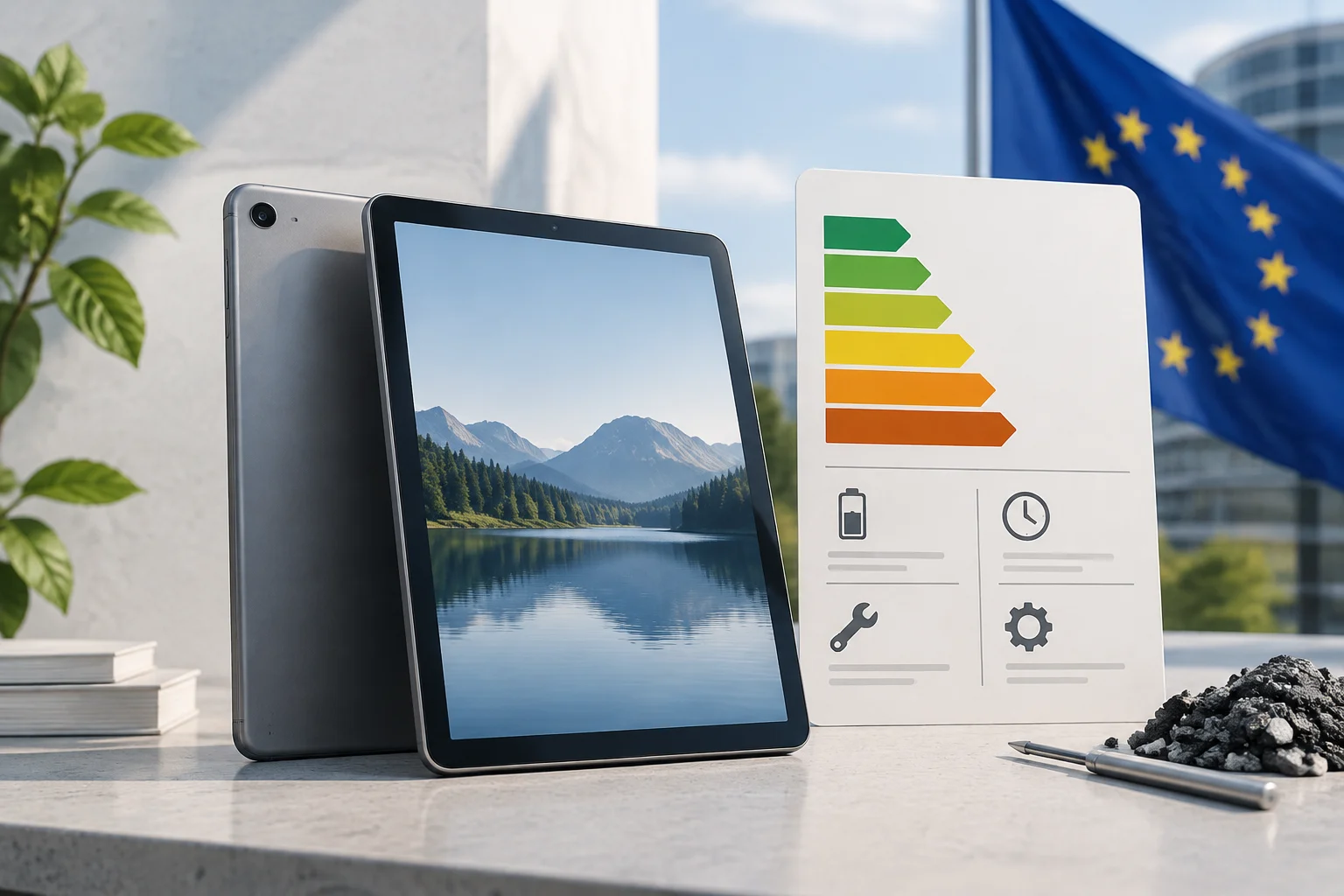
Which rules apply to tablets
Tablets placed on the European Union market are subject to specific ecodesign requirements under Regulation (EU) 2023/1670. Its scope includes slate tablets, alongside mobile phones and other devices. The measure forms part of the European ecodesign framework: it is neither a voluntary certification nor a buying recommendation, but a regulation that sets conditions for product categories covered by its scope. When checking a particular device, the first question is therefore whether its category and configuration fall within the definitions in the regulation.
The European Commission says that ecodesign and energy-labelling requirements for smartphones and tablets have applied since June 2025. For someone buying in Spain, the practical consequence is that the date matters when comparing information for new models or commercial documentation. It should not be assumed that current obligations appeared in the same way in products or sales materials from earlier periods. The applicable date is a useful starting point, but it does not by itself establish that every tablet format is covered.
It is important to distinguish the specific tablet rules from other provisions that may affect electronic products or accessories. Rules for electronic displays, for example, exist, but their title alone does not prove that every tablet is subject to all their requirements: the scope and exclusions of each measure must be checked. The principal reference for this topic is Regulation 2023/1670, not a general interpretation of rules intended for displays or chargers. Keeping those instruments separate helps avoid attributing an obligation to a device without first checking its legal category.
Timeline and scope: check the type of device
Regulation 2023/1670 was adopted in 2023 and sets ecodesign requirements for smartphones, certain other phones, cordless phones and slate tablets. The Commission’s subject page summarises that the ecodesign and energy-labelling regime for smartphones and tablets has applied since June 2025. This date should be read as the start of application of the rules, not as proof that every tablet, regardless of its format or use, is covered without exception. The provisions and product definitions remain essential when assessing an individual device.
A product’s marketing name does not always settle its legal classification. Before concluding that an obligation applies to a specific device, check the product definition and exclusions in the legal text. A convertible, a device with a keyboard or a specialised product may need an individual assessment; it is not enough for a retailer to list it under the general heading “tablet”. The physical design, intended use and regulatory definitions can all matter when establishing which requirements apply.
It is also important not to mix the ecodesign timetable with that of other consumer rules. The European Directive on the repair of goods is a separate measure, with its own transposition and application. Its existence does not mean that all its obligations are automatically included in a tablet product listing, nor that it replaces the requirements of Regulation 2023/1670. A buyer should treat each instrument as a distinct source and consult the one that addresses the question at hand.
Repairability, spare parts and batteries: what the obligation means
Regulation 2023/1670 addresses durability and repair-related matters, including conditions concerning access to spare parts and information relevant to repair and maintenance. It also sets parameters for components such as batteries. This does not mean that every repair is free, that every part will remain available indefinitely, or that users can open and repair every model without specific tools or expertise. The regulation sets defined conditions; it should not be read as a blanket promise of cost-free, unrestricted repair.
The precise details depend on the type of part, who is entitled to receive information, and the periods and conditions set out in the regulation. So, when faced with a marketing claim such as “easy to repair”, consumers should look for more specific information: which components can be replaced, for how long they are offered, who can access instructions, and whether the intervention affects the warranty or the device’s resistance. Regulation and a brand’s service policy are related sources, but they are not interchangeable.
A useful check is to consult the official documentation for the exact model and compare it with the legal text: identify the precise model, find the repair or support section, and review the conditions for spare-part availability. A promise of support does not, by itself, prove that every regulatory condition is met; equally, a lack of clear information on a commercial page is not enough to declare non-compliance without checking the required documentation and sales context. Keeping those limits in mind avoids turning either marketing wording or an incomplete web page into a definitive legal conclusion.
Energy label: comparable information, not a buying verdict
The Commission includes smartphones and tablets in its information on energy labelling and ecodesign. The label provides standardised information to support comparisons between products; the regulation and its annexes determine what must be communicated and how. When assessing a model, locate the label and the associated product information sheet, then check that they correspond to the particular variant being offered. A listing for a different capacity or configuration may not describe the product in front of the buyer.
A label does not capture every reason for choosing a tablet. It does not replace an assessment of performance, screen quality, accessory compatibility, update policy, price or repair conditions. Nor is it sensible to equate an energy class with an overall quality rating: it measures the aspects defined by the regulation, not every possible use or preference. Buyers can use it as one source of comparable information while considering other features separately.
The Commission maintains an information page on phones and tablets that provides a starting point for relevant rules and materials. If a seller displays a label, the buyer can compare the product identity and the information shown with the manufacturer’s details and regulatory documentation. If information is missing, or the label appears to relate to another variant, the appropriate conclusion is that the check is incomplete—not that the device is necessarily non-compliant. That distinction is particularly useful when product listings contain several configurations under one general name.
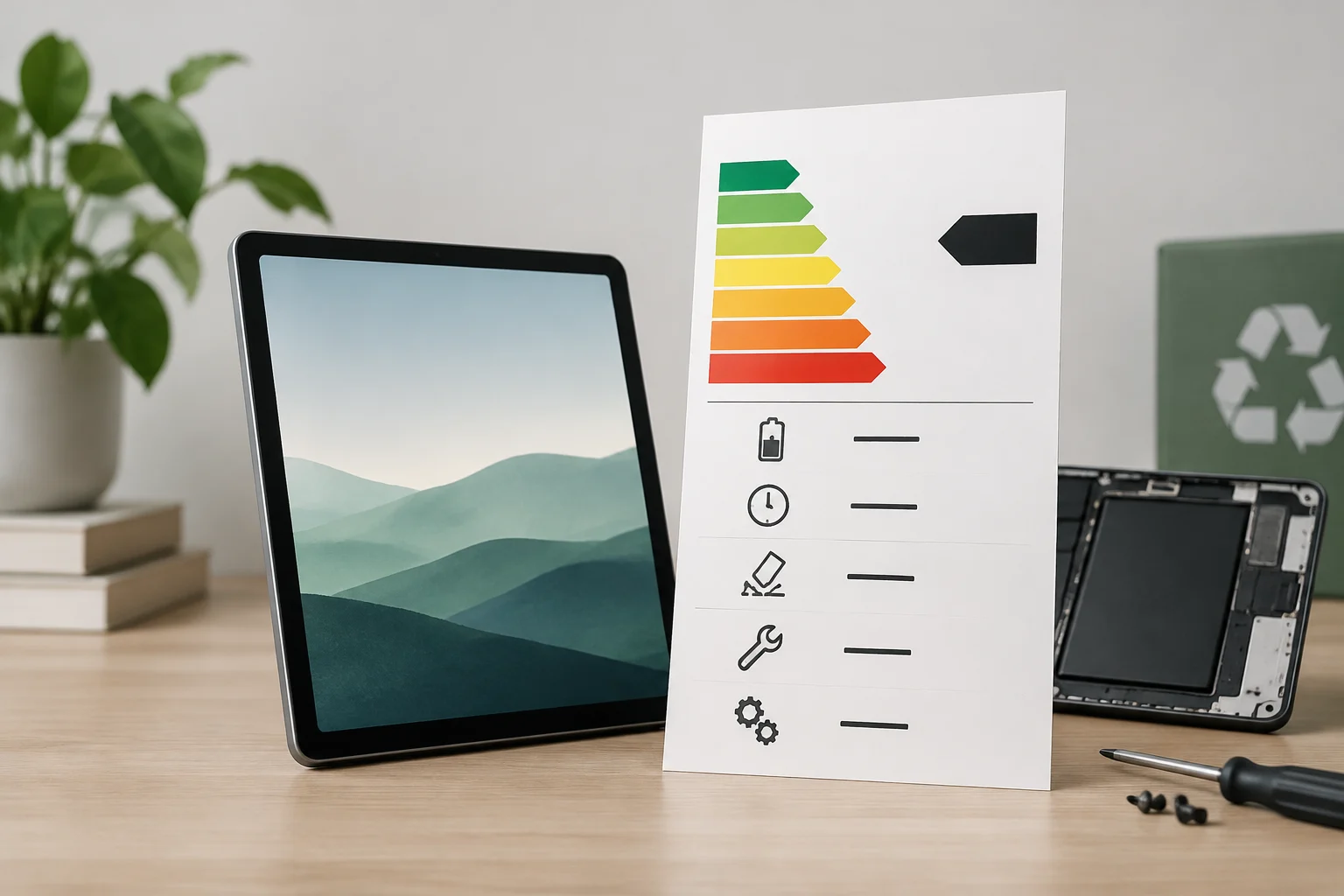
How to check a model before buying
To review a tablet without confusing advertising with a legal obligation, follow a straightforward sequence. First, note the exact brand and model, including suffixes that distinguish size, connectivity or capacity. Then look for the corresponding register entry or energy information sheet and open the manufacturer’s support documentation, rather than relying only on the generic name shown by a retailer. These steps help establish that the information being compared actually refers to the device on offer.
Next, compare claims about durability or repair with the requirements applicable to that product. A promise of “extended updates” should state the period and coverage; a repairability claim should clarify which parts and conditions it refers to. The regulation addresses several aspects connected with product lifetime, but it does not turn vague promotional terms into independently verifiable facts. Where the seller’s wording is broad, look for model-specific documentation before drawing conclusions.
A practical checklist can reduce errors: exact model, matching label or product sheet, repair information and an official source. When comparing more than one device, record the variant and date checked for each. Product pages change and commercial conditions can vary; saving the information sheet consulted makes it possible to distinguish what was published from what is merely assumed to be current. It also makes a later comparison more reliable if the seller updates a listing or changes the configurations it offers.
What cannot be concluded from these sources alone
Regulations describe obligations, but the text of a regulation alone does not prove that an individual model meets them in practice. To establish compliance for a particular tablet, the relevant documentation, the marketed variant and, where appropriate, conformity information would need to be examined. This article explains how to approach that check; it does not certify models or assess a retailer’s offer. The distinction matters because a general account of the rules is not a substitute for evidence about a specific product.
Nor should one claim that energy labelling provides an “overall score” that determines the best tablet, or that the rules guarantee affordable repairs, unlimited parts availability or software updates for a uniform period. Those matters require checking the applicable clauses and the manufacturer’s specific information. The regulation establishes concrete conditions, not a general promise that every product will have identical longevity. Price, service arrangements and a user’s needs also remain separate considerations.
The useful conclusion for buyers is narrower: since June 2025, a specific European ecodesign and labelling framework has existed for tablets within its scope. Consulting the regulation, identifying the variant, and checking the label and official documentation helps separate verifiable obligations from commercial claims. If a case turns on whether a hybrid device falls within a particular legal definition, that classification should be checked before applying this summary as a definitive answer.