The promise of chiplets and the integration problem
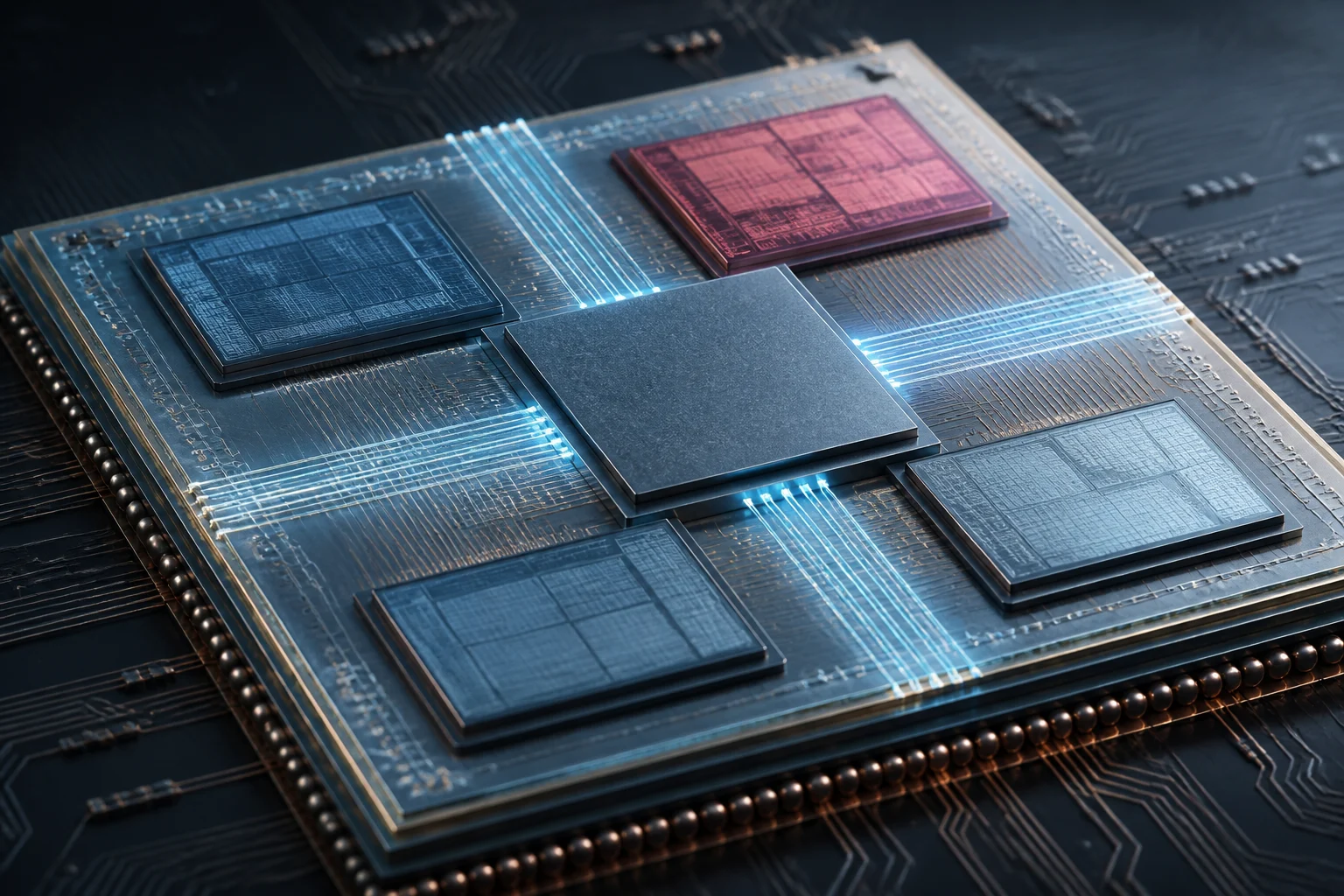
Splitting a processor into several dies makes it possible to assign different functions to separate silicon blocks and potentially combine manufacturing processes. This modularity can avoid making an entire design depend on one large die, but it does not remove the integration work: chiplets must communicate inside the package under strict power, space, and signal constraints. The UCIe standard—Universal Chiplet Interconnect Express—aims to provide a common foundation for that die-to-die communication and for some of the associated protocols and functions. By itself, it is not a processor design, a universal package format, or a guarantee that two components from different suppliers will work together without adaptation.
The distinction matters when evaluating a modular design: “using chiplets” describes an architecture; “using UCIe” describes an interface governed by a specific specification. Even with a common interface, companies must decide on the physical implementation, signal distribution, power delivery, thermal management, and test strategy. Combining processes or suppliers could provide flexibility, but it also adds design and validation work. Cost reductions or performance improvements should therefore be treated as case-dependent possibilities, not automatic outcomes of adopting the standard. UCIe supplies one shared part of the system; it does not replace an assessment of whether the complete package is viable.
What UCIe defines: interface, protocols, and management
The consortium describes UCIe as a package-level interconnect specification covering a die-to-die I/O physical layer, die-to-die protocols, and a software stack that leverages PCI Express and Compute Express Link. In practical terms, the specification is intended to help teams agree on connection and transport details, rather than inventing every link between dies from scratch. Version 1.1 added, among other elements, reliability mechanisms and architectural attributes to support test and conformance plans. Version 2.0 introduced a standardized management architecture and functions for testing, debugging, and telemetry throughout the life cycle of a system in package.
These functions are not, however, a complete management or security solution for every product: a design must integrate them and decide what data it collects, how access is controlled, and how it behaves when faults occur. The useful boundary is the difference between what the common interface defines and what remains the product’s responsibility: policies, firmware, system memory coherency, end-to-end security, and application behavior are not automatically resolved by a UCIe link. The organization’s public documentation provides guidance on the specification’s scope; product teams must consult the applicable revision and check the relevant intellectual-property rights and terms before implementation.
Versions and rates: what UCIe 3.0 adds
UCIe 3.0 was announced on August 5, 2025. According to the consortium, it supports rates of 48 and 64 GT/s, compared with the maximum of 32 GT/s cited for UCIe 2.0, and includes architectural changes. The specifications page highlights a sideband channel that can reach 100 mm, continuous transmission using mappings for Raw Mode, early firmware download through the Management Transport Protocol, priority sideband signaling, and power-saving mechanisms, including recalibration during operation. These figures describe revision capabilities, not the performance of a finished product: effective bandwidth and power consumption also depend on the implementation and physical system.
The UCIe-S and UCIe-A labels distinguish classes aimed at different package configurations; UCIe 3.0 announces 48/64 GT/s rates for both. UCIe 2.0 also includes UCIe-3D for three-dimensional packaging and hybrid bonding. It is not helpful to reduce these labels to a simplistic “slow and cheap” versus “fast and expensive” comparison: selection depends on design rules, materials, geometry, manufacturing availability, and product goals. The consortium’s public information is enough to identify specification capabilities, but not to determine what rate a particular combination of dies and package will reach. That requires validation on the actual implementation, not extrapolation from the version name.
Interoperability: a specification is not end-to-end certification
Practical compatibility has several layers. Two implementations must conform to the revision and shared options they have selected; in addition, the package, PHYs, channels, and test tools must be compatible with the specific configuration. The functions each chiplet offers above the link must also be agreed. So two suppliers announcing UCIe IP does not prove that any pair of their products can connect directly: they may differ in version, enabled protocols, package, lane configuration, or signal requirements. The standard reduces the number of agreements that have to be invented, but it does not eliminate compatibility matrices or joint testing.
There is public evidence of integration between organizations: in 2023, Intel reported on the Pike Creek test chip, which combined one chiplet with UCIe IP manufactured on Intel 3 and another with Synopsys IP manufactured on TSMC N3E, connected using EMIB. It is a useful demonstration of one specific combination, not proof that every pairing of suppliers, processes, and packages is interoperable. The consortium publishes conformance materials and describes test attributes in its specifications; the evidence reviewed does not support claiming that a universal public register certifies complete products as interoperable in every scenario. When evaluating a purchase, request test results and exact conditions: revision, PHY, protocols, process, package, temperature, and measured signal limits.
Ecosystem and products: an open standard, different implementations
Adoption can take different forms. Foundries, IP suppliers, design companies, and packaging manufacturers may work with UCIe in particular parts of their offerings; that does not mean they all provide a chiplet ready to combine with any other. The public membership list and consortium announcements show industry participation, but commercial availability must be confirmed by node, process, package, and schedule. Similarly, integration technologies such as EMIB or SoIC describe packaging approaches; they are not synonyms for UCIe. A solution can combine a physical packaging technology with a chiplet interface, and each announced combination must be checked.
One announced product example is AMD’s Versal RF series: the company said that certain devices will include UCIe 1.1 interfaces and that it expects production chiplets in the fourth quarter of 2027. That is a future-dated announcement relative to this article; it should not be described as a product already available or as proof of universal compatibility. By contrast, NVIDIA presents NVLink-C2C as its own chip-to-chip interconnect for high-bandwidth coherent connections within its systems. These options illustrate how the industry can use proprietary interfaces, open interfaces, or combinations of technologies depending on the product. They do not establish a fair performance ranking without comparing equivalent specifications and measurement conditions.
How to evaluate a “UCIe-ready” design
When evaluating a proposal, the first question is not merely “Is it UCIe-compatible?” but “Which revision, PHY class, protocol, and exact configuration?” Ask the supplier to identify the implemented revision and optional functions, and to explain backward-compatibility limitations. Then verify that the implementation is available in the project’s process and package, and that the channel models and design flows cover that combination. An IP or tool-support announcement is evidence of an ecosystem, not automatic approval of the final design or a promise of product performance.
The second step is to turn interoperability into verifiable evidence. Define an interface and version matrix for every chiplet; request link tests using the intended configurations and operating conditions; agree on who diagnoses failures and what logs will be available; and include tests for signal integrity, power, temperature, and error recovery. Finally, assess functional integration separately: UCIe can facilitate the link, but it does not ensure that blocks share semantics, coherency, or software without additional work. In practice, the specification reduces part of the integration risk; it does not eliminate the need for joint engineering. The best sign of readiness is not a promotional label, but documentation tying a specific implementation to reproducible tests and acceptance criteria.