Repairability is not the same as a guaranteed useful life
When comparing washing machines, it is easy to treat “repairable” as a single promise: that any fault can be fixed, that parts will be available forever or that repairs will be inexpensive. It does not necessarily mean any of those things. Repairability depends on several factors: whether the right part remains available, whether it can be obtained under the applicable conditions, whether technical information is provided and whether there is a service provider able to work on the appliance.
Regulatory spare-parts availability is therefore useful, but limited, information. It indicates that certain parts must be capable of being supplied for a set period and to specified recipients; it does not certify that the washing machine will work throughout that period, that every fault can technically be repaired or that the cost of the work will be reasonable. Spare-parts supply should also be distinguished from the legal guarantee: they are separate matters with different requirements and effects.
This guide examines regulatory documents and publicly available pages; it does not compare appliances through dismantling, testing or measurements. That distinction matters: a documentary review can identify obligations and check what information a manufacturer publishes, but it cannot, by itself, establish a model’s actual durability or how easy a particular repair will be. The conclusions should therefore be read as buying criteria, not as a ranking of brands.
What EU rules cover
The European Commission summarises the ecodesign and energy-labelling requirements that apply to household washing machines and household washer-dryers. For repairability obligations, the relevant framework includes Regulation (EU) 2019/2023, which sets ecodesign requirements for those appliance categories. Public information on EUR-Lex helps place the subject within EU regulation, although anyone resolving a specific question should consult the regulation itself and check its scope and definitions.
The regulation provides for the availability of groups of spare parts for a minimum period that can extend to ten years after the last unit of a model is placed on the market. But that period is not a countdown that starts on the day you buy the appliance. The reference point is the end of the marketing of the last unit of the model, so it should not be described as “ten years from when you buy the washing machine”. Nor does it mean that every component one might imagine has to remain in the catalogue on the same terms.
The rules distinguish between parts and recipients: some components are reserved for professional repairers, while certain parts must also be available to end users. That distinction means that a single figure is not enough to compare models. To interpret the requirement, check which parts are included, who may request them and what conditions apply to their availability. The word available should not automatically be taken to mean “immediately in stock” at a particular shop.
Parts, recipients and time limits
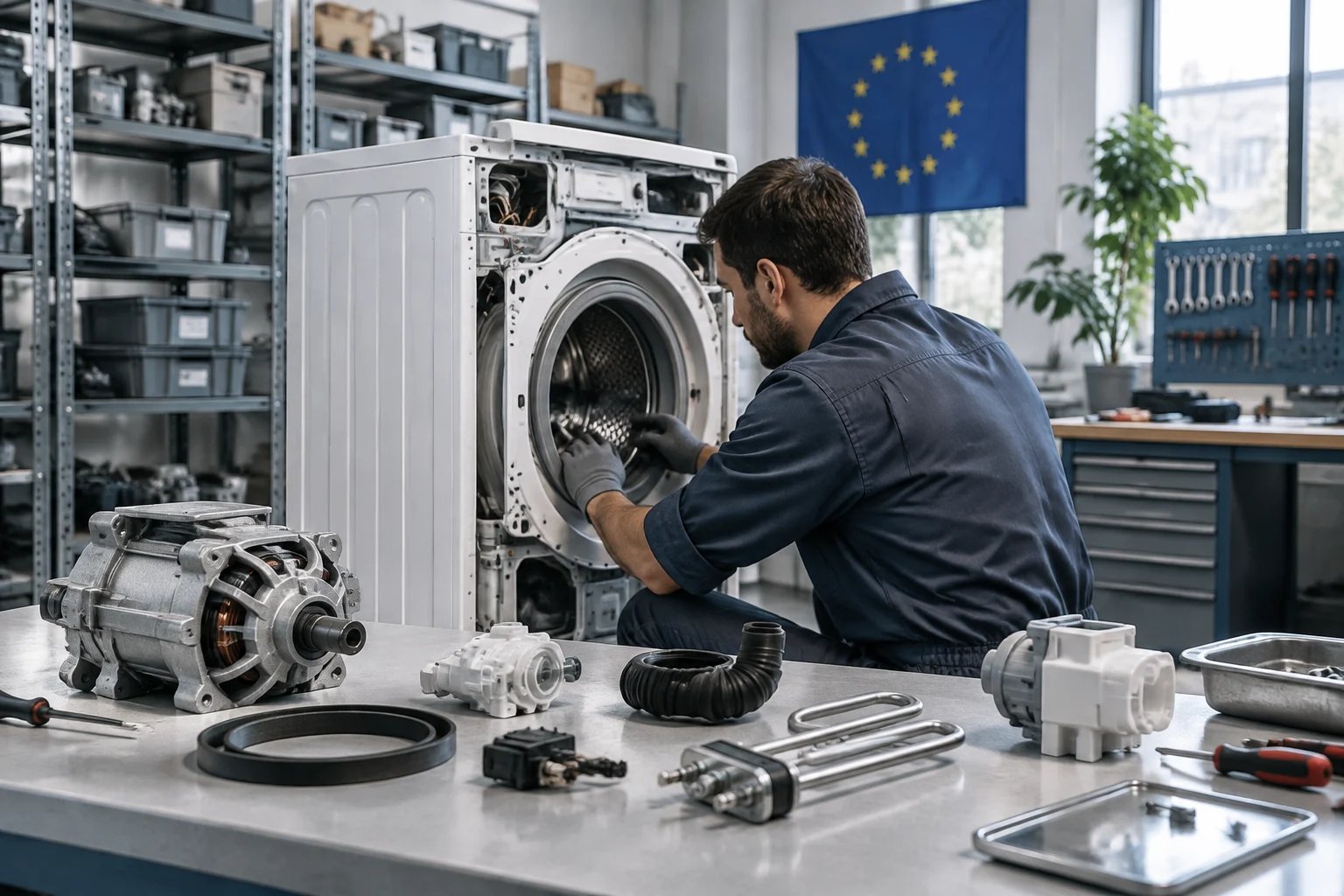
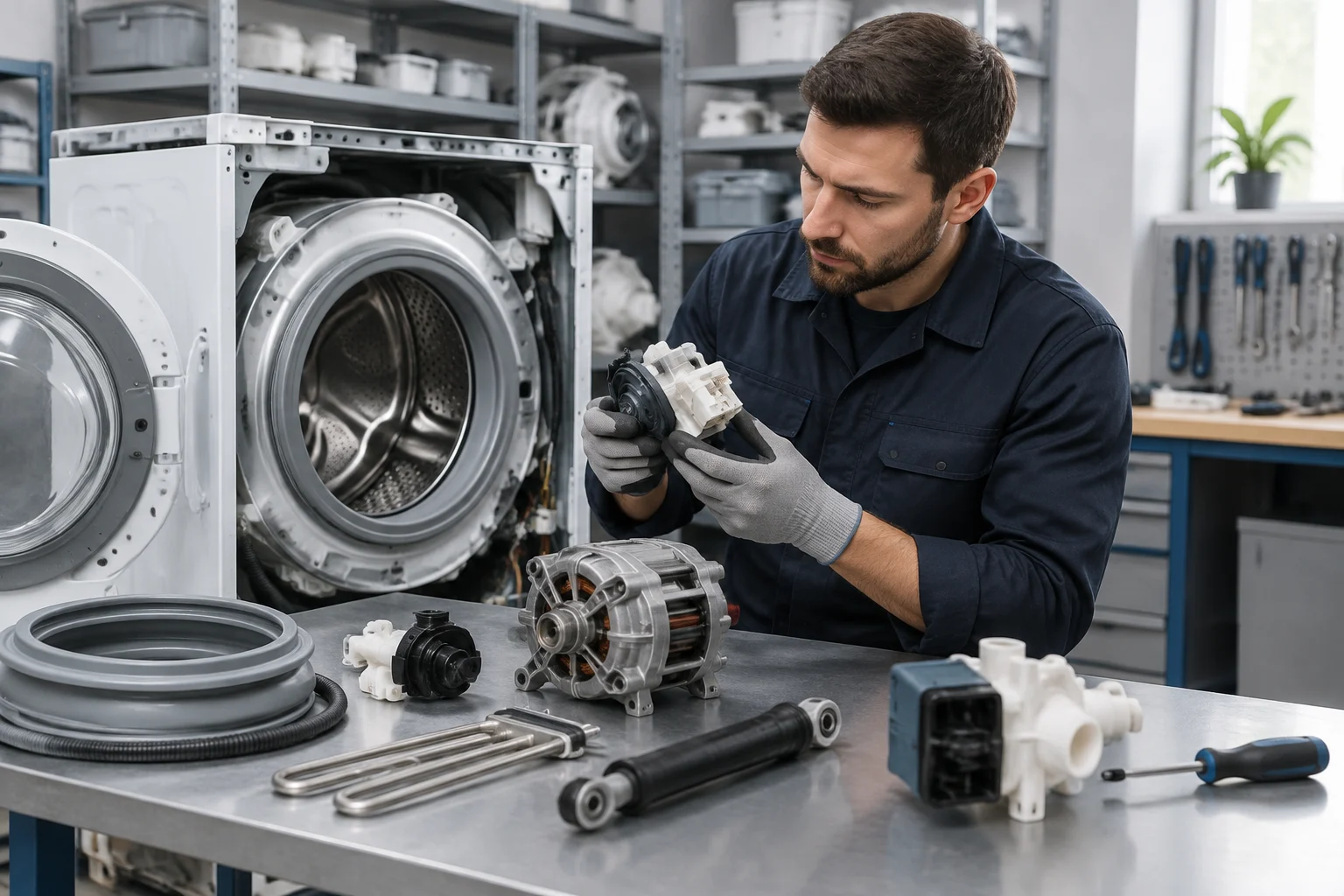
Parts covered for access by professional repairers include functional components such as motors and their brushes, transmissions, pumps, shock absorbers and springs, as well as parts of the drum assembly and counterweights. The regulation also addresses repair and maintenance information. The exact list and technical conditions should be checked in the regulation, rather than reconstructed from a marketing label or press release.
For end users, the regulation includes some parts associated with use and more accessible replacement, such as doors, hinges, seals, locking mechanisms and peripheral plastic parts, as well as other specified components. Do not infer that every consumer can buy every spare part on the professional list: access depends on the part category and the recipient defined by the rules. In some cases, fitting a part may require knowledge, tools or procedures that make it advisable to use a qualified service provider.
The regulation also sets requirements for spare-parts delivery times, along with requirements relating to repair information. For a purchase, it is worth separating three questions: whether the part is covered, who can obtain it and the period within which it is expected to be supplied. If a fault requires several parts or diagnostic work, the existence of one part does not guarantee that the appliance can be returned to working order. The regulation imposes obligations on products within its scope; it does not remove these practical dependencies.
How to check the rules against manufacturer information
The rules establish a common baseline for products to which they apply; a brand’s service pages may add useful information, but they should not be confused with the legal text. A warranty page, for example, may explain cover or procedures without detailing the availability of every spare part throughout the regulatory period. The absence of information from a customer-service page does not, by itself, prove that a company is not complying: the information may appear in another section or depend on identifying the exact model.
Before buying, look for the technical sheet and manual for the specific model, its repair conditions and the method for identifying parts. If the manufacturer provides a spare-parts search tool, check whether it works with the exact model or product number and whether it distinguishes parts for professionals from those for consumers. Also ask whether stated availability means supply to order, local stock or some other arrangement. Avoid comparing promises of different kinds as if they were equivalent.
A practical check can be organised as follows:
- Identify the exact model and keep its reference number, not just the product-range name.
- Look for the spare-parts and repair policy in the manufacturer’s official documentation.
- Check the parts mentioned against the categories and conditions in the regulation.
- Check who can obtain them and which service provider can fit them.
- Keep the spare-parts availability period separate from the guarantee and any commercial extension.
A warranty page, such as the one published by Balay, can be useful for checking that brand’s warranty conditions, but it is not, in itself, proof that every specific part will be available for a specified period. Verification should rely on information relevant to the model and the question being investigated.
What to compare before choosing a washing machine
The energy label and consumption figures can help compare expected use, while repairability information addresses a different aspect: potential maintenance. Neither replaces an assessment of capacity, dimensions, programmes or consumption, but each may form part of a more complete decision. The European Commission brings together information about ecodesign and energy-labelling requirements for washing machines; check that the figures on the product sheet relate to the model and market where it is sold.
For a useful comparison, record consistent information: model, parts covered, authorised recipient, period and the point from which it is counted, repair documentation and technical-service availability. If a brand publishes only a general statement such as “spare parts available”, ask for details. If the information is not accessible before purchase, treat it as an unresolved commercial uncertainty rather than a demonstrated advantage.
It is also reasonable to ask for indicative parts and labour costs, although these are not a direct measure of regulatory repairability and may change over time depending on the fault and service provider. For a household decision, the total cost of an intervention may be more useful than the mere existence of a component: travel, diagnosis, fitting and technician availability can all affect whether repair is viable. The regulation does not set the final price of a repair.
Scope and limits of this guide
The main conclusion is deliberately specific: EU spare-parts requirements offer a verifiable way to compare certain aspects of repairability, but they are not a general guarantee of ten years of operation. The cited availability period is linked to the end of marketing of the last unit of the model, and the parts covered do not necessarily have the same access conditions.
This is a documentary assessment. No washing machine has been tested, no spare part has been ordered and stock at distributors has not been confirmed. Regulations describe obligations; a commercial page describes information published by a company; neither document, on its own, can measure how long a real repair will take or what it would cost in a particular location. These limits do not invalidate the comparison criteria, but they do prevent them from being turned into a prediction of service life.
When choosing, use the regulation as a baseline and the model documentation as an additional check. If a seller’s claim does not identify the period, parts and recipients, ask for clarification. And if the information you need is decisive—for example, the availability of a specific part—contact the manufacturer or an authorised service provider directly before buying. This helps avoid confusing a general obligation with a broader promise than the documents support.