
Definition and Fundamental Purpose
A release note is a technical document that structurally records the changes, improvements, and fixes incorporated into a specific software product iteration. It does not limit itself to listing tasks: it presents modifications in a way that allows the reader to understand what that delivery includes and how it relates to the product they already use. Its purpose is to function as a continuous guide to leverage new features or system updates.
Unlike internal engineering logs, these notes are directed at the client. Therefore, they must translate technical work into understandable benefits for the end user, without requiring them to know implementation details. The information can range from a newly available feature to a fix that modifies an existing experience; in both cases, it is important to explain the change in a way that helps the reader interpret its effect.
In a context of subscriptions and continuous updates, notes reflect the work of development teams and help users understand what has changed, why it was done, and what value it adds to the product. That transparency can sustain trust and reduce friction when adopting a new version: when the user knows the scope of an update, they have more elements to decide how to incorporate it into their work.
Its function is not only informative but also strategic. A well-crafted note shows attention to the user experience and serves as a common point for product, marketing, and technical support teams. By presenting changes clearly, it reduces ambiguity and offers a shared reference to answer questions, communicate news, and evaluate future updates.
Standard Structure and Key Components
Release notes usually follow patterns recognized in the industry to favor coherence and quick reading. Changes are grouped into predefined categories, such as new features, improvements, and bug fixes. This classification allows distinguishing whether an entry describes a new capability, an evolution of something existing, or the solution to a problem, and guides the reader on the type of impact they can expect.
Each entry needs sufficient context for the change to be identifiable without having to reconstruct it from other documents. Therefore, it is recommended to include a publication date and, in many cases, a version or build identifier. The date situates the information in time; the identifier helps determine which delivery it corresponds to and facilitates traceability when comparing versions or consulting the product history.
The writing of each element is decisive. Instead of listing internal technical tasks, best practices propose answering the question what's in it for me? from the user's perspective. For example, 'refactoring of the export module' describes engineering work but does not clarify its practical effect. In contrast, 'large exports now take seconds instead of minutes' communicates a result the reader can value. The example illustrates the shift in focus: from internal activity to the relevant consequence for the software user.
In addition to the main categories, notes usually include sections for known issues and behavior changes. Pointing out these issues helps manage expectations, especially when an update may present a limitation or modify the usual way of using a feature. Omitting that context can generate doubts or misunderstandings about whether the observed behavior is deliberate or an undocumented problem.
Links to complementary documentation, as well as screenshots or explanatory videos, can provide additional context. They do not replace a clear description, but they allow expanding details or visually showing a modification when the written explanation is not enough. Thus, the main note can maintain a direct reading and, at the same time, offer paths for each audience to delve deeper according to their needs.
Creation and Review Process
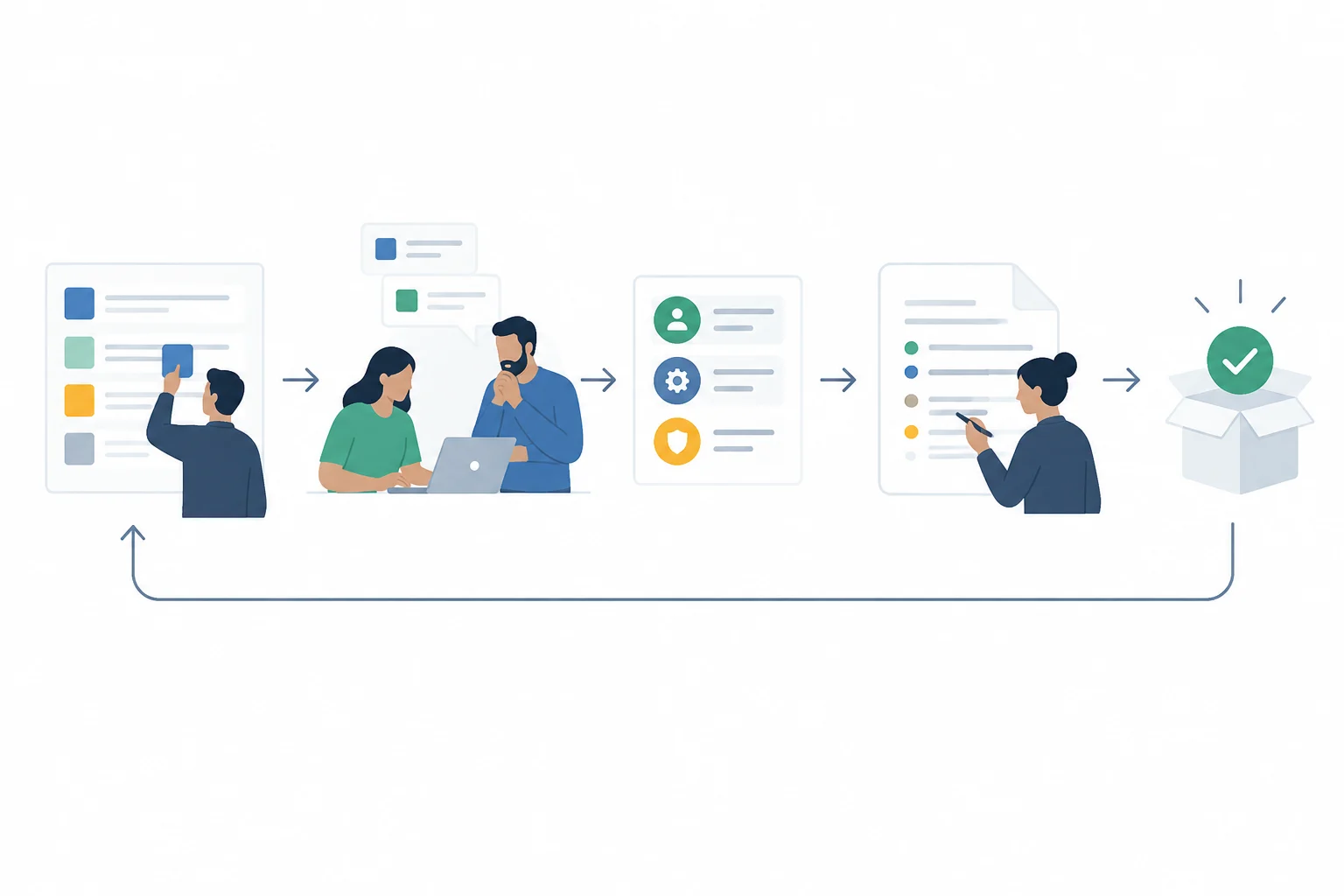
Elaboration begins by identifying the technical modifications made during the development cycle. Product teams and engineers collaborate to gather changes recorded in the sprint backlog and classify them according to their effect on the end user or system stability. This initial collection must be rigorous: if a relevant modification is not detected in this phase, it is likely that it will not reach the documentation accompanying the launch.
Gathering changes is not enough. It is necessary to check that the information accurately describes what was implemented and that the classification is useful for readers. Reviewing the collected elements allows separating significant modifications from details that do not provide context to the target audience, and detecting if it is necessary to clarify the scope of a fix or improvement. The goal is for the notes to represent the actual content of the version, not just a preliminary list of tasks.
With the data gathered, narrative sections are written with a consistent tone and structure. Maintaining these criteria facilitates that communications from different versions are recognizable and comparable. Editorial consistency also avoids describing the same type of change in very different ways in each delivery, which could make understanding the product history difficult.
Before publishing, the documentation undergoes a final review to verify its accuracy and correspondence with the software to be implemented. This check allows correcting inaccurate information and confirming that the text does not promise a result different from the available one. The review thus links communication with the product reality and reinforces the reliability of the notes.
Responsibility usually falls on product managers and technical writers, in collaboration with feature owners and engineers. This multidisciplinary participation combines product and implementation knowledge with the ability to communicate it accessibly. The resulting notes can be technical without being reserved for those who participated in development.
Finally, they are published in accessible channels, such as the official product documentation or a public changelog. Availability matters because a useful note must be consultable by users and other stakeholders, both when receiving an update and when they need to review what changed in a previous version.
Importance in Quality Management and Auditing
Release notes are part of software quality management because they relate documentation with launch events. This relationship records how the product evolves and allows auditors and quality teams to follow changes over time. It also provides a context to check if quality requirements were met and if bug fixes responded to documented problems.
In regulated or enterprise environments, being able to demonstrate what changed in each version and why is crucial to meet regulations and security standards. Notes provide a consultable historical record to resolve disputes, investigate incidents, or plan future updates. The value of the record is not only in preserving a description: it allows relating a version with the decisions and modifications that distinguish it from previous ones.
This documentation also serves as evidence that the development process is controlled and that attention is paid to the quality of the final product. For that evidence to be useful, entries must be clear and correspond to the changes effectively published. A precise explanation makes it easier to interpret the history, while an ambiguous description limits its utility for later reviews.
Notes also facilitate technical auditing by offering a reference to compare versions. In environments with strict change controls, administrators need to know what an update includes before planning it; having that information helps them evaluate the scope of the version and organize the timing of the implementation more precisely.
By centralizing the change record, the risk of operational errors derived from not knowing what was modified is reduced, and a more efficient management of the software lifecycle is supported. Documentation does not replace planning or quality controls, but it offers a common consultation point to understand the product evolution and prepare decisions related to its update.
Practical Examples and Best Practices
Examples from technology companies show different ways of applying these practices. GitHub publishes release notes for its enterprise products and groups changes by predefined types, with clear formatting and style guidelines. This organization helps administrators plan updates and end users understand which features have been incorporated or modified. Its structure stands out for clarity and reader focus.
MongoDB maintains a detailed record of release notes for its different software series. Its documentation includes information about stable versions, upgrade paths, and specific changes for each version. By gathering these data, it provides users with elements to decide when and how to update their infrastructure, with the goal of minimizing service interruption risk.
Together, these examples point to practices that make notes more useful: publishing them regularly, adapting the message to different audiences, and proactively communicating important changes. Regularity facilitates consulting the product evolution; adjusting the language helps each audience find pertinent information, and anticipating relevant changes allows users to understand what they should consider.
OpenAI publishes release notes for ChatGPT that detail new features, interface changes, and feature retirements. In addition to informing about modifications, these notes guide users on how to adapt to them. Thus, the documentation fulfills a practical function within the product experience: it explains what changed and helps interpret how it affects daily use.
The utility of a release note depends, in the end, on the content being clear, linked to a specific delivery, and explaining the change from the reader's perspective. Ordered classification, precision in details, and adequate communication for each audience allow the document to serve both for understanding an update and for consulting history, planning changes, and supporting quality processes.