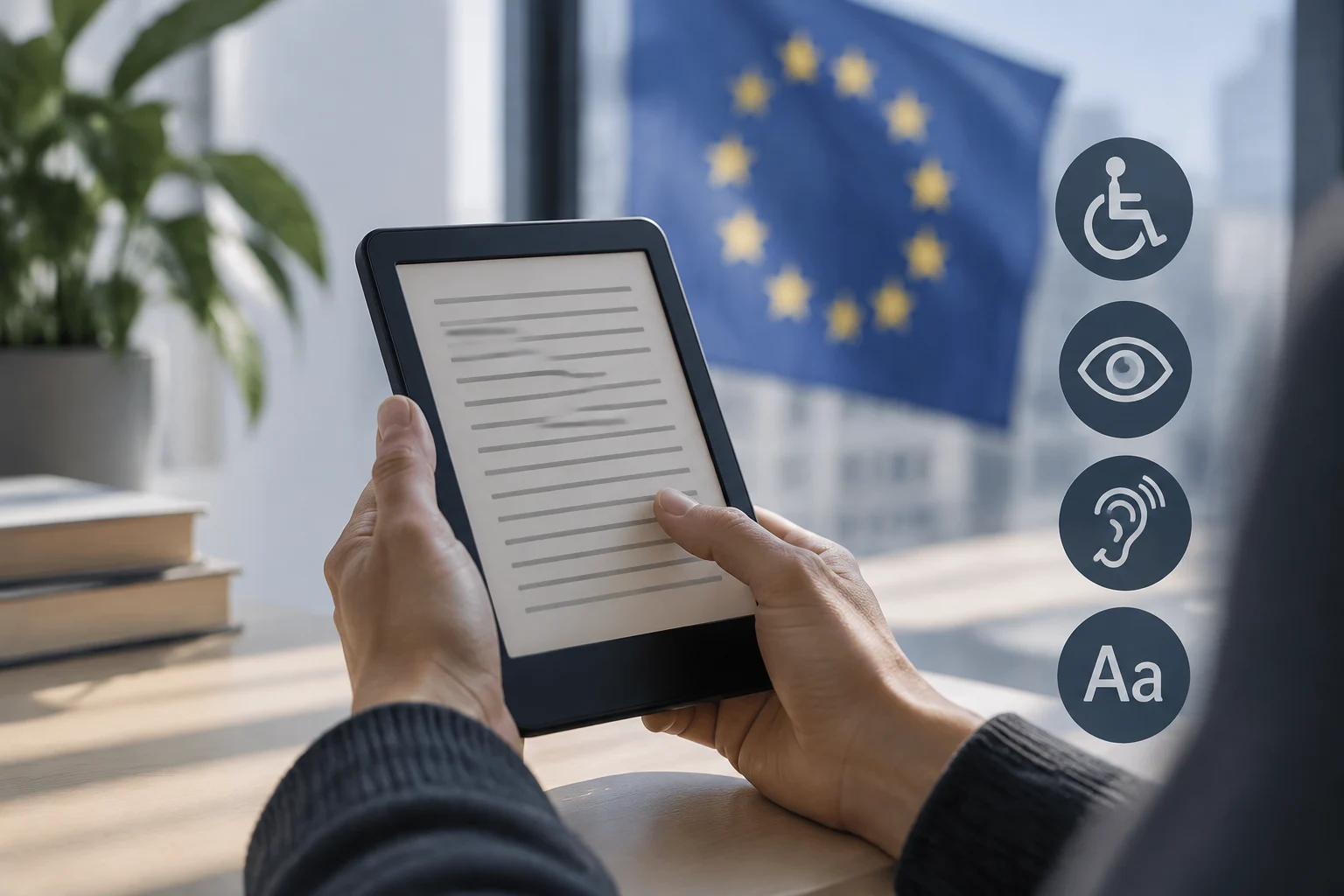
The key question: reading service or device
European accessibility legislation does not provide a list of features that every e-reader on the market must include, without distinction. It does set requirements for certain products and services, including e-book services and the specific software used to access them. When discussing accessibility on an e-reader, it is therefore useful to distinguish among the physical device, the service that distributes books or makes them available to read, and the application or program that displays them. These parts may work together, but they are not the same thing under the law.
That distinction matters in practice: an obligation that applies to a service does not, by itself, prove that every e-reader is accessible, or that a particular model complies with or breaches the rules. The Directive sets requirements for the areas it covers; it is not a universal label for every device that can be used to read. Assessing a particular feature requires information about the product or service, not just a general reference to the legislation. A buyer may need to establish whether a statement refers to the reader itself, the shop, the reading software or the books being supplied, since a claim about one element does not necessarily describe the others.
It is also possible for the same device to provide its own reading functions while connecting to a separate shop or relying on software from another provider. In that situation, the different components and services may have different operators and different obligations. The general legal framework is a useful starting point, but it cannot answer every question about the accessibility of an individual reading setup without details about how that setup is provided and used.
What European legislation covers
Directive (EU) 2019/882, known as the European Accessibility Act, harmonises requirements that apply to specific categories of products and services. In digital reading, its scope includes e-book services and dedicated software for accessing them. The Spanish legislation transposing the Directive is Law 11/2023, whose title refers to the accessibility of certain products and services. The legislation therefore addresses reading-related services and software, rather than creating a single accessibility specification for every device capable of displaying a book.
That scope should not be confused with a uniform requirement covering the entire digital-book ecosystem. A reader may have features of its own, such as display settings, and may also connect to a shop or use an application. The rules may be relevant to services and programs within their scope, but that relevance does not establish, without examining the circumstances, which specific obligation applies to each manufacturer, distributor or provider. The regulated subject and the party responsible for meeting the requirement depend on the activity and the service, not merely on the device’s commercial name. This is why a statement about a particular model should not be treated as a legal conclusion about all the services or software that can be used with it.
In other words, saying that something is “compliant with the law” without specifying which service, software, feature or actor is being assessed leaves out essential information. The Directive supplies the framework; evaluating an implementation requires checking the applicable requirements and the relevant documentation. The research consulted for this guide does not include declarations of conformity or technical files for specific models. It consequently supports a general explanation of the rules, but not a model-by-model assessment or a comparison between brands.
Application dates and exceptions
The Directive was adopted in 2019, and Spain transposed it through Law 11/2023. The requirements provided for in the legislation began to apply on 28 June 2025. That date marks the general start of the application of these obligations. It does not mean that every device already in consumers’ hands had to be replaced on that day, nor does it automatically establish the status of any particular product. The date is important when considering the framework, but it is only one part of a legal assessment.
The framework includes exceptions and conditions, including circumstances involving a fundamental alteration to a product or service and a disproportionate burden on the operator. These are not automatic exemptions for any business: whether they apply depends on the circumstances and on the provisions of the law. The Directive also provides transitional measures for certain contracts and products, so the legal analysis may vary depending on the type of service, the date and the operator’s situation. A broad statement about an exemption should therefore not be taken as proof that a particular provider qualifies for it.
This makes the date a useful point of reference, but not a complete answer for every case. The rules do not allow us to conclude that a model is non-compliant simply because it predates June 2025, or that it is exempt merely because it was already on sale before that date. For a dispute or a specific compliance question, it is necessary to consult the applicable legal text and the competent authority. The circumstances and any relevant transitional provisions also need to be considered rather than inferred from a product’s launch or purchase date alone.
What buyers and existing digital readers can check
Anyone looking for a more accessible reading experience can check the features described by the manufacturer and the book provider. On the device, it is reasonable to look for settings for text size and appearance, read-aloud options or compatibility with assistive technologies, if those features matter to the person. On the shop or in the application, it may help to check whether accessibility information relates to the service and the content, or only to a feature of the device. Clear descriptions make it easier to understand which part of the reading experience is being discussed.
The law does not replace this practical check or guarantee a particular preference, such as a chosen font size or a specific navigation mode. Nor does the appearance of an option in a product listing, by itself, show how it works with every format, book or software update. These are separate questions about what a standard requires, what a provider declares, and what a person needs. They are connected, but they are not interchangeable. A feature that is useful to one reader may not address another person’s needs, and a general accessibility statement may not describe the particular format or service that someone intends to use.
Before deciding, it is worth gathering verifiable information: what feature is offered, on which model or service, which formats it works with, and where the provider publishes its terms or accessibility details. If a feature is essential, asking the seller or manufacturer a specific question provides more useful information than relying on a general promise of “accessibility”. It can also clarify whether the statement concerns the device, the software, the store or the supplied books, avoiding assumptions about functions that have not been documented.
What the evidence does—and does not—allow us to say
The legal documentation consulted supports the conclusion that European requirements exist for e-book services and dedicated software, and that Spain transposed them through its own law. It does not provide evidence for classifying specific e-readers, comparing brands or asserting that a particular feature is present or absent on a commercial model. No manufacturers’ declarations of conformity, independent accessibility tests or market-surveillance files have been consulted. The available material therefore establishes the general legal context, not the performance of individual products.
The conclusion must consequently remain limited: the legislation is relevant to digital reading, but it does not, by itself, guarantee that any e-reader is accessible. Assessing a particular device would require identifying the model and market, reviewing documented features, and determining whether the subject under examination is the hardware, software or e-book service. Without that information, attributing a breach to a brand would go beyond the evidence available. A precise assessment would also need to identify which legal requirement is relevant to the service or product in question.
Accessibility also depends on individual needs and on the combination of hardware, content and software. The legislation establishes a common framework; it does not replace an assessment of actual use or demonstrate that every combination will work in the same way. That limitation does not invalidate the general conclusion, but it does prevent it from being turned into a verdict about specific products. Readers should therefore distinguish an explanation of the law from an evaluation of a particular device or reading setup.