An attractive property does not equal a viable application
Announcements about materials often begin with a feature that is easy to sum up: lower weight, a large internal surface area, high conductivity or exceptional strength. These properties can matter, but on their own they do not answer the question that matters to a company or anyone assessing a technology: can the material be made consistently, and can it maintain its performance in its intended use? A laboratory result is a starting point, not a certification of industrial readiness.
The distance between those two stages does not mean the finding is false. It means that different questions are being answered. A test may show that a particular sample has a property measured under controlled conditions; an application also requires knowing how the material behaves when size, manufacturing process, environment and time in service change. It is useful to distinguish three claims: that a property has been observed, that the result has been reproduced, and that a process exists to produce material suitable for a specific function.
The right question depends on the application
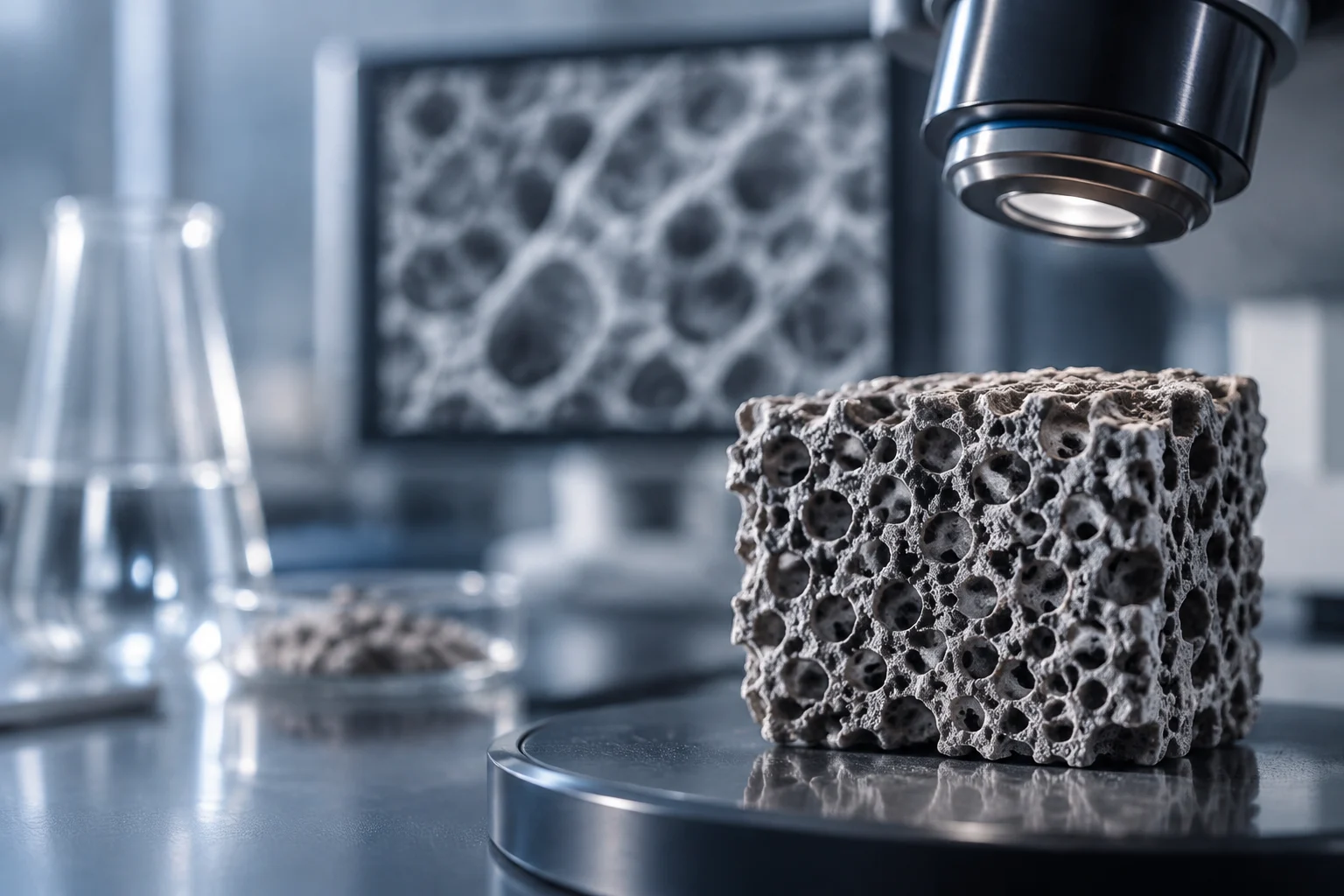
There is no universal set of tests that turns any substance into a technology ready for commercialisation. A coating, a structural component and a porous material intended to store or separate molecules have different requirements. Even a property that appears beneficial can bring trade-offs: greater porosity, for example, does not by itself tell us about mechanical strength, resistance to moisture or the ease of manufacturing parts with useful dimensions. Assessment should start with a function and its service conditions, not a label such as “material of the future”.
Reproducibility: checking that the effect does not depend on an exceptional sample
The first check is whether other teams can obtain comparable results by following a sufficiently detailed procedure. Judging this requires information about raw materials, purity, preparation, treatment, sample geometry and measurement methods. If those elements are not reported, it is difficult to distinguish a property inherent to the material from an effect specific to a batch, instrument or protocol. Reproducibility does not mean that every replication must produce an identical number; it means that variation is characterised and the conclusions remain valid within that variation.
It also matters how many samples and batches were analysed, whether appropriate controls were included, and what uncertainty accompanies the measurements. An isolated maximum value may be useful for exploring possibilities, but it does not necessarily describe what a normal process would produce. Look at the distribution of results and at failures, not only at the best specimen. A figure without context about variability has limited reach, however impressive its central value may seem.
Graphene illustrates why this issue matters in the transition from research to production. A commentary published in Nature Communications raised a reproducibility gap in research on scalable graphene synthesis. This is not proof that every graphene production process is inconsistent, nor an assessment of every manufacturer: it is a warning about the difficulty of comparing results and transferring them to reproducible synthesis. When reading a claim about graphene, it is therefore worth asking which method was used, what criteria were used to assess quality, and whether the evidence comes from repeated, comparable samples.
Scale and manufacturing: the process is part of the material
Increasing production volume does not necessarily mean repeating an experiment more times. Synthesis can change when moving from a small quantity to a larger batch: mixing, heat transfer, process times or local conditions can alter the structure and, with it, the properties. A manufacturing route may also depend on raw materials that are difficult to obtain, slow steps, specialised equipment or controls that are impractical outside a laboratory.
An analysis of the challenges of scaling porous materials published in Communications Materials highlights the synthesis and processing problems involved in moving to a larger scale. It is a perspective on general difficulties, not proof that a particular material has reached industrial production. That distinction matters: reviewing a roadmap or a scale-up proposal is not the same as verifying that commercial production already exists. Scale must be documented using actual quantities and processes, and distinguished from a projection.
What to look for in a manufacturing demonstration
Useful evidence explains what was produced, by which method and with what quality controls. It also clarifies whether the final material retains the relevant characteristics and what proportion of the batch meets specifications. If only a prototype or demonstration is presented, it should be treated as such; it should not automatically be turned into evidence of a stable production line.
- Were several independent batches made, or just one batch?
- Are process yield, batch-to-batch variation and acceptance criteria reported?
- Does the account describe which inputs and stages limit increased volume?
- Does the form produced—powder, film, coating or part—match what the application requires?
Performance and lifetime: measuring under conditions resembling use
An application needs specifications related to its real environment. Temperature, humidity, pressure, chemical exposure, load cycles, radiation or contact with other materials can change behaviour. A material may perform well in a short test and lose that advantage after repeated cycles; it may also work in a laboratory configuration that is incompatible with the final design. Performance data should therefore be accompanied by test conditions and a description of what counts as failure.
Durability is not established by a single initial measurement either. Tests should represent, as far as possible, the ageing and degradation mechanisms relevant to the intended use. Accelerated tests are sometimes used, but their results should not be presented as a direct prediction of years of service without explaining the model and its limitations. Service life is a conclusion that requires evidence over time or a justified extrapolation, not an automatic consequence of a good initial property.
The article on AgSCN as a hole-transport material in inverted perovskite solar cells is an example of research directed at a specific function. Its title identifies the material and the role studied; on its own, it does not establish that the compound has been adopted in commercial products or demonstrated an industrial service life. To assess such a case, read the full primary paper: device configuration, controls, metrics, number of samples, evaluated stability and test conditions. The conclusion should stay within the scope of the published measurements, without jumping from “studied in a cell” to “already ready for the market”.
Comparable data and standards: making verification possible
The quality of a claim also depends on whether other people can interpret and compare the data. For porous materials, for example, adsorption results can depend on how the sample was prepared, the measurement procedure and the information reported. The NIST publication on best practices for reporting adsorption data for porous materials addresses precisely the need to document such data usefully. Its scope is methodological: it helps communicate and assess measurements; it does not by itself certify a product or guarantee that a process can be scaled.
When an appropriate standard exists for a property or test, check what it measures and whether it actually applies to the intended use. A standard may define a measurement method or requirements for a category, but it does not replace evaluation of the material in its final design. It is also necessary to distinguish a study mentioning a standardised method from independent certification of a product by an outside organisation. Documentation should make clear who measured, using which procedure, on what samples and under what conditions.
A practical reading checklist
When you encounter a claim about a new material, record the following before accepting a broad conclusion:
- Object: composition, structure and physical form, specified well enough to distinguish variants.
- Method: synthesis route, sample preparation and measurement protocol.
- Result: measured property, units, uncertainty, controls and variation between samples.
- Scale: quantity actually produced, number of batches and quality obtained.
- Use: service conditions and a relevant comparison with the alternative it is intended to replace.
- Lifetime: ageing or cycle protocol, failure criteria and limits of extrapolation.
- Status: distinction between publication, prototype, process demonstration, commercial offering and verified adoption.
How to discuss specific cases without getting ahead of the evidence
Popular lists of promising materials can help readers discover terms, but they are not enough to confirm progress. For that, consult the source supporting the claim: a primary paper for research findings, technical documentation for process specifications, or an official communication for a commercial offering or company announcement. Reviews and commentaries can provide context, but should be identified as synthesis or interpretation, not confused with a new experiment.
Artificial intelligence applied to materials discovery calls for a similar caution. A Nature article examines the scaling of deep learning for this field; it supports discussion of computational discovery methods, but does not justify concluding that every predicted material has been synthesised, validated or made into a product. A prediction is a hypothesis prioritised for investigation. Synthesis, characterisation, replication, performance testing and manufacturing decisions still lie between it and an application.
Use precise verbs in writing. “The team measured” or “the study reported” describes observed evidence; “could be useful” expresses a possibility; “is used commercially” requires evidence of availability or adoption. Avoid “will revolutionise” or “is about to arrive” when there are no supporting data. Language should not make a possibility sound like an accomplished fact.
Questions for assessing whether a technology is close to an application
Before treating industrial use as imminent, it is more useful to seek concrete answers than to count mentions or headlines. The absence of a particular data point does not prove that a technology will fail; it means the conclusion should be narrower. An application may be at an early research stage, in prototype validation or at a pilot-process stage, and each status carries different uncertainty.
These questions help place the evidence without requiring all basic research to resolve commercial questions immediately:
- Which property was measured, and under exactly what conditions?
- Are composition and method described in enough detail to reproduce them?
- Was the result repeated across samples, batches or independent laboratories?
- Was the form and quantity needed for the application manufactured?
- Was performance compared with a relevant alternative using the same criterion?
- What lifetime tests exist, and what limits apply to extrapolating them?
- Is there production or availability documentation, or only a proposed future use?
The most responsible answer may be “promising result, not yet demonstrated at scale”, and that wording does not diminish the work. It distinguishes what is known from what remains open and allows the assessment to be updated when new evidence appears. In materials, technological maturity cannot be inferred from an isolated property: it is built through reproducible evidence, controllable processes, relevant performance and documentation proportionate to the claim.