Before comparing, define what you need to clean
Comparing air purifiers starts with identifying the problem. Looking for help with airborne particles—such as dust or pollen—is not the same as addressing odours and some gaseous pollutants. Nor is it enough for a device to advertise a high-efficiency filter: it matters how much air it treats, under what conditions, and which type of pollutant was evaluated. The United States Environmental Protection Agency (EPA) presents portable air cleaners and filters for heating and air-conditioning systems as different options to consider in light of the intended use and the space. EPA: Guide to Air Cleaners in the Home.
A catalogue figure cannot, on its own, answer all these questions. Before comparing models, note the approximate size of the room, the type of pollutant you are concerned about, the operating speed you would be willing to tolerate, and whether you need a portable unit or a filter integrated into the heating and cooling system. Then check that each manufacturer provides information for the same pollutant category and under sufficiently comparable conditions. If that information is unavailable, the prudent conclusion is not that the products are equivalent; it is that the documentation does not support a complete comparison.
It is also useful to distinguish three things that are often conflated: what the manufacturer states, what a programme or evaluation method certifies, and what an independent review verifies. A product sheet may describe components and specifications; a standard sets out procedures; an editorial test may assess a device in a particular situation. None of these sources should be attributed to another. This is a documentary guide: it does not include our own tests or a ranking of models.
CADR: a useful measure, not a universal guarantee
CADR stands for clean air delivery rate. In practical terms, it expresses how much clean air a purifier delivers in relation to particular pollutants and according to an evaluation method. AHAM publishes information about the ANSI/AHAM AC-1 standard, which covers measurement of the performance of electric room air cleaners. The page consulted identifies the 2020 edition; to learn the exact requirements and scope, consult the standard itself rather than infer them from a figure on a box. Information on ANSI/AHAM AC-1-2020.
The number is meaningful only if you know which pollutant it represents, which units it uses, and the reference under which it is presented. A particle-related figure does not automatically demonstrate the same performance against gases or odours. CADR should also not be confused with the capture efficiency of a filter material: a filter may retain a high proportion of certain particles in a test, but a device’s performance in a room also depends on airflow and how the complete unit operates. The useful question is not “Which number is biggest?” but “What was measured, and under what conditions?”
ENERGY STAR maintains product criteria for room air cleaners. Its page can be consulted to verify which requirements the programme applies at the time of reading, but an energy label does not replace checking the target pollutant, recommended room size, or methodology behind the CADR figure. ENERGY STAR criteria for air purifiers. A comparison should record the source and date of every figure: without context, a number is difficult to verify and may not correspond to the current version of a product.
Filters: examine the stages and their functions
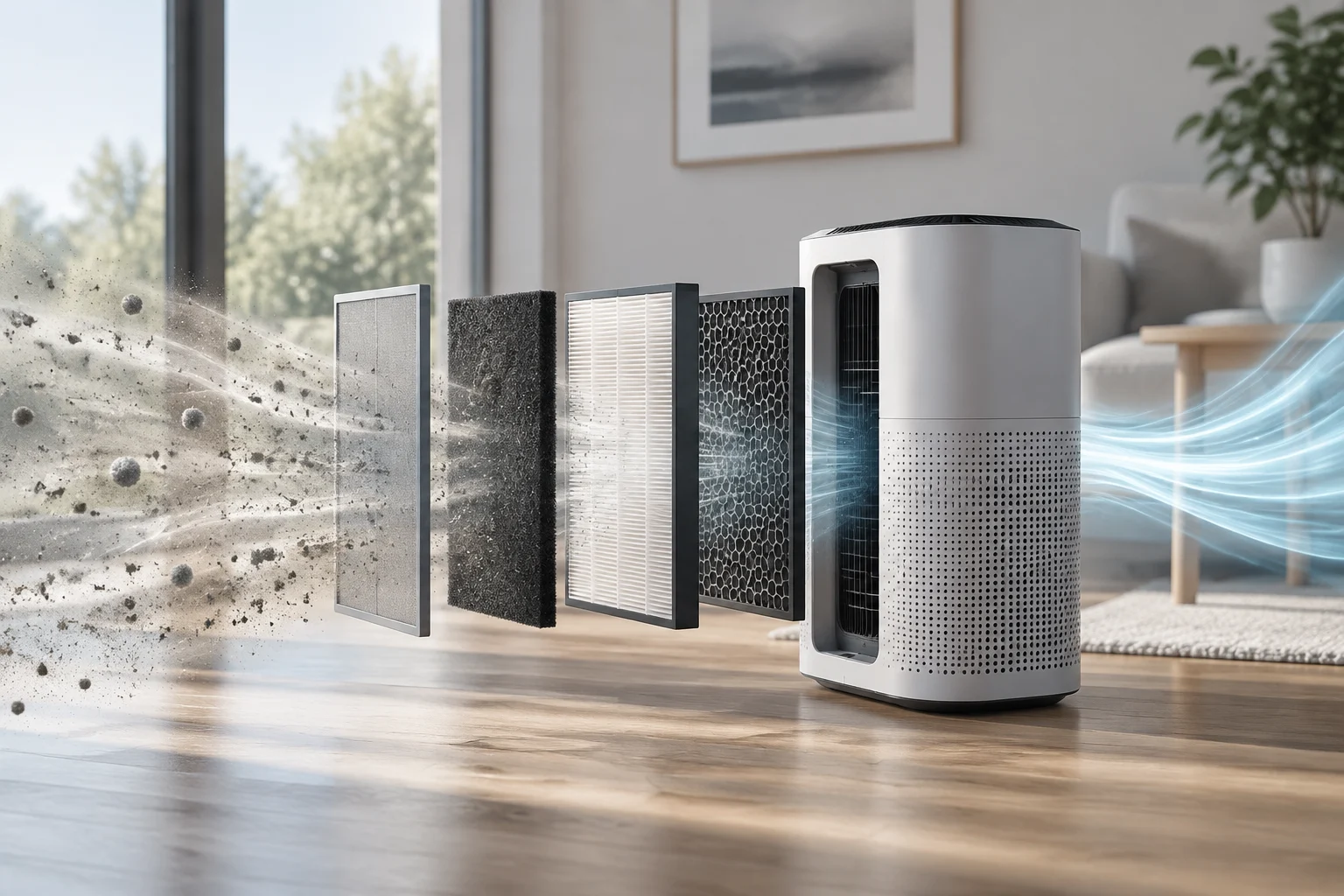
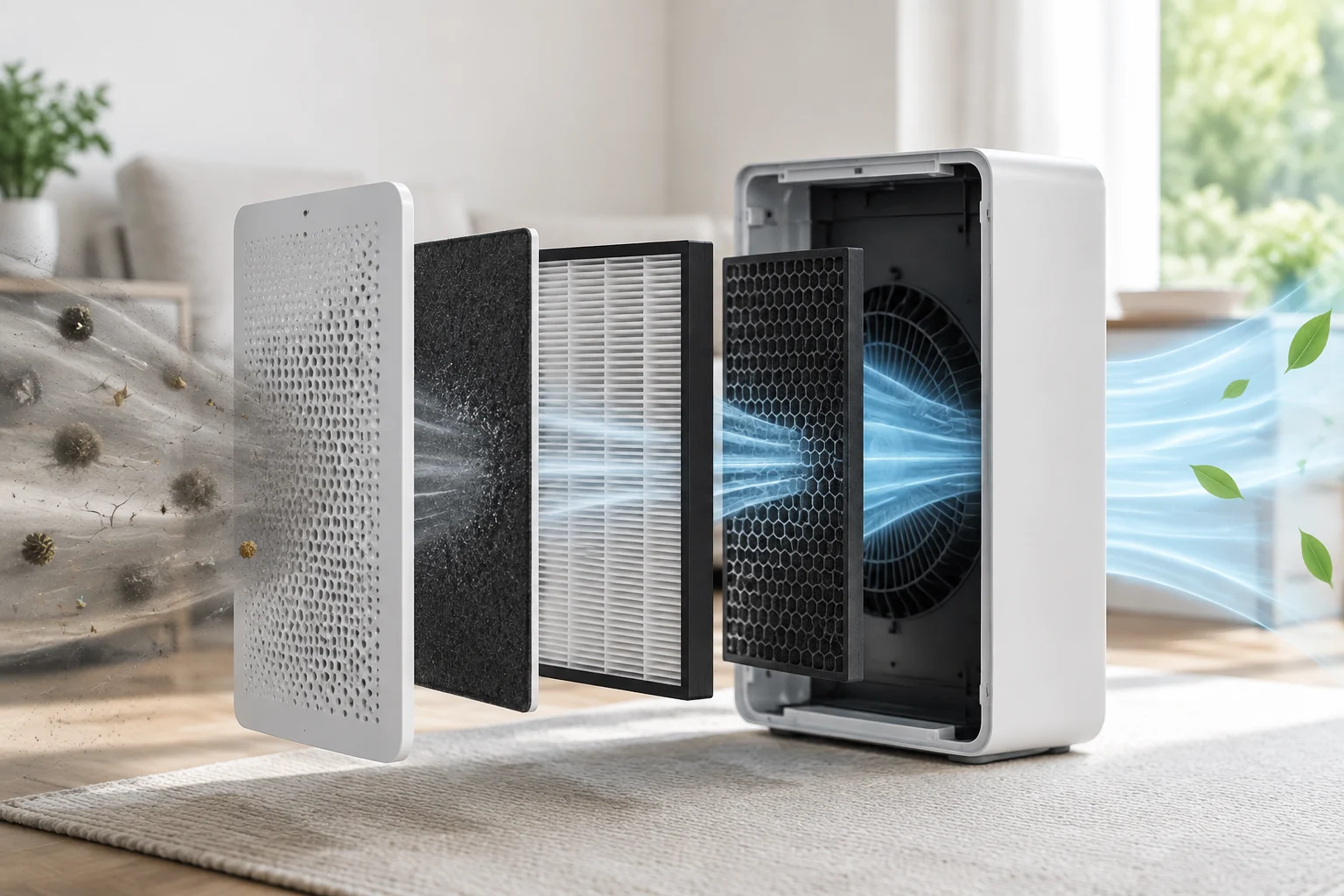
A filter’s marketing name does not describe the whole system. A device may combine a pre-filter for larger particles with other stages for fine particles or particular gases. The PSA purifier manual, for example, lists an electrostatic pre-filter and an assembly that includes G4, activated-carbon and HEPA filters. That describes this particular product; it is not evidence that every purifier uses those stages or that different combinations are equivalent. PSA purifier manual.
When reviewing the documentation, look for the exact name and stated function of each filter; check whether it can be cleaned or must be replaced; and find the instructions on replacement intervals, orientation and access to the compartment. Do not assume that “HEPA” or “activated carbon” is enough to compare two devices. You need to know what the manufacturer claims about the complete system and what support it provides for the specific application. A particle filter and an adsorbent medium for certain gases are not interchangeable simply because both appear on a product sheet.
Manufacturers’ maintenance pages may clarify which replacements they recommend for their own product ranges, but this is commercial information and should be treated accordingly. Rowenta, for example, has a page devoted to filter types, care and replacement. Its schedule should not be extrapolated to models from other brands: the interval may depend on design, use and surroundings. Rowenta information on filters and maintenance. If a manual does not specify a fixed period, do not invent one; record the conditions or indicators it does provide.
Maintenance cost: compare the cycle, not a single part
Maintenance costs cannot be estimated rigorously without identifying the exact model, the compatible replacement, its price in the relevant market, and the stated replacement frequency. A generic search for “HEPA filter” may return parts with different dimensions, compatibility and availability. For each candidate device, find the replacement’s part number or official name and check it against the manual or the manufacturer’s sales channel. If there is no verifiable price information, the right approach is to leave the cost unquantified.
A simple spreadsheet helps prevent comparisons based on different assumptions. For every consumable, record the observed price, currency, market, seller, date and manufacturer-recommended replacement interval. If several filters have different lifespans, calculate each expense separately and add them only after stating the comparison period. Do not turn a recommendation that depends on use into a guaranteed service life: dust, operating intensity and other circumstances may affect maintenance, and the available documentation may not establish how long a consumable will last in each home.
Before deciding, also verify that the replacement is available where the device will be used and that the documentation clearly identifies compatibility. A part appearing on a general webpage does not prove that it is in stock or sold at the same price in every country. Total cost should be presented as a dated, location-specific estimate, not as a permanent property of the product. This research contains no current prices, specific models or availability data that would support a verifiable cost comparison.
What can be concluded without a physical test
Documentation can organise questions and verify claims, but it cannot replace practical assessment of noise, ease of use or performance in a particular room. Nor can it guarantee that a device will achieve its advertised result in every home. The EPA provides guidance on household air cleaners and filters and should be consulted to understand the general scope of these tools; the guide does not turn a manufacturer’s specification into an independent measurement of a particular model. EPA: Air Cleaners and Air Filters in the Home.
An academic study of methods for evaluating gas removal examines the use of FTIR measurements and CADR calculations for that purpose. It is a relevant methodological reference for understanding that gas evaluation requires a specific approach; by itself, it does not prove that a particular commercial product removes all gases or allow results to be extrapolated to untested devices. Research on evaluating gas removal and CADR. This limitation should be stated explicitly rather than hidden behind a single figure.
A responsible documentary comparison therefore distinguishes published specifications, programme criteria, manufacturer instructions and available independent evidence. If two product sheets do not provide equivalent data, point out the difference and avoid declaring a winner. Assessing real-world use would require comparable tests, with described conditions and identified models. No devices have been tested and no results have been measured here, so there is no basis for recommending a particular model or claiming that one is better than another.
Checklist before choosing
An organised review reduces the risk of buying on the basis of an ambiguous label. Gather the technical sheet, manual, source for any certificate or evaluation, and official replacement-parts page for each candidate. Then compare the same types of information across devices and note any gaps. If a crucial detail—such as the recommended area or the pollutant associated with CADR—is undocumented, do not fill it in with an assumption.
Use this list as a documentary screening tool, not as a substitute for medical advice or a technical assessment of the home:
- Intended use: particles, odours or gases; a room or a heating and cooling system.
- Performance: CADR with identifiable pollutant, units and method; stated room size and source of the figure.
- Filters: stages, stated function, whether they can be cleaned, and exact replacement part.
- Maintenance: instructions, replacement interval or condition, and local availability.
- Cost: compatible part, seller, currency, market and date observed; explicit calculation period.
- Limitations: distinction between manufacturer claims, certification criteria and independent tests.