Maximum power does not describe a complete charge
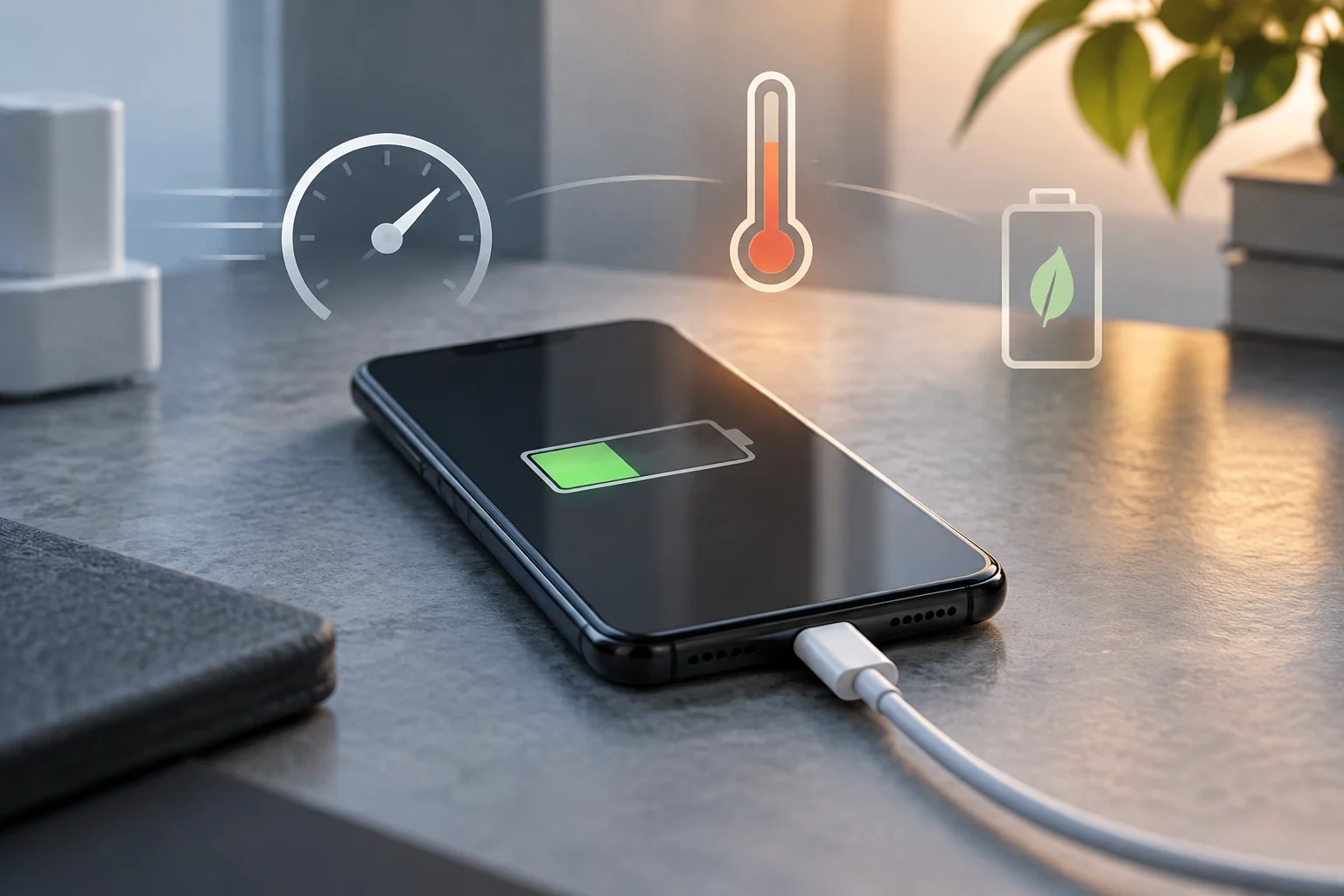
Comparisons between fast and slow charging often begin with one figure: the wattage promised by the charger or supported by the phone. It gives an indication of the maximum power that may be available, but it does not, by itself, tell you how long a real charge will take or how much wear it will cause. The phone and charger must be compatible, and the power delivered may change as the battery fills. The charge level, temperature and the device’s electronic management also matter. So two similar maximum figures do not guarantee identical charging sessions: they describe a possible limit, not everything that happens from the moment you plug in the phone until charging ends.
It is useful to distinguish between three figures that are often conflated in product specifications: the charger’s maximum power, the maximum power the phone supports, and the power actually sustained during a session. The charger’s figure does not guarantee that the phone can use it; nor does the phone’s figure mean it will receive that power continuously. Without comparable measurements from the same device, at the same temperature and starting charge level, a maximum figure cannot be turned into a reliable conclusion about charging time or degradation. Keeping these distinctions clear prevents the most eye-catching specification from being mistaken for a summary of the entire process.
The word “slow” does not identify a single mode, either. It may mean using a lower-powered adapter, a charge reduced by the system because of temperature, or a configurable limit. These situations are not equivalent. If two different phones are being compared, their batteries, components and controls may also differ. A useful comparison should therefore separate a phone’s design from its observed behaviour, rather than automatically attributing every difference to the wattage. It is also worth specifying what is being compared: the accessory, a phone setting or a particular charging session.
Which specifications are worth comparing
When choosing a phone or interpreting its specifications, it is more useful to gather information explaining how charging is managed than to focus on a single figure. Check the maximum power the phone supports, which charging protocols it lists as compatible, and whether the manufacturer explains the conditions required to reach that power. If a detail is not in verifiable documentation, do not assume it based on the name of a technology or the wattage printed on the adapter. Reading these details together helps clarify which combination of phone and accessories is being described, without confusing a theoretical possibility with what will happen in every use.
Temperature is another central factor. Look for whether the manufacturer documents controls that reduce or pause charging in certain circumstances, and what warnings it gives about using the device while charging. The documentation available for this research does not allow us to compare the thermal behaviour of specific models or confirm that one system manages heat better than another. A manufacturer’s description of a feature tells you that an option exists; it does not, by itself, demonstrate a measured longevity advantage. That distinction matters: knowing about a feature is not the same as having long-term results comparing it with another model.
To compare models systematically, gather these criteria: the power the phone accepts, the accessories and protocols it requires, the optimisation options it offers, and any configurable charging limits. Also check the fine print: a feature may depend on the model, operating-system version or charging habits. Do not equate compatibility with sustained performance, or assume a software feature can compensate for every usage condition. If battery longevity is what you want to compare, also look for tests conducted under equivalent conditions, rather than specifications alone. This helps show which details can be compared and which questions remain unanswered in the documentation reviewed.
System controls help, but do not settle the whole comparison
Apple documents Optimized Battery Charging and, on compatible devices, a charge limit in its iPhone guide. These controls let users change how and to what level the phone charges. The exact options available depend on the model and system. Before deciding what to do, consult the instructions for your device rather than assuming all iPhones—or all phones—offer the same settings. The manufacturer’s documentation is relevant for finding out which controls are available, but it does not replace a comparison of results between devices.
Optimized Battery Charging and a charge limit are not synonyms for slow charging. The former is intended to manage when charging is completed in the circumstances considered by the system; the latter lets users set a charging ceiling on devices that support it. Neither should be interpreted as a quantified guarantee of additional years of use: the documentation reviewed explains the features and how they work, but does not provide an independent comparison of phones subjected to identical protocols. In other words, describing what a setting does does not, on its own, let you calculate how much it would change battery longevity.
In practice, these options may be useful if they suit your routine and you want to avoid leaving the phone for longer than necessary at a particular charge state. But there is no need to enable a feature without understanding its effects on availability or daily capacity. A battery that does not reach 100% may provide less immediate runtime, even if that setting is a deliberate choice. The right approach depends on the balance you need between everyday runtime and charging preferences. Before choosing a limit, consider the charge level you usually need; do not treat the option as a universal requirement.
How to read evidence about degradation
Studies of lithium-ion batteries may examine temperature, charging speed, chemical reactions and ageing, but not all of them study complete phones or reproduce their internal controls. One paper on effects associated with fast charging examines degradation mechanisms in cells; another academic article discusses heat generation and degradation mechanisms during high-temperature ageing. These research strands help identify relevant variables, but they do not, by themselves, justify the conclusion that every phone charged quickly will lose a particular amount of capacity. The mechanisms studied provide context; they are not direct predictions of the outcome for every phone.
How far results can be transferred depends on the method: cell chemistry and format, temperatures, charging rates, cycle count, defined limits and the criterion used to identify degradation. An accelerated test can be useful for studying mechanisms, but it is not automatically equivalent to years of everyday use. Nor is it sound to apply a conclusion about one cell or laboratory conditions to all phones without knowing whether their batteries, circuitry and charging strategies are comparable. A result’s scope depends both on what was measured and on the precise conditions in which the measurement was made.
When you read a headline about fast charging, look for the original paper and ask what was measured, what was held constant, and which devices or cells were tested. A general claim about a category is not a substitute for data on a specific model. The sources gathered here do not include a comparative test of phones that would quantify the effect of fast versus slow charging under identical conditions. That gap should be made explicit: the available evidence indicates which factors to examine, but does not establish a universal rule. If a study does not answer the comparison you are interested in, it is better to present it as information about mechanisms rather than as a conclusive consumer answer.
Choose according to your use, not a slogan
If you need to regain battery life quickly, fast charging can be a practical feature when both the phone and accessory are compatible. If you usually charge for many hours and do not need to fill the battery quickly, you can prioritise the optimisation options and limits available on your model. That choice addresses a practical need; the available sources do not establish it as a proven formula for extending the life of every battery. Practical convenience and a conclusion about longevity are related, but they are not the same question: one is about what suits you, while the other requires comparative evidence.
Before buying, check the manufacturer’s documentation rather than inferring performance from names such as “turbo”, “super-fast” or “smart”. Confirm the power the phone supports, the charger and protocol it requires, the charging options it includes, and whether the manufacturer details any restrictions. If longevity is important to you, look for independent tests that identify the model and compare results under controlled conditions. A test mentioning a high wattage or showing just one charging session is not enough. Information about how long one session takes does not necessarily answer how the battery ages over time.
As a practical guide, use this list when comparing: documented compatibility before advertised power; controls and limits before vague promises; and comparable tests before extrapolations. If there is no model-specific evidence for two phones, it is reasonable to compare their features while acknowledging that the long-term effect has not been quantified for that pair. There is no need to reject fast charging on principle or assume that slow charging is always better. Keeping specifications separate from what a test would demonstrate prevents a personal preference from becoming a general recommendation.
What can be concluded—and what remains open
The cautious conclusion is that maximum wattage is not enough to assess the effect on a battery. Temperature, the management system, configurable limits, phone design and usage conditions are also part of the comparison. Manufacturer documents describe available features; cell studies investigate mechanisms under defined conditions. These are different kinds of evidence and answer different questions. Considering them together helps clarify what can be checked, but does not remove the lack of comparable tests across commercial phones.
The sources examined do not support a ranking of brands or models, or a recommendation of one charging speed as best for everyone. Nor do they provide consistent ageing data for commercial phones that would let us calculate how much battery life changes between two charging modes. This guide is therefore a tool for assessing specifications and limitations, not a laboratory test or universal recommendation. A ranking would require data on identified models and test conditions that could be directly compared.
If your phone’s manufacturer offers Optimized Battery Charging or a configurable limit, consult the instructions for your model and decide whether the everyday runtime you give up by limiting the charge is worth that preference. When comparing phones, ask for documentation on protocols and controls, and look for studies that clearly describe their methods. Until equivalent tests on specific models are available, the most honest answer to “fast or slow?” is: it depends on the device, usage and evidence that does not let us quantify the difference here. That conclusion does not deny that conditions matter; it defines what can be claimed from the information available.