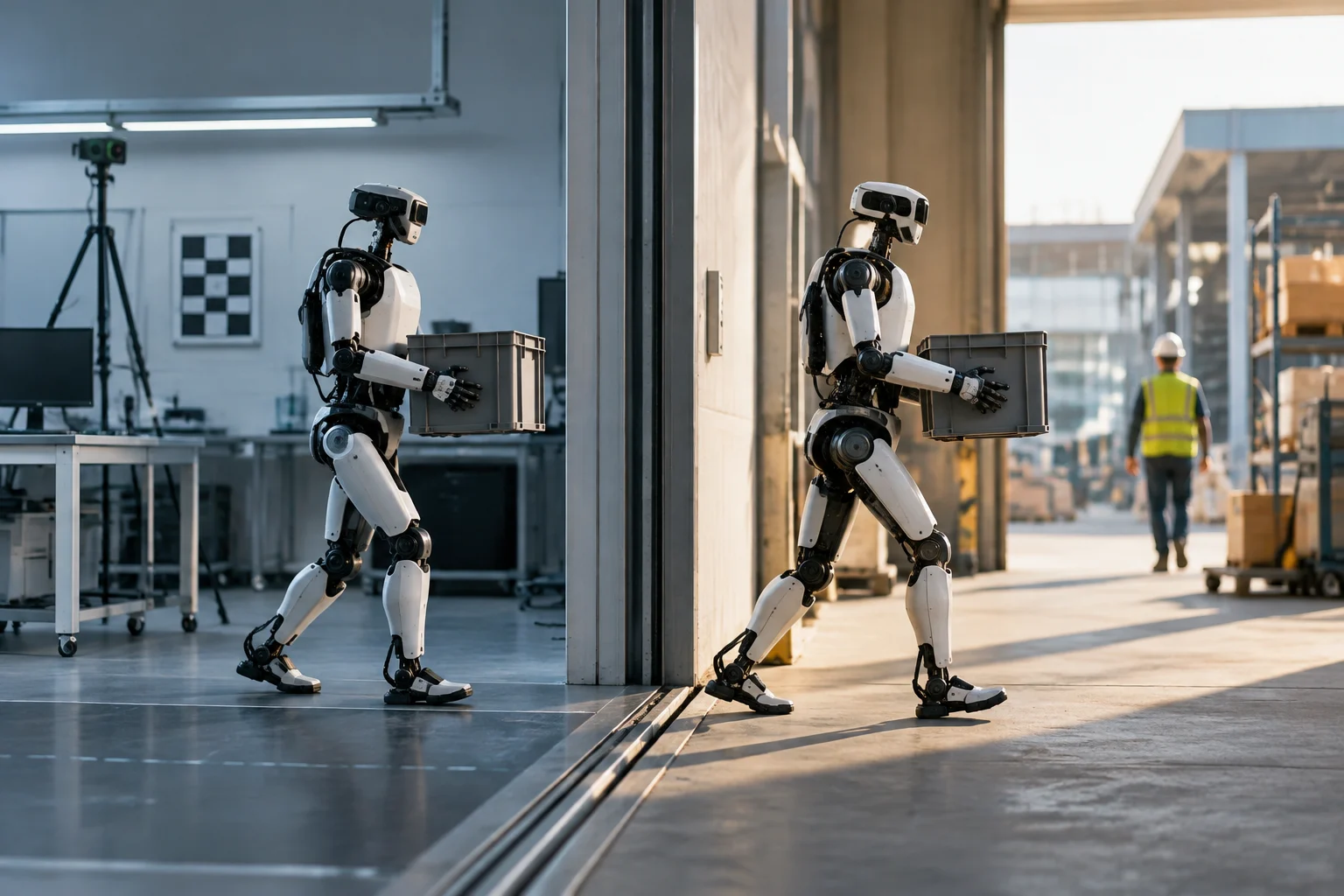
Applied research starts with a defined problem
A robot completing a task in a demonstration is not enough to conclude that a viable application exists. The useful question is more specific: what problem does it solve, for whom, and under what conditions? An experimental result may show that a particular technique works in a defined scenario; it does not automatically demonstrate that the system is useful, safe or sustainable in a real workplace.
It is worth separating three levels that are often blended together in announcements and summaries. The first is the technical result: for example, that the robot carried out a particular operation. The second is the performance of that operation against a reference point or practical need. The third is the feasibility of the complete system, including installation, supervision, maintenance, failure management and compatibility with existing processes. Success at one level does not mean the next levels have been met.
Applied research directs knowledge towards a practical need, but that orientation is not equivalent to a certification of maturity. Minciencias’ institutional definition is a general frame for understanding the term, not proof that a specific robot is ready for deployment. The first editorial filter is to identify exactly what has been demonstrated and what falls outside the study’s scope.
Reading the trial: task, setting and conditions
An interpretable evaluation describes the task precisely enough for someone else to understand what the system was expected to do and how success was determined. “Handled objects” is less informative than specifying the kind of object, the operation, the starting and ending points, and what counts as success or failure. It also matters which tasks were omitted: a demonstration of one isolated operation does not necessarily evaluate a complete work sequence.
The environment can substantially change the difficulty. Find out whether the trial took place in an orderly laboratory or under conditions that reflect the intended space; whether objects, lighting and layout were fixed; and whether people or other equipment shared the area. These differences do not invalidate a controlled experiment: they define what it can support as a conclusion. A simple test can be rigorous if its scope is stated clearly; the problem arises when conclusions are generalized beyond that scope.
Metrics should match the task and be presented with context. A success rate, for example, requires knowing what counted as an attempt, how many cases were evaluated and how human interventions were handled. Time taken may also matter, but it is no substitute for quality, safety or the ability to recover from errors. When materials do not explain the denominator, conditions or success criterion, a figure can be difficult to interpret, however precise it may appear.
Repeatability and testing under varied conditions
A successful run demonstrates possibility, not necessarily consistency. To assess repeatability, look for information about the number and variety of trials, repetitions, which conditions changed and which remained constant. If the system works only with a carefully prepared configuration, that may be a legitimate technical result, but it does not justify inferring that it will respond in the same way to ordinary environmental variations.
It is also important to distinguish repeating the same demonstration from testing robustness. Repeating under nearly identical conditions helps reveal variability; introducing relevant changes can expose different limits. Practical questions include what happens when an object has shifted, perception is incomplete, an interruption occurs or an action does not proceed as expected. The system may stop, ask for help or recover automatically: each option has different operational consequences.
A study on distributed real-world evaluation of generalist robots, identified on OpenReview by its title, is an example of research that places evaluation outside the laboratory at the centre of its approach. The title alone does not support attributing specific results to it or concluding that a universally accepted method exists. It does, however, recall a useful distinction when reading publications: real-world evaluation is something to document, not something to assume from a demonstration.
Safety, people and operational integration
Safety is not simply a matter of the robot completing a task without incident during a demonstration. It is important to understand which hazards were considered, what measures reduce risk, how the system behaves when things go wrong and which actions remain in human hands. In shared applications, it matters how the work area is bounded, how operation is stopped and who can restart it. If a publication does not address these aspects, the correct conclusion is that they are not documented in that source—not that they are necessarily inadequate.
Moving from prototype to operation also requires integration with the existing workflow. The system may depend on tools, sensors, power supply, networks, planning systems or human procedures. Feasibility can also be affected by the time needed to prepare a task, the frequency of intervention, recovery after a stop and maintenance. These are distinct from algorithm performance and may lie outside the objective of an academic paper.
European projects provide examples of robotic research linked to specific needs: CORDIS documents initiatives on robot fleets for agriculture and forest management, and on cable-driven parallel robotics for maintenance and logistics involving large-scale products. Project pages help establish objectives and context; they should not be confused with an independent assessment of results or evidence of commercial deployment. A project’s practical-sounding name does not prove that the application has been integrated at scale.
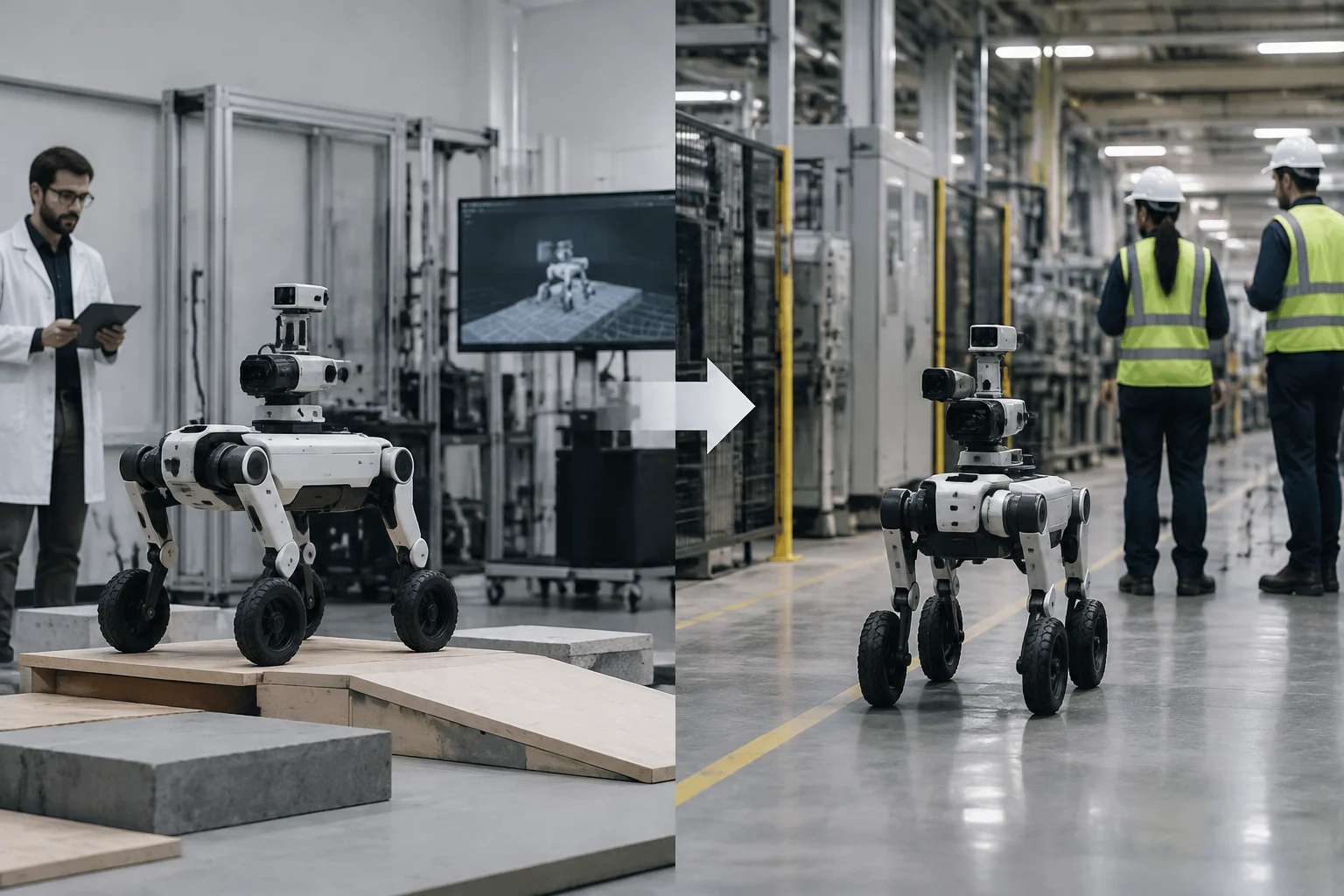
Cross-checking publications, materials and claims
A sound reading brings together different sources and gives them distinct roles. The scientific paper makes it possible to examine the method, task and stated limitations. Project materials may add context about objectives, partners and phases. An external evaluation can help establish whether the demonstration and its conclusions hold up beyond the team that developed the system. None of these sources automatically replaces the others.
When reviewing an announcement, separate promotional language from what was actually measured. “Autonomous”, “generalist” or “real-world conditions” need an operational definition: which decisions did the robot make without intervention? What kinds of task did it cover? Which conditions were treated as real? If the data have not been published, the wording should preserve that uncertainty rather than fill gaps with a favourable interpretation.
A short checklist can help prevent leaps in reasoning:
- Task: Is the objective and success criterion described?
- Environment: Are trial conditions and permitted variations stated?
- Evidence: Are metrics, evaluated cases and interventions explained?
- Operation: Are safety, failures, integration and supervision documented?
- Scope: Does the conclusion distinguish between demonstration, evaluation and deployment?
If information is missing, record it as a limitation of the available evidence. There is no need to dismiss the work: simply avoid claiming more than the evidence supports.
What signals indicate progress
Progress towards an application is better understood as an accumulation of evidence than as a binary leap from “prototype” to “ready”. Positive signals include an explicitly relevant task, metrics that address a need, a trial that makes its conditions understandable, and explanations of failures as well as successes. Evidence gains strength when trials are repeatable, relevant variations are tested, and the way the system is supervised and recovered is documented.
Even so, these signals alone do not guarantee operational readiness. Suitability depends on the specific use, risk tolerance, applicable requirements and local conditions. An application that is appropriate in a controlled setting may not be appropriate in another with different people, materials or processes. It is therefore worth asking which part of the system was evaluated and which part remains a working hypothesis.
A responsible conclusion can be precise without being categorical: a demonstration establishes that the system did something under certain conditions; a broader evaluation makes it possible to judge how far the result can be repeated and adapted; readiness for operation additionally requires answers about safety, integration and maintenance. The boundary between promising research and a viable application is not marked by a convincing image, but by the quality and scope of the published evidence.