What is announced and what the dates mean
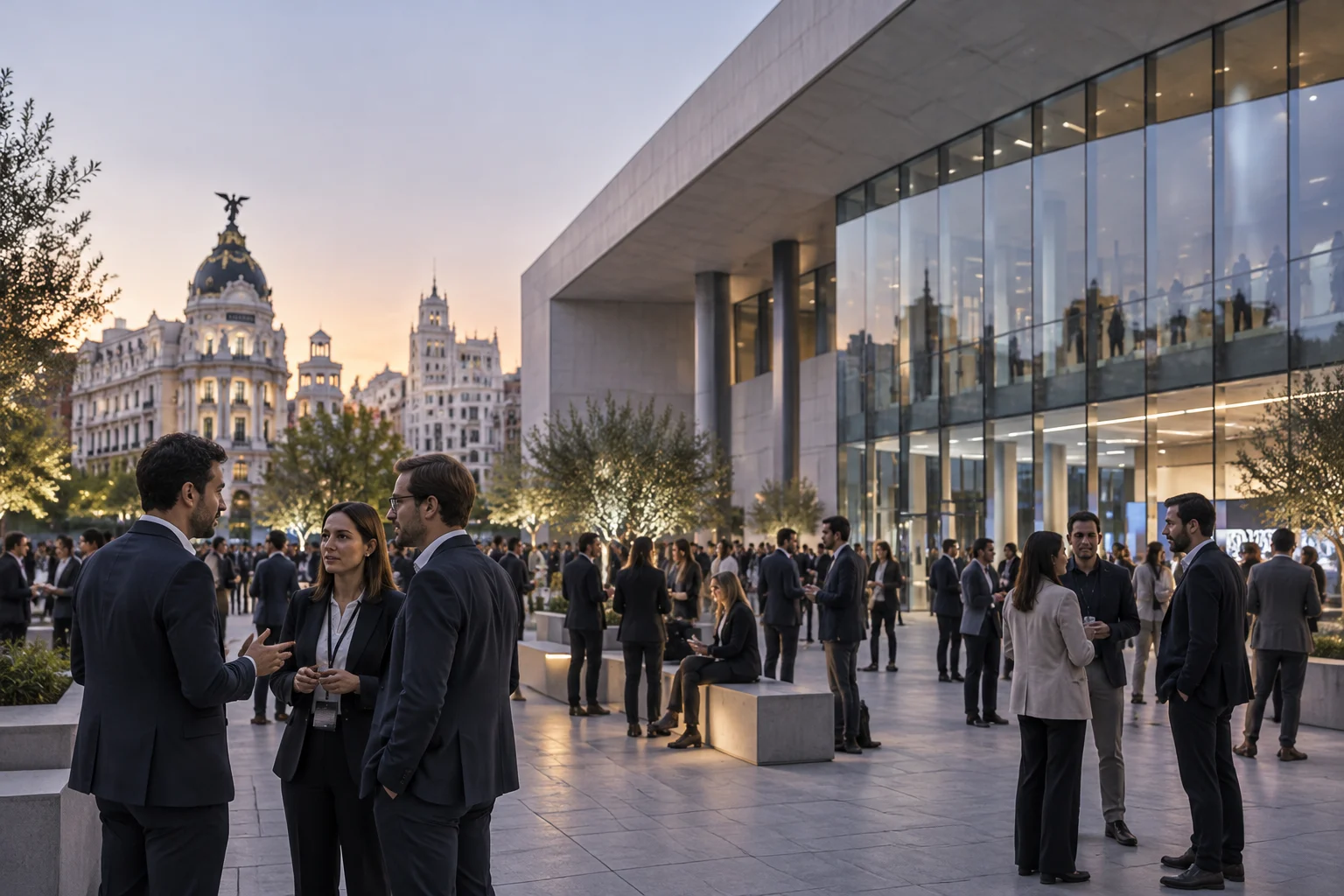
Madrid Tech Week 2026 is announced for October 28 to November 5. It is not necessarily a single fair occupying all those days in one venue: the published description presents it as an initiative connecting seven specialized tech events. This distinction matters for planning attendance, travel, and meetings.
The organization calls this its second edition. A news item published on September 22 records the calendar and figures communicated during the presentation; the Madrid Tech Week website also displays the dates. Since the interval includes nine calendar days, it is advisable to interpret the range as a programming window and check which days correspond to the specific event of interest.
As of this guide, dated October 18, 2026, the event is in the future. The announcement does not equate to a complete agenda: to make practical decisions, one must cross-reference each session, registration, and location on the participating event's page, rather than assuming activities occur on every day of the period.
Seven events, not a single fair
The concept of Madrid Tech Week is to bring together seven events under a common brand. This allows professionals from different fields to find related activities, but it also means that format, audience, and access conditions may vary among the congresses, fairs, and meetings integrated into the week.
Organizer information mentions over 1,200 companies, seven large stages, and 600 experts. These are announced figures for the initiative, not an audited count or a guarantee that each participant will be present throughout the entire calendar. Interempresas coverage adds a forecast of over 46,000 attendees and more than 600 speakers; these should be read as communicated estimates, not as results already achieved.
For a visitor, the consequence is concrete: choose the event based on professional goals—finding suppliers, attending talks, or networking—and verify the corresponding entry. The umbrella brand helps discover the whole; it does not replace specific instructions regarding accreditation, schedules, and access.
Sectors: a broad agenda with sessions to confirm
Published information places the week around several technological and business areas. The Madrid Tech Week site highlights areas such as artificial intelligence, cybersecurity, cloud, and Big Data; another publication related to the initiative also mentions blockchain, robotics, automation, and advanced manufacturing. This breadth describes the general thematic scope, not proof that each topic has a confirmed session on each day.
Tech Show Madrid, one of the events linked to the Madrid calendar, identifies among its sectors cloud, cybersecurity, Big Data, artificial intelligence, data centers, eCommerce, and digital marketing, as well as human resources and learning technology. Its own website sets its sixth edition for November 4 and 5, 2026, at IFEMA MADRID. This specific event must not be confused with the entirety of Madrid Tech Week.
This distinction is useful when preparing an agenda: those seeking specialized conversations should review the program of the sectoral meeting, not limit themselves to the general themes announced by the week's brand. An area may appear in the global description without the details of its speakers, rooms, or sessions being published in the consulted sources.
Venue and dates: avoiding mixing events
It cannot be affirmed that all of Madrid Tech Week has a single venue based on available information. The Tech Show Madrid page does indicate IFEMA MADRID for its November 4 and 5 dates; that data corresponds to Tech Show Madrid and should not be automatically extended to the other six events. The week may include distinct appointments with their own locations and schedules.
This precision also avoids confusing the call with other city activities. Eventbrite, for example, lists separate tech meetings in Madrid in late October and November. A date coinciding or being close does not prove that an activity is part of Madrid Tech Week: there must be an explicit link in the organization's or event's agenda.
Before booking transport or accommodation, it is advisable to check three elements in the source of the event you wish to visit: exact date and time, address and venue, and registration conditions. If a location is shared on a third-party page, organizer confirmation is preferable, especially when activities belong to different brands.
How to check agenda, access, and participation
The Madrid Tech Week website serves as an entry point to consult the call, but participation information may be distributed across each event's pages. The most reliable route is to locate the event of interest, open its official page, and cross-reference the program, venue, and registration there. General figures help size the initiative; they do not replace operational details.
For IT professionals and business managers, a brief review before attending can avoid unnecessary travel:
- Confirm that the event is listed as part of Madrid Tech Week and review its specific dates.
- Verify venue, schedule, registration, and possible access requirements on the organizer's website.
- Re-check the program close to the date, as available sources do not certify that all schedules and participants are finalized.
- Separate forecast metrics—attendance, companies, or speakers—from final data after the event.
In summary, Madrid Tech Week offers a common framework for seven events, not necessarily a single congress with uniform venue and agenda. General dates are announced; to decide which to attend, the decisive data is the specific sheet of each appointment.