Why cooling is an architectural decision
In a server with high-power accelerators, cooling is not an accessory chosen at the end: it shapes rack organization, the infrastructure that can power the equipment, and how heat is removed from the building. As computing capacity becomes more concentrated, thermal density becomes a design variable alongside electrical power, space, and availability.
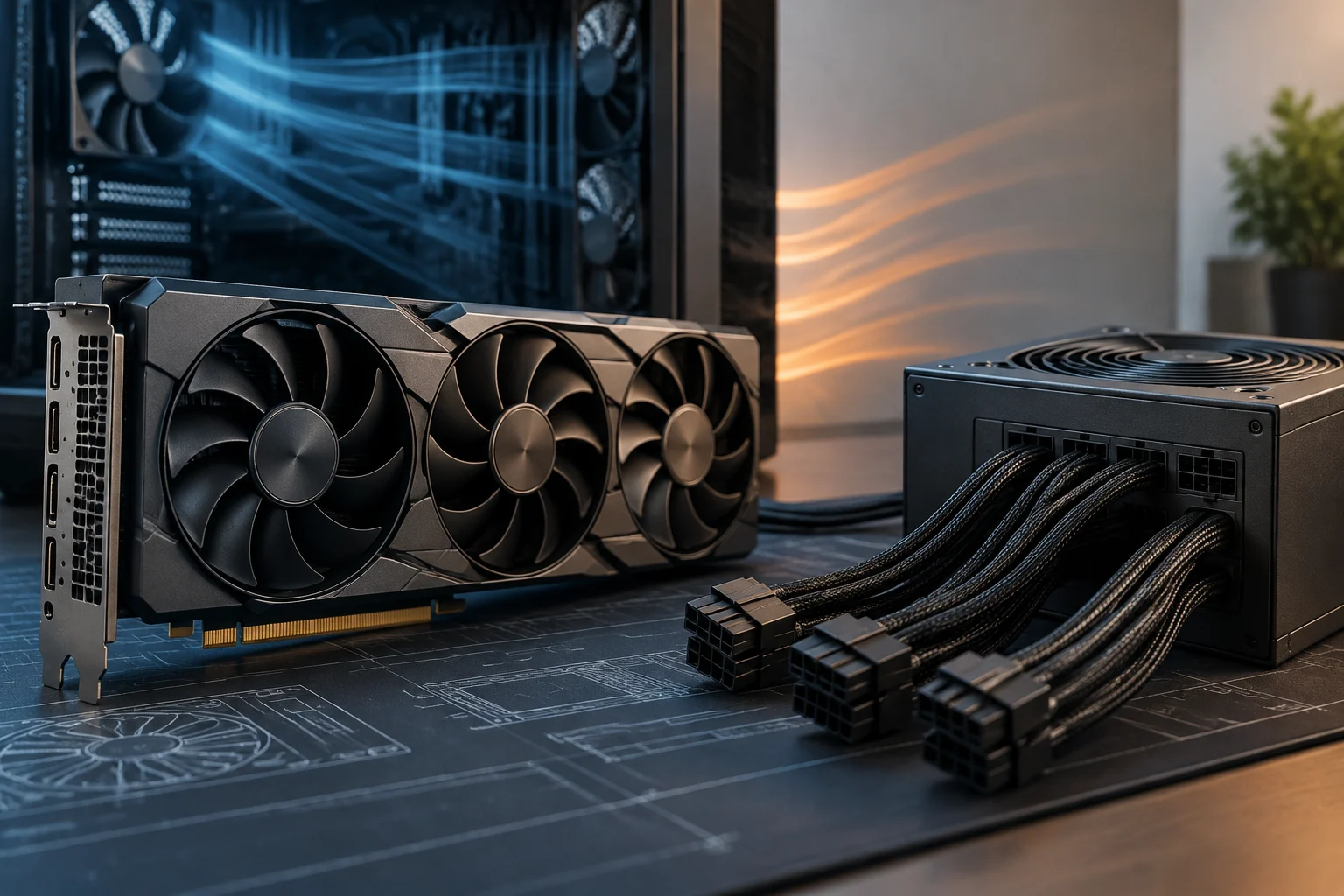
GPUs are used in data centers for tasks such as artificial intelligence and machine learning, as well as for graphics applications. But the presence of GPUs alone does not determine which cooling system a server needs: the specific configuration, expected workload, and operating conditions permitted by its components must all be known. Comparing technology names is not enough, nor is it sound to extrapolate from a consumer graphics card.
That is why broad figures for accelerator power or rack density should be treated with care. The available research includes secondary analyses describing rising thermal loads, but it does not provide primary specifications for a particular server that would establish a universal threshold beyond which air cooling is no longer viable. The practical point is different: check the requirements of the actual equipment and facility, rather than making a decision from a single figure.
Air and liquid: two ways to remove heat
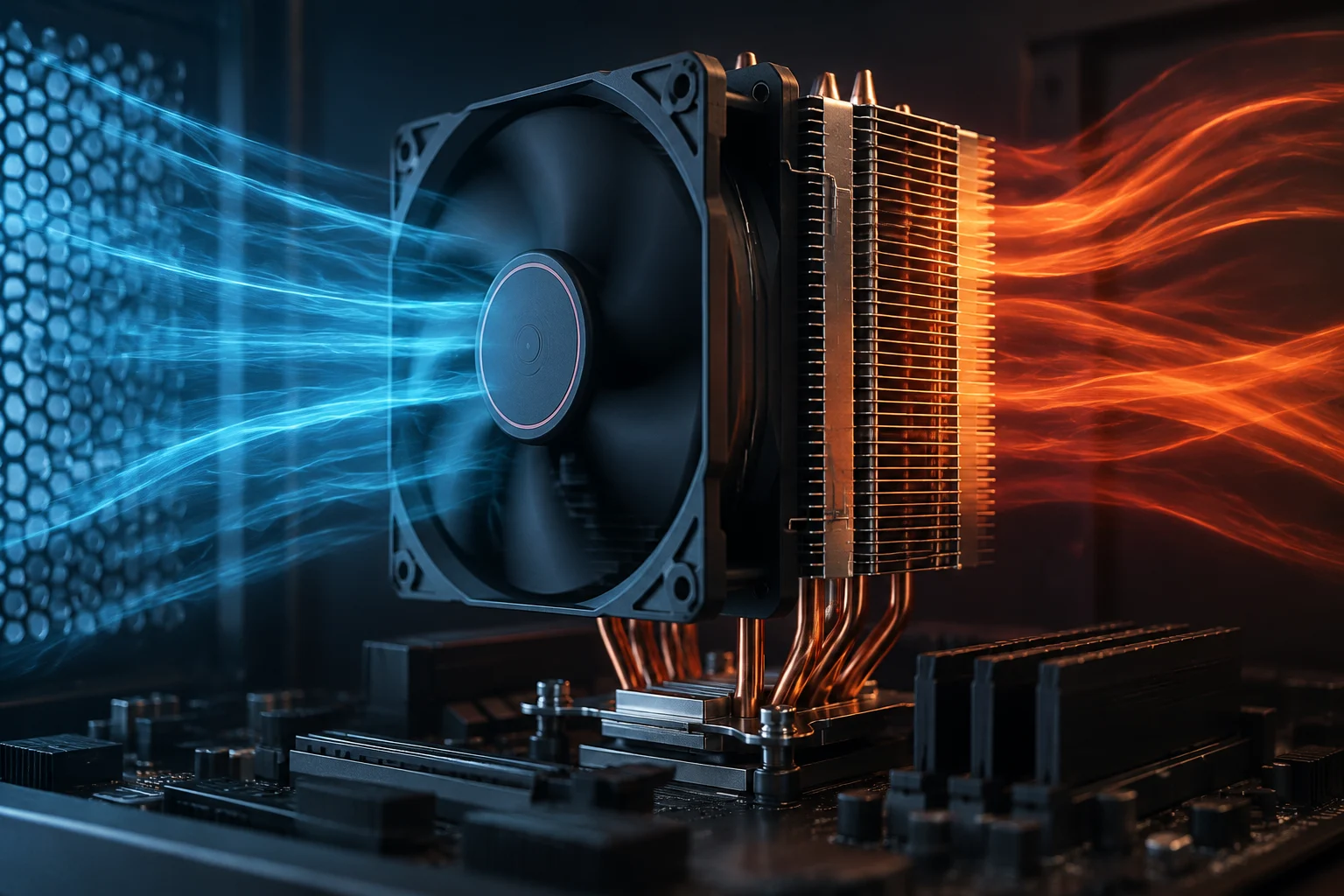
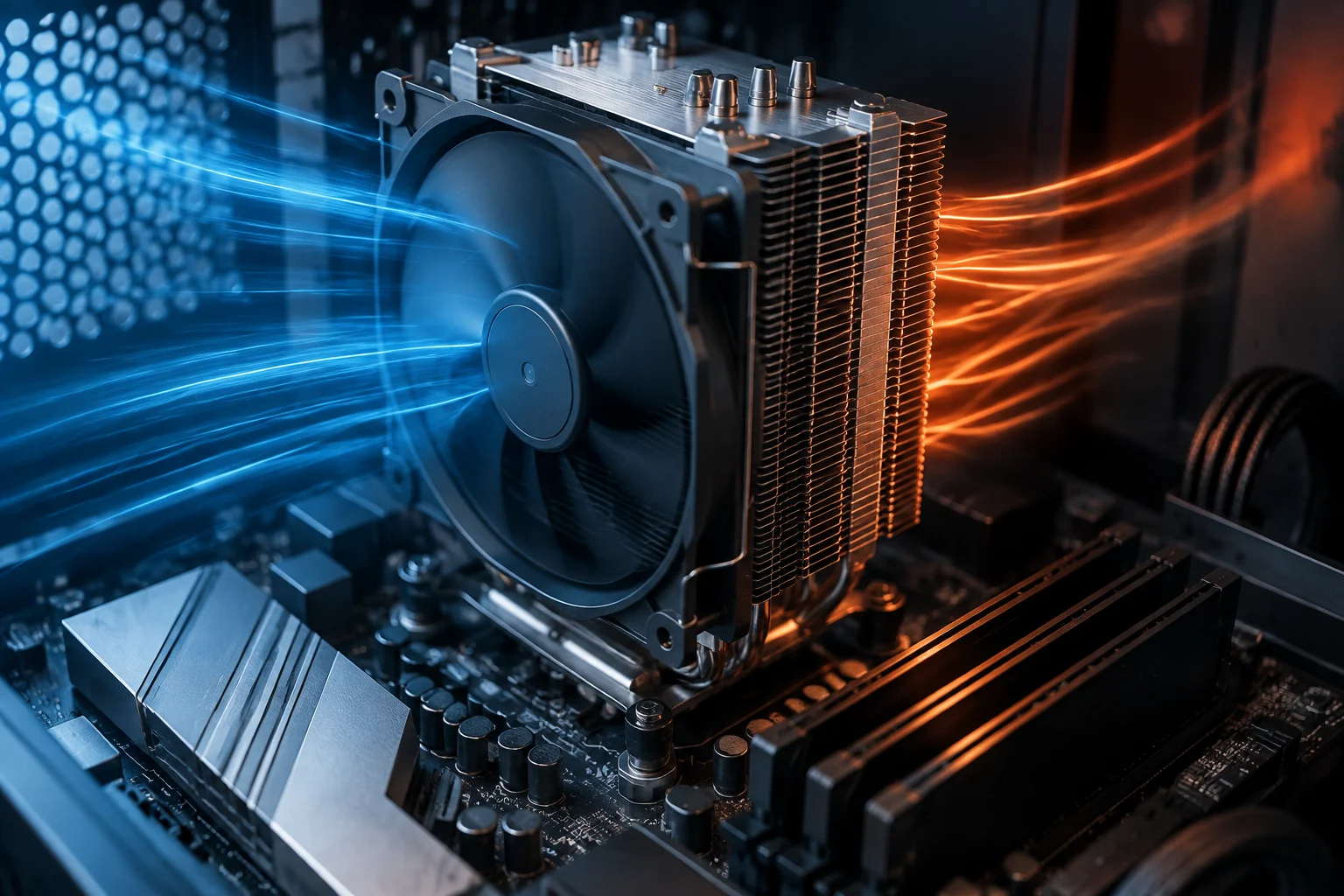
With air cooling, heat moves from the component to a heatsink, after which airflow carries it out of the server or rack. This is a familiar architecture and may be suitable when equipment design, thermal load, and the climate-control system can maintain the required operating conditions. Its limit is not defined only by chip temperature: airflow, heat distribution, and the facility’s ability to remove that heat also matter.
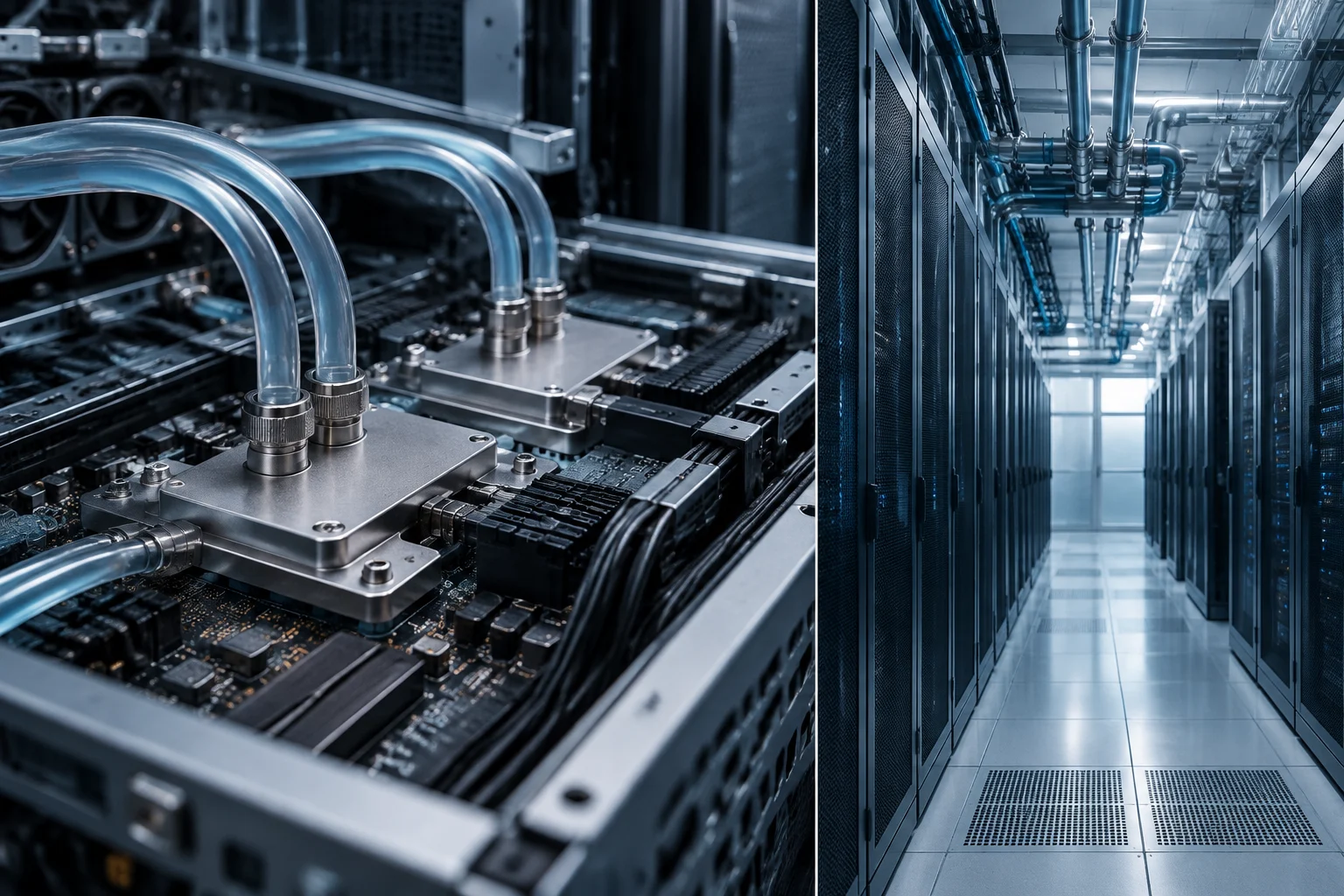
Direct-to-chip liquid cooling—often called direct-to-chip or DTC—changes the first part of that path. Rather than relying solely on air passing through a heatsink, a cold plate is placed in thermal contact with the component, and liquid circulates inside it to collect heat. The liquid captures heat close to its source; a loop then has to carry it to a heat exchanger or distribution unit, and the facility must reject it outdoors.
The useful distinction is not that one method “cools” and the other does not, but where heat is collected and what infrastructure moves it afterward. Liquid cooling can reduce some of the load that air would otherwise have to manage inside the server, but it requires pipes, connections, controls, and maintenance. A meaningful comparison with air cooling must specify the equipment, operating conditions, and what falls within the measurement boundary.
What each part of the liquid loop does
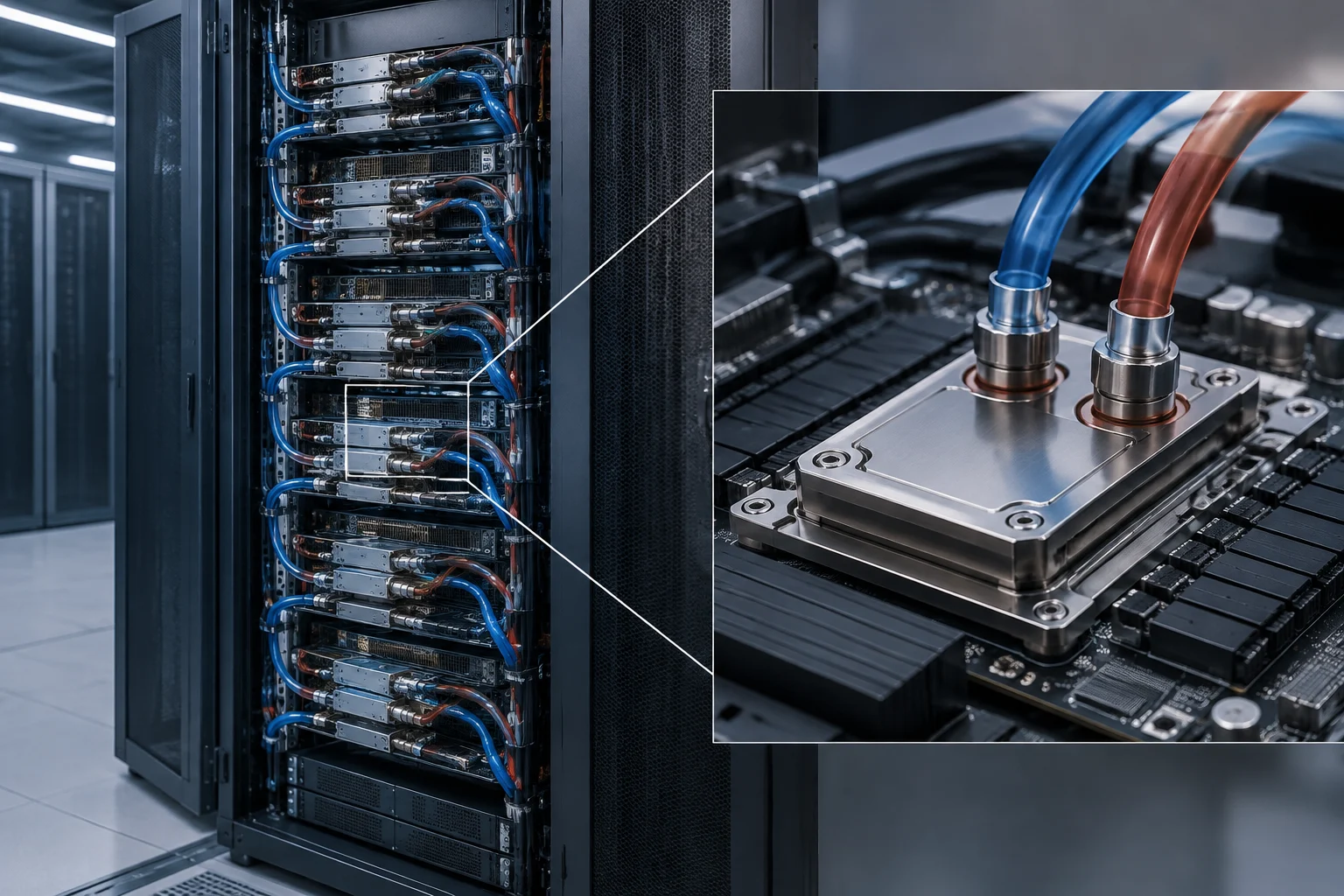
In a cold-plate design, the loop begins at the heat-transfer surface positioned over the chip. Liquid passes through the plate, absorbs thermal energy, and returns through a return line. Pumps maintain flow; pipes and couplings connect the components; and the control system monitors operating variables. Construction details differ between solutions, so the term “liquid cooling” does not specify the design by itself.
The coolant distribution unit, or CDU, serves as a unit for distributing and managing coolant. Depending on the design, it may separate the server’s technology-cooling loop from the facility water loop and provide pumping and heat-exchange functions. Separation between the two loops is an architectural choice: it defines which fluid circulates alongside the IT equipment and how it connects to the building infrastructure. The CDU does not replace the system that ultimately rejects the heat.
It is also important to distinguish between single-phase loops and two-phase designs. In a single-phase solution, the fluid remains liquid throughout the loop and primarily collects heat as its temperature rises. A technical document hosted by Open Compute Project describes another architecture: direct-to-chip cooling with pumped two-phase refrigerant. That document is a technical proposal dated February 2025; it does not show that all DTC systems work the same way or that one architecture is universally superior.
Specifications to request before making comparisons
The first check is to establish the thermal conditions the equipment supports: liquid inlet and outlet temperatures, required flow rate, operating pressure, and component temperature limits. These parameters should come from the server, cooling unit, and facility documentation—not generic values copied from a PC guide. Without compatible operating conditions, the comparison is meaningless.
The next step is to identify what the stated heat-removal capacity means and which configuration it applies to. A heat-removal figure must be tied to equipment or a loop, inlet conditions, flow rate, and a measurement method. The electrical needs of pumps and controls must also be reviewed, along with the power consumed by the system that rejects heat outside the room. One figure on its own does not prove net savings.
A minimal technical evaluation should include:
- Thermal load covered: which components and what portion of the server the liquid loop will cool.
- Liquid conditions: planned supply and return temperatures, flow rate, and pressure.
- Integration limits: connectors, pipes, space, service procedures, and server-manufacturer requirements.
- Auxiliary consumption: pumps, controls, and heat-rejection equipment included in the balance.
- Test conditions: workload, ambient temperature, compared configuration, and measurement period.
What cold plates still leave outside the loop
A cold plate collects heat from the components connected to it; it does not automatically turn every part of the server into a liquid-cooled component. Depending on equipment design, other components may still rely on air, and the room air may still need conditioning. “Direct-to-chip” describes one part of the heat path, not necessarily the whole thermal system.
The facility also still needs somewhere for the heat to go. Liquid leaving the server has gained energy and must transfer it to another loop or a heat-rejection system. That exchange may involve facility water, heat exchangers, and external equipment, but the exact arrangement depends on the project. Consequently, better heat transfer inside the rack does not automatically mean lower energy use across the data center as a whole.
Failure handling and service tasks also need consideration: loss of flow, a pump shutdown, a leak, or an interruption in cooling can affect the equipment. According to Data Center Dynamics’ coverage of ASHRAE’s 2024 recommendations, ASHRAE noted risks associated with thermal changes and cooling interruptions, and highlighted the CDU as part of the architecture. Continuity and failure response are part of the design, not secondary details to leave until later.
Efficiency: what can be claimed and what needs testing
The fact that liquid collects heat more directly is not enough to conclude that a data center will use less energy or that each GPU will perform better. Overall efficiency depends on the energy used by pumps and other equipment, how heat is rejected, and the conditions of the comparison. A local thermal advantage does not by itself prove system-wide savings.
To substantiate a savings claim, an analysis should compare equivalent configurations under the same workload and disclose the measurement boundary. A comparison between two different servers, or between facilities with different loads and conditions, cannot attribute the outcome solely to the cooling method. The observation period should also be known, as should whether the calculation includes auxiliary consumption and heat rejection.
The OCP technical document on two-phase direct-to-chip cooling sets out potential benefits in operational metrics, but it is a technology document and should be read as such: it describes an architecture and its rationale, not independent proof of savings in every deployment. The practical decision is to request comparable, measured data before accepting claims of lower cost, energy use, or environmental impact.
An infrastructure decision, not a label
For an operator, the useful question is not whether liquid cooling is better in the abstract, but whether the planned server can operate within the facility’s design conditions and what changes when it is integrated. Compatibility, loop distribution, maintenance, auxiliary consumption, failure recovery, and heat rejection all need to be checked. The technical specification must cover the complete system, not just the cold plate.
Those comparing proposals should separate three levels of evidence: hardware specifications from the manufacturer, loop-integration documents, and independent measurements of the system under comparable conditions. Commercial information or a general description of the technology can help frame questions, but it cannot replace those tests. If data for the relevant model and configuration have not been published, the responsible conclusion is to limit the scope of the claims.
Direct-to-chip cooling is an architecture that brings heat collection closer to processors and accelerators. It may be relevant in servers with high thermal density, but it does not eliminate distribution or heat-rejection work, and it does not by itself justify efficiency figures. A decision requires exact operating conditions, system boundaries, and tests that compare outcomes without confusing an improvement at the chip with an improvement across the entire facility.