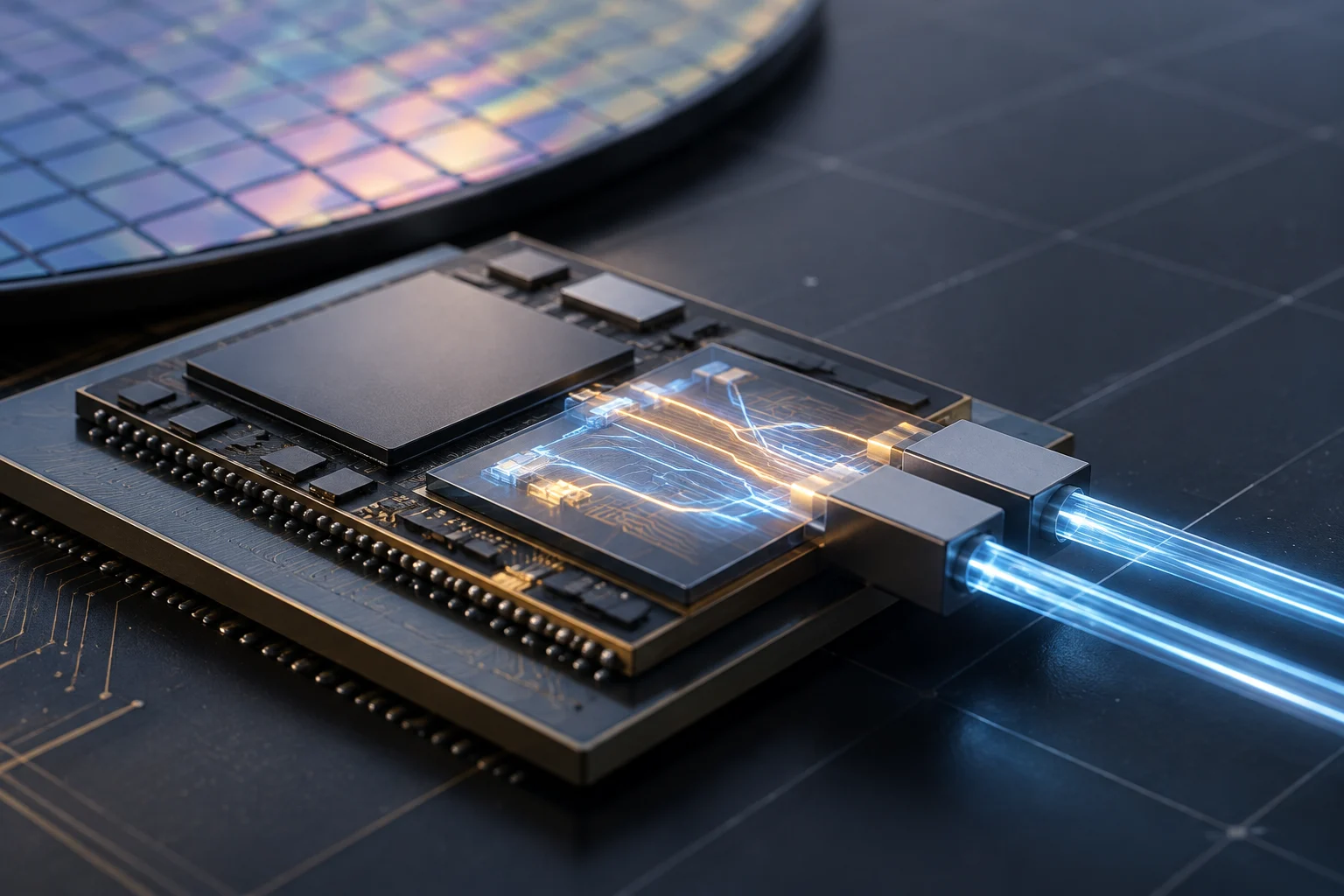
The idea: bringing light closer to chips
Co-packaged optics, or CPO, appears in the verified material as the subject of a study comparing the power consumption of data-center switches using CPO with that of switches using pluggable transceivers. The title of the DOI record identifies the topic, but the available abstract does not provide results or methods that would allow the architecture or its performance to be explained in detail. For that reason, this article does not present a technical description of COUPE as though it were confirmed by the sources supplied.
The draft suggests that co-packaged optics could route some data through optical connections close to circuits, rather than relying on electrical paths to pluggable modules. The sources in the package do not document that explanation or support attributing advantages in power consumption, signal integrity, reach, or latency to a particular solution. A plausible explanation is not the same as a verified fact: without relevant technical documentation, those details should not be stated as confirmed properties of COUPE.
The title of the DOI-identified article does establish that it concerns comparative research into the power consumption of data-center switches with CPO and pluggable transceivers. It does not reveal the result or authorize generalizing it to all equipment or to TSMC’s technology. The existence of a study is not, by itself, evidence that one option performed better. Assessing its conclusions would require the publication and its test conditions.
COUPE and the architecture attributed to TSMC
The original draft discusses the name COUPE, the integration of photonic and electronic components, and a possible relationship with computing chips. None of the verified sources included here addresses COUPE or confirms that description. The TSMC annual report to which the draft attributes some statements was not supplied either. Consequently, the name’s expansion, the structure of the photonic engine, and its relationship to a computing chip cannot be treated as verified.
A source is also missing that would distinguish, specifically for COUPE, between a photonic engine, its integration with control electronics, and a complete CPO solution. A rigorous description of these levels requires documentation defining what each includes. The absence of such documentation in the package does not prove the description false; it means that the material received does not verify it. The scope of this correction is limited: it does not replace missing details with an invented technical explanation.
The Intel sources included in the package concern Intel packaging technologies or collaborations, not COUPE or a TSMC roadmap. The supplied arXiv abstract, meanwhile, concerns a RISC-V SoC with AI acceleration. Neither of these materials confirms specific claims about COUPE. The IEEE Xplore page retrieved for one record shows an anti-bot verification, not usable technical content about this technology.
The 2026 timeline: what can be stated
The draft says that TSMC announced a COUPE solution on a substrate whose production would begin in 2026, and mentions a roadmap associated with CoWoS. The verified package contains neither that announcement nor symposium material that would allow its dates, context, or wording to be checked. The timeline therefore cannot be presented as a TSMC statement confirmed by the sources available here. Supporting a specific date requires an identifiable primary reference and enough context to establish which milestone it describes.
It is important to distinguish an announced target from the start of manufacturing, volume production, and commercial availability. Even if a roadmap date were verified, that alone would not demonstrate that manufacturing had started, that particular volumes had been achieved, or that a product was available. In this case, the material received also does not establish which stage the alleged announcement described. This gap should not be filled with a guess: the timeline remains unverified in this package.
No sources were supplied that identify commercial systems using COUPE or establish its availability. This review therefore does not claim that the technology is in production, that the target has been met, or that commercial customers exist. Those points could be clarified with current primary announcements, product documentation, or verifiable availability information, but they do not follow from the sources included in this task.
Speed, energy, and latency figures
The figures in the draft—200 Gbps, twice the energy efficiency, and ten times lower latency—have no relevant support in the current package. They cannot be retained as verified data or attributed to TSMC without locating and reviewing the original sources. According to its title, the DOI-identified article compares power consumption between CPO and pluggable transceivers; the abstract supplies no results, methods, or conclusions. It therefore does not confirm the figures cited.
Evaluating a speed figure would require knowing which link and transmission direction it describes, as well as the unit and test conditions. An energy comparison requires information about the reference configuration, the components included, and operating conditions. Latency likewise requires identifying the path and operation measured. The available material provides none of these details about COUPE. Results from another architecture cannot simply be transferred, nor can a context-free figure be turned into a guaranteed performance claim for a complete package or data-center network.
The draft’s methodological criticism—that the announcement omits certain parameters—cannot be confirmed without consulting the announcement either. Both the figures and the assessment of their scope therefore remain unverified. Rigorous writing should distinguish a measured result from an announced target or an attributed claim, and use each category only when appropriate evidence is available.
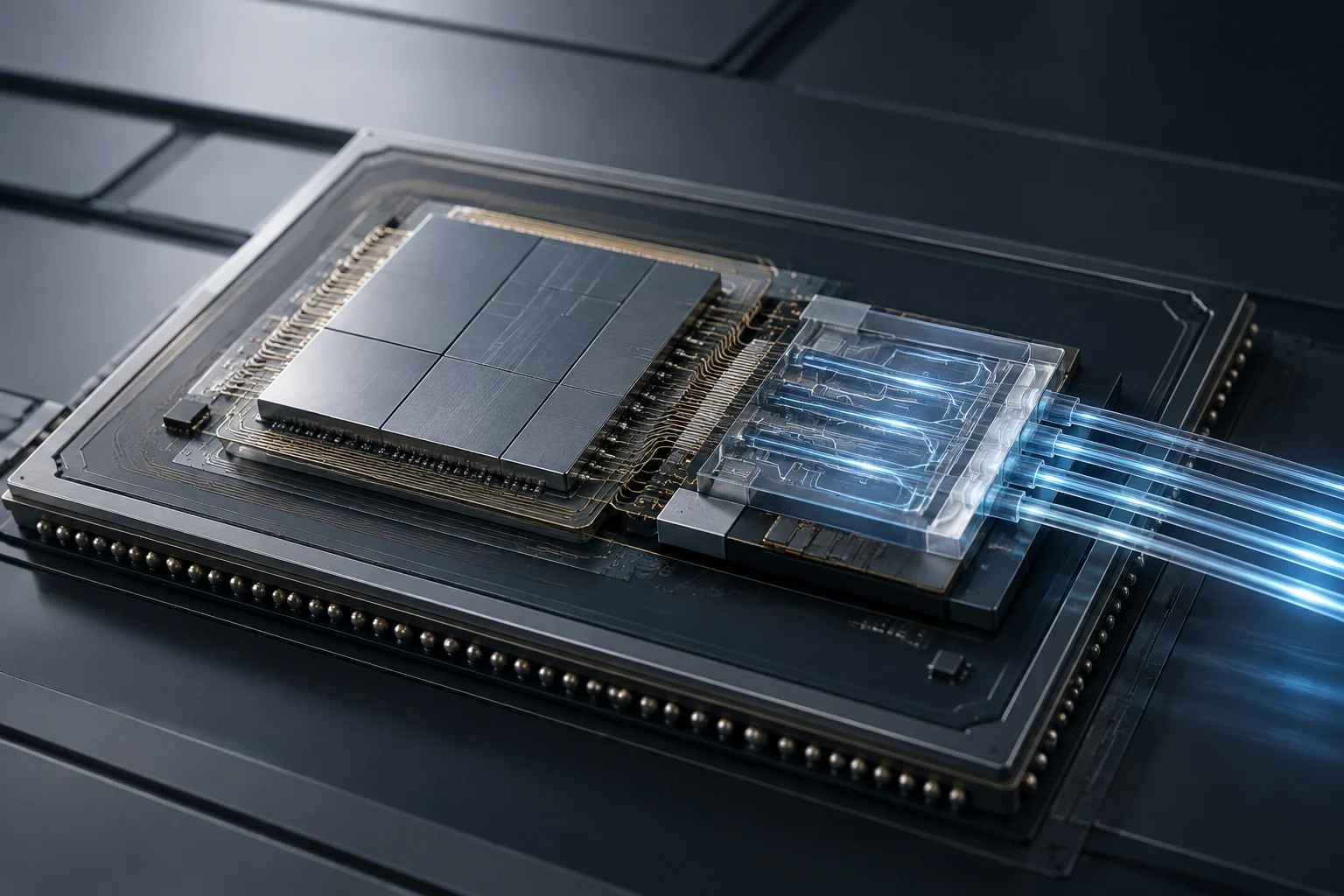
Manufacturing, reliability, and maintenance
The original text raises issues such as manufacturing yield, cost, thermal behavior, reliability, repair, and maintenance. These are relevant when evaluating an integration technology, but the sources received offer no COUPE results that would allow them to be described as observed characteristics or documented problems of that solution. If included, they should be framed as general open questions, not conclusions about a specific product.
Discussing COUPE’s manufacturing yield or reliability would require data applicable to that technology. Claims about temperature require information about the conditions evaluated; any cost comparison must specify which components and stages it covers. The package provides none of these data. Nor does it establish how components in a particular implementation would be repaired or replaced, which may depend on system design and manufacturer practices. The absence of specific evidence does not authorize filling these gaps with predictions.
A comparison between pluggable modules and integrated optics also needs an equivalent basis. The DOI record identifies a study of power consumption in data-center switches with CPO versus pluggable transceivers, but the abstract reports no results. That is not enough to conclude that either option is cheaper, more reliable, or easier to maintain. The publication and its methods would be needed to assess those questions, and any findings would have to be applied carefully to the design studied.
What is needed to complete the verification
Supporting the draft’s central claims requires direct TSMC sources explaining what COUPE is, how it is integrated, how it relates to CoWoS, and what timeline the company announced. The original references for the speed, energy, and latency figures are also needed. If technical results are described, sources should say how they were obtained, which configuration was evaluated, and what comparisons they support. For an announcement, the context must make it possible to distinguish targets, manufacturing stages, and availability.
The current package supports narrower points: the Intel source about Lens Technology concerns an advanced-packaging collaboration; the arXiv abstract concerns a RISC-V SoC; and a retrieved IEEE Xplore page did not show verifiable technical content. The DOI record’s title identifies comparative research on data-center switch power consumption with CPO and pluggable transceivers. None of these items, on its own, confirms the announcements or performance attributed to TSMC. A source supports only the claims it actually documents.
The conclusion must be limited to what can be verified: the sources available in this package are not enough to confirm COUPE’s timeline, figures, or commercial status. This does not prove that the draft’s claims are false, but it prevents presenting them as established facts on the basis of this material. The headline retains the topic under discussion; it does not independently validate the promises attributed to the technology. Claims about status in 2026, quantitative comparisons, and adoption remain open until relevant, current primary sources are reviewed.