Autonomy is always demonstrated for a task
Calling a robot “autonomous” without specifying what it does leaves the important question unanswered: autonomous at which task, under what conditions, and with what assistance? A system may move through a familiar corridor without help yet require supervision when obstacles or the available space change. It is therefore better to treat autonomy as a capability tied to a task and context, not as a universal property of the device. This distinction also prevents unlike capabilities from being compared as if they were equivalent simply because they are described with the same word. A useful claim should make clear what the robot did, what circumstances applied, and what role—if any—a person played.
This distinction also matters when reading announcements. Completing a prepared sequence may show that a robot carried out that sequence in those circumstances; on its own, it does not show that the robot can solve different tasks, respond to unexpected changes, or work without supervision for long periods. The careful conclusion is limited: the evidence supports what was tested, not a general capability that was never measured. A clear presentation should make the boundary visible between what was observed and what cannot yet be concluded. That boundary is not a reason to dismiss a demonstration; it is a way to describe accurately what the demonstration establishes.
As a framework for assessing any claim, first ask for an operational definition: what counts as completing the task, what conditions were present, and what assistance was allowed? Without that definition, a success rate—even an apparently high one—has no clear interpretation. The goal is not to reduce autonomy to a single number, but to ensure that any number is accompanied by the scenario and rules that give it meaning. Readers can then understand what the result represents without attributing more reach to it than it has. A task-specific definition also makes it easier to compare later tests, provided their conditions and criteria are genuinely comparable.
Describe the scenario before comparing results
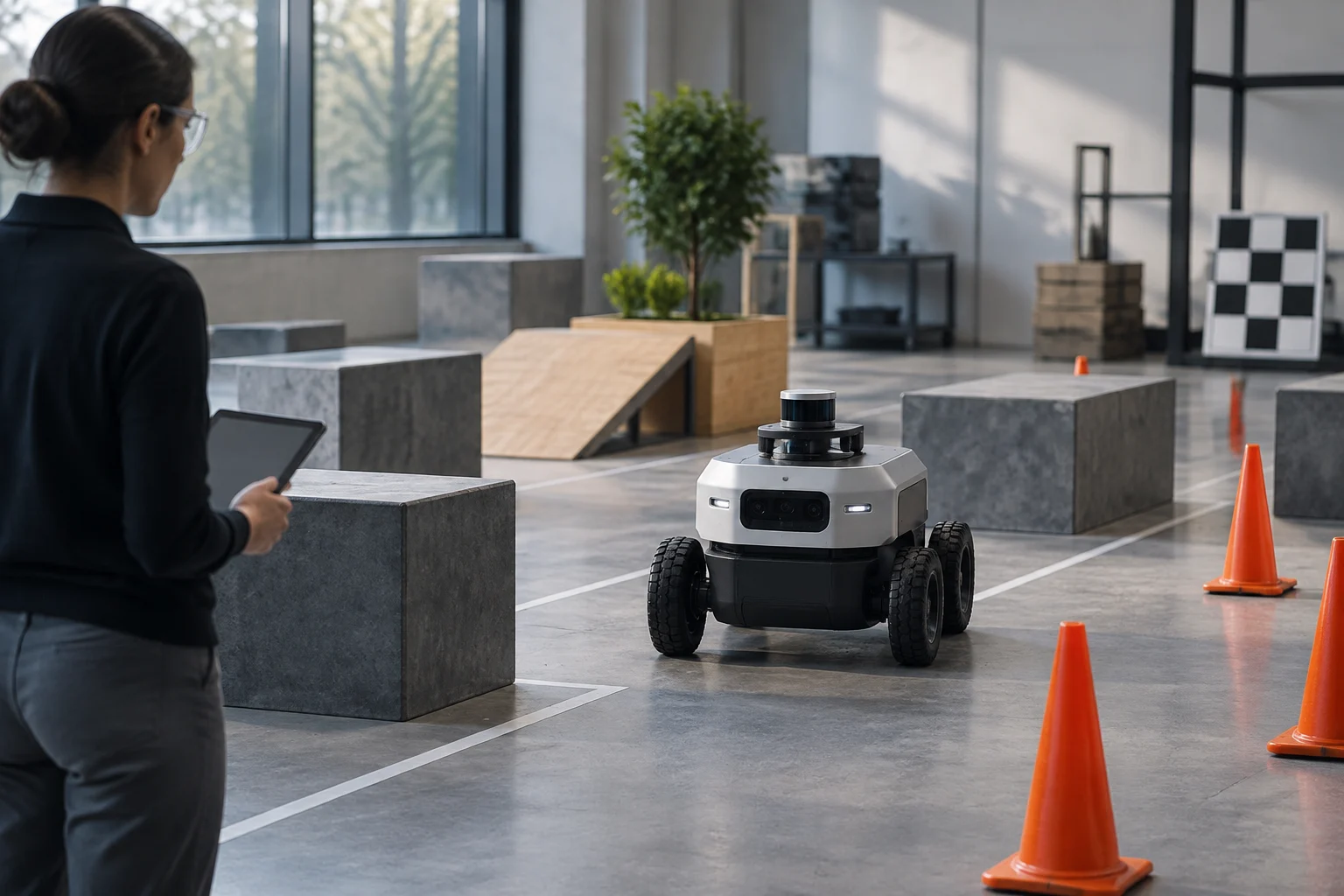
An interpretable test should explain what task was requested and the environment in which it took place. For a mobile robot, this may include the type of surface, route, obstacles, and available space; for a manipulation task, it may include the objects and their arrangement. It also matters whether the environment remained unchanged between attempts or whether variations were introduced. These details are not methodological decoration: they determine which capability was assessed. Knowing them makes it possible to distinguish an execution in stable conditions from one exposed to relevant changes, and to understand what a result can reasonably support.
Evaluating the efficiency of a surveillance robot is the subject of an article by Star Robotics. Its focus is specific: it does not automatically transfer evaluation criteria to every type of robot, nor does it replace a description of the task under examination. The reference can help readers approach evaluation in that particular area, but it does not by itself answer every question about other uses. To put it in context, consult the original article: https://star-robotics.com/como-evaluar-la-eficiencia-de-un-robot-de-vigilancia/. The subject named by the source should be kept in view when using it: a reference about surveillance robots should not silently become evidence about all robotic systems.
The number of attempts and the starting conditions should also be clear. A successful run in a single demonstration does not show whether the result is repeatable. If averages are published, it is useful to state how many attempts they include and how those attempts were selected. The sources verified for this review do not establish a universal minimum number of repetitions; transparency and context are therefore preferable to presenting an arbitrary number as a standard rule. Reporting the conditions makes it possible to assess an average without mistaking it for a guarantee of performance in every circumstance. Repetitions add useful evidence, but their meaning still depends on what was repeated and how the test was conducted.
Success, failures, and human help: metrics that tell the story
The success rate is an intuitive metric, provided “success” is defined before results are observed. Is the task considered complete if the robot reaches its destination but hits an obstacle along the way? Does it count as a success if a person repositions an object or tells the robot how to continue? A useful evaluation clarifies these criteria and separates attempts completed without help from those that needed assistance or ended in failure. If the criteria change between tests, the resulting rates no longer describe the same kind of outcome. A figure without a definition may look precise while leaving the central question unresolved.
Human interventions deserve particular attention. There is a difference between monitoring for safety, giving the system a normal instruction, and taking control to correct a trajectory. If all of these are summarized as “autonomous operation,” information needed to compare tests is lost. It is better to specify what kind of assistance was allowed and when it occurred, rather than grouping different situations under one label. It also helps to say whether intervention was occasional or necessary to finish the task. A transparent account lets readers distinguish supervision from hands-on correction, instead of treating every human presence as either irrelevant or decisive.
In addition to the final outcome, it can be useful to record error types, task time or duration, and recovery after a failure, where relevant. No single metric should be assumed to suit every case: in navigation, deviations or obstacle detection may matter; in manipulation, the result and stability of the sequence may be important. The metric should follow the task, not the headline one hopes to defend. Presenting several relevant measures gives a fuller account of performance without pretending that one isolated figure summarizes every aspect. The choice of measures should therefore be explained in relation to the task, rather than treated as a universal checklist.
From demonstration to use beyond the tested environment
A controlled test helps isolate a capability, but it does not guarantee that behavior will persist when the environment changes. The difference between these contexts should be presented as a limit on the scope of the evidence, not as automatic proof that a robot will fail in real conditions. To assess how far results can be generalized, readers need to know which elements varied, which remained fixed, and whether the evaluation included situations different from those used during development. The clearer that description is, the easier it is to see which changes were covered and which remain untested. A claim should not leap beyond the conditions that its test actually represents.
The Colosseum is a research benchmark on generalization in robotic manipulation. The article describes an evaluation of generalization in that area; it is therefore an example of work with a defined scope, not a guarantee that its results apply to every platform or task. Its title and academic record can be consulted at https://arxiv.org/html/2402.08191v2. The methodological value of a benchmark depends on checking which task and conditions it includes before extending its results to other settings. A benchmark can inform evaluation without serving as a universal measure of autonomy.
Comparisons between simulation and real hardware should be described carefully, not treated as if the two were equivalent. A simulation result may help explore configurations or repeat conditions, but it should not be presented as a physical measurement if the robot did not perform that test. If an announcement combines data from both settings, the distinction should be visible. The measurement context is part of the result: without it, a figure cannot show how closely the test resembles the use being described. Naming the environment in which each result was obtained prevents a test from being credited with properties it did not measure.
What evaluation sources contribute—and what they leave out
The sources verified for this review do not document a common standard covering the autonomy of all robots. The Star Robotics article concerns the evaluation of surveillance-robot efficiency, while The Colosseum addresses generalization in robotic manipulation tasks. These references have different scopes; neither should be presented as a universal protocol for navigation, manipulation, and other uses. Their value lies in the specific questions they address, not in a claim to settle every question about robotic autonomy.
That specific scope is both a strength and a limit. An evaluation applied to surveillance robots does not automatically demonstrate skill at other tasks, safety in every environment, or the ability to complete prolonged work. Similarly, results from a manipulation benchmark do not guarantee the same performance in navigation or on other platforms. Claims should retain the scope supported by the methods and experiments described. Defining a reference’s limits does not dismiss it: it helps use the source for the subject it covers and prevents it from being turned into support for unrelated conclusions. This distinction is especially important when a familiar term such as “autonomy” is used across very different applications.
Nor is citing an article enough to turn a specific capability into general autonomy. It is necessary to check what type of robot and task the source covers, which indicators it uses, and which aspects it leaves out. The available references illustrate specific topics—surveillance-robot efficiency and generalization in manipulation—but do not, on their own, establish a shared certification method. Maintaining this distinction protects the accuracy of the analysis and makes it easier to trace where each conclusion comes from. It also gives readers a straightforward way to identify what further evidence would be needed for a broader claim.
Questions for assessing an announcement without overgeneralizing
Before comparing two robots, check whether their tests concern sufficiently similar tasks and scenarios. A success figure obtained in a clear environment is not directly equivalent to one recorded with changing obstacles. It is also important to know whether the result comes from physical runs, simulation, or a combination, and whether failures as well as successes were reported. Without that information, a comparison may look precise while actually saying little. Similarity between test conditions matters just as much as the way results are expressed, because different test designs can make identical-looking numbers mean very different things.
Readers can ask straightforward questions: What task was defined? How was completion decided? How many times was it repeated? What variations were tested? When did a person intervene? How were errors recorded? If a study is cited, what robot, task, and methods did it cover? These questions do not assume bad faith, and they do not require every announcement to publish an academic study. They help distinguish a bounded demonstration from broader evidence. They also make it quick to identify which information is missing to interpret a claim carefully. A concise answer to these questions can make an announcement more informative without overstating what the evidence proves.
The conclusion should keep the same scope as the test. If the robot navigated repeatedly through a described scenario, that is what can be claimed; if the test also measured obstacles, deviation, and recovery, those findings can be added. Autonomy is not established by a word, but by traceable evidence and explicit limits. This caution makes it possible to recognize real progress without turning one successful run into a promise about tasks that have not yet been assessed. Ultimately, a precise account of what was and was not done makes any statement about performance more useful.