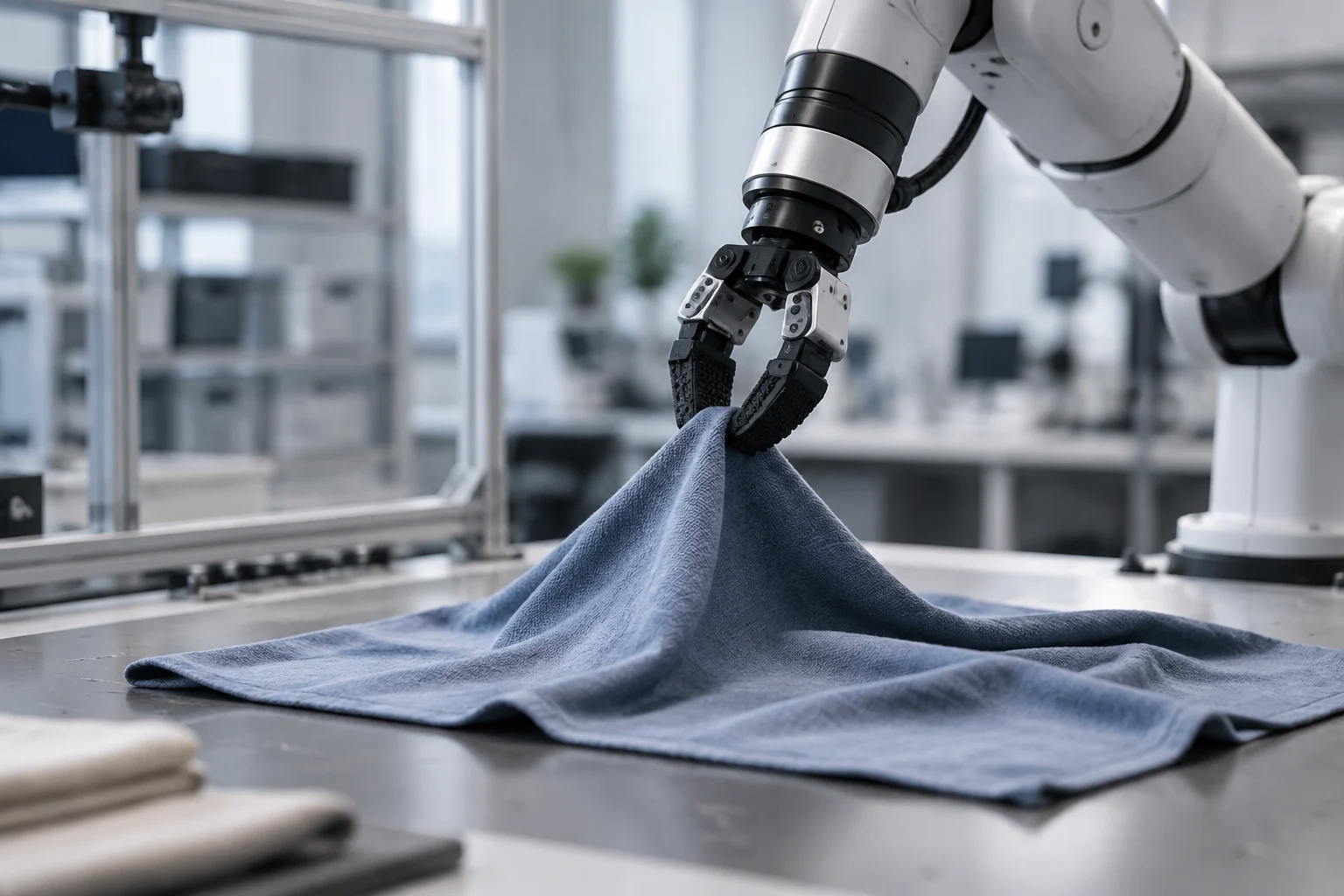
The gap between understanding an instruction and moving an object
A robot can receive an understandable instruction—for example, to place a part in a tray—and still fail to carry out the movements required. It must interpret what a camera shows, estimate the objects’ positions, anticipate how they will interact, and choose an action precise enough to succeed. The difference between deciding what task to perform and reasoning about how to make a specific movement is the problem addressed by ManipBench. The work was published in the proceedings of the 2025 Conference on Robot Learning and evaluates vision-language models’ reasoning in low-level robotic manipulation. (PMLR)
The distinction matters because a convincing verbal answer does not show that a model can control a robotic arm well. ManipBench offers a shared evaluation of reasoning capabilities related to manipulation, including understanding interactions between objects and handling deformable objects. It is a way to examine skills relevant to control, not a complete test proving that a model can receive an open-ended instruction, plan a long sequence, and execute it physically without assistance. The benchmark measures reasoning related to movements; it is not, by itself, a certification of autonomy.
It is also useful to distinguish understanding a task from carrying it out consistently. In a reasoning evaluation, a model may show that it can identify which object should be moved or which action would make sense. In the physical world, it must also turn that answer into instructions the robot can execute. That transition brings additional requirements, such as maintaining accuracy across several steps and responding to changes in the scene. ManipBench is useful for examining one part of this chain, not for replacing evaluation of all its stages.
What the evaluation contains
ManipBench evaluates several dimensions of manipulation reasoning, including interactions between objects and the handling of deformable objects. The paper presents the benchmark as a means of studying low-level reasoning associated with precise movements. (PMLR)
This breadth makes it possible to examine more than one capability, but it is not equivalent to reproducing every condition of a real physical space. The work focuses on the low-level reasoning defined by its authors and does not, on its own, demonstrate how a system would respond to every variation in an environment. A benchmark evaluation is not the same as thousands of independent tests with robots.
The shared structure makes it possible to compare models within the scope defined by the study. At the same time, results should be interpreted in light of the questions and tasks included by the researchers. The existence of a comparable score does not mean that every variation in objects, scenes, or execution conditions that may arise beyond the evaluation is represented.
What the published results indicate
The authors’ abstract highlights that vision-language models’ performance varies significantly by task. It also reports a strong correlation between performance on ManipBench and trends observed in real-world manipulation tasks, and notes that a considerable gap from human understanding remains. These are results reported by the study itself and describe its experiments; they are not a universal measure of every robot or model in existence. (arXiv)
The correlation is worth attention because it suggests that some reasoning tests related to manipulation may provide relevant signals about physical performance. But correlation does not show that a benchmark score causes better control or that it can accurately predict the outcome of a new deployment. Nor does it automatically turn a correct answer into a correctly executed action. The useful conclusion is limited: the benchmark provides indications, not an operational guarantee.
Variation between tasks is a reason not to sum up performance with a single general impression. A model can produce different results depending on the type of reasoning being evaluated, so an aggregate figure could conceal important differences. To interpret capabilities and limitations, it is useful to keep each result tied to the task that produced it, without extending it beyond the experimental conditions.
What ManipBench does not demonstrate
The central limitation lies in the distance between reasoning about a scene and controlling a physical system over time. A benchmark evaluation does not, by itself, reproduce perception errors, slipping, changes in lighting, occlusions, latency, calibration, or equipment wear. On a real robot, a small deviation can change contact with an object and alter the outcome of a sequence. Therefore, a good result in a bounded evaluation does not justify concluding that a system will complete household or industrial tasks from start to finish safely and reliably.
The correlation described by the authors should not be confused with guaranteed generalization to other robots, cameras, tools, or environments either. The strength of any conclusion depends on the tasks and conditions evaluated. This methodological limit does not invalidate the work: it indicates that the evaluation should be supplemented with repeatable physical tests and transparent conditions.
Physical reliability also depends on whether the system maintains its result when execution conditions change. An answer about a scene does not, by itself, reveal how the robot will react if an object moves, becomes hidden, or does not make the expected contact. Such cases require observing and correcting the action as it unfolds, which is different from demonstrating reasoning in a bounded evaluation.

How to read an AI robot demonstration
When watching a manipulation demonstration, the practical question is not only whether the robot did something impressive, but exactly what task it performed and how many times. It is useful to distinguish an isolated action from a long sequence, check whether the result depends on a prepared scene, and find out whether a person intervened to correct errors. A convincing video may show a real capability, but it does not, by itself, reveal the success rate, failed attempts, or how much performance changes when object positions are altered.
It is also important to distinguish the system’s stages. One model may interpret the instruction, another module may plan, and a controller may execute the movements; attributing the entire result to one model oversimplifies the architecture. To compare evaluations, it is useful to know the hardware, environment, tasks, number of trials, success criteria, and human interventions. ManipBench provides a framework for discussing manipulation reasoning, but it does not replace these questions about physical execution.
Repeating a demonstration matters because one successful execution cannot tell us whether the result is usual or exceptional. Reporting how many trials were conducted and what counted as success provides context for interpreting what was seen. It also helps distinguish cases where the robot completes the task without assistance from those where a person intervenes or carefully prepares the conditions.
A measurement tool, not a deployment promise
The value of ManipBench lies in making clear that a model’s competence is not uniform: it depends on the task and the reasoning requested. Its authors report differences between tasks and a relationship between benchmark results and trends observed in real-world manipulation. These observations can guide later evaluations, provided they remain tied to the scope of the study. (arXiv)
The most rigorous interpretation avoids both extremes. It is not right to treat the benchmark as proof that models can already manipulate objects generally, or to dismiss it because it does not encompass the entire physical world. It is a bounded evaluation that organizes important questions and highlights differences between tasks; its conclusions should retain that scope. To assess future progress, it is useful to combine structured evaluations with hardware trials, repeated under varied conditions and clearly documented. Until then, it is a tool for measuring and asking better questions, not a guarantee of everyday performance.
The benchmark can help determine what to investigate next: which types of reasoning remain difficult and which results would be useful to check on hardware. That role is different from certifying a product or predicting how it will behave in any environment. A bounded evaluation is valuable when its conditions remain visible and a signal of capability is not mistaken for a promise of deployment.