What Snap announced and what Specs means
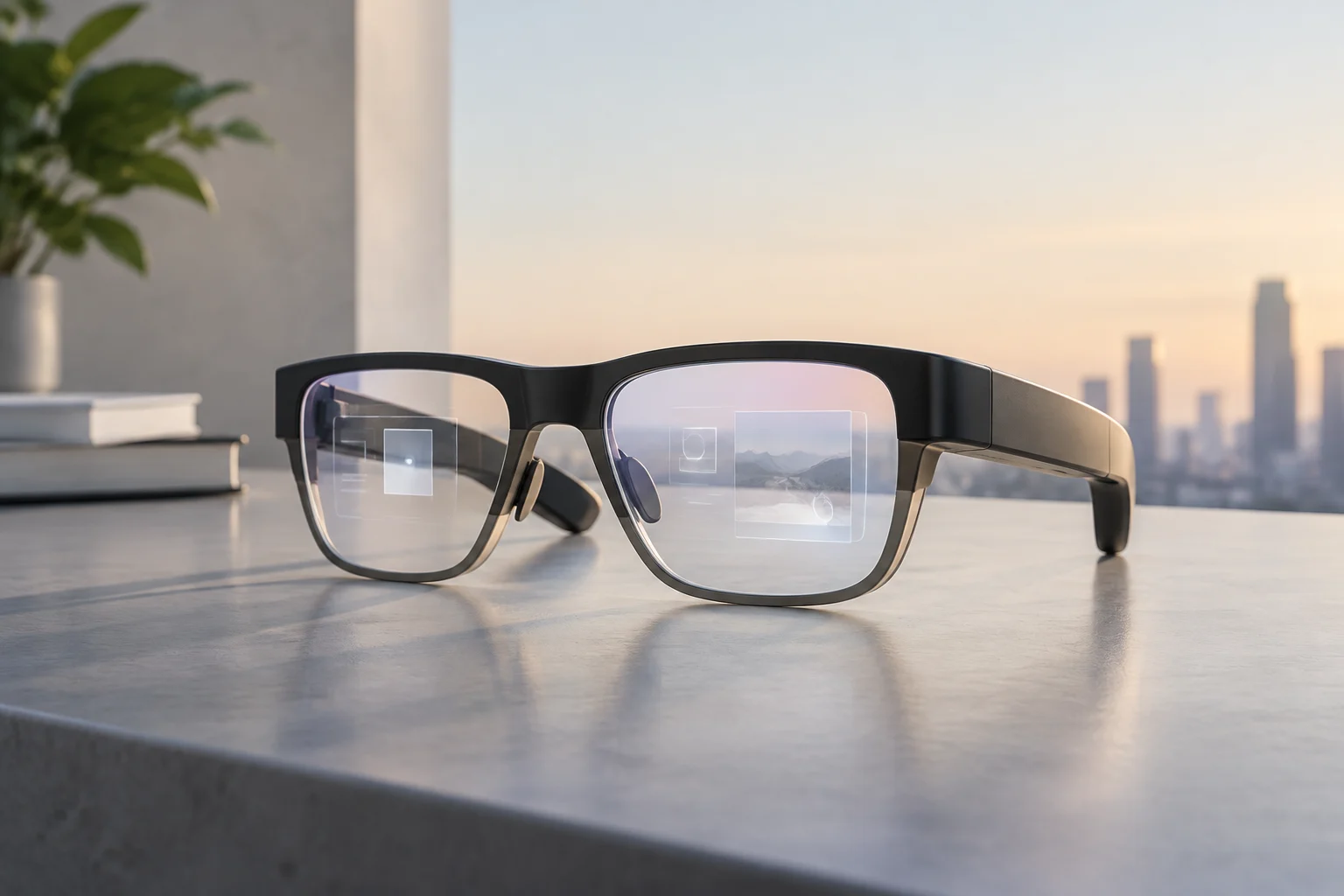
Snap introduced SPECS on June 16, 2026, during Augmented World Expo. The company describes them as augmented-reality glasses that combine digital information and experiences with the physical environment. They are not simply conventional glasses with a camera or assistant: the concept includes a transparent display that overlays content in the wearer’s field of view. The announcement is official, but it is not the same as a complete technical specification or an independent product evaluation. The date matters: this was an announcement in June, not breaking news today.
Snap positions the device around AI assistance, work tools, entertainment and shared experiences. These are uses proposed by the company, not a list of capabilities tested under everyday conditions. Launch coverage also describes a standalone product, with no external computing unit; even so, that description does not establish battery life, sustained performance or the quality of the experiences.
For anyone considering glasses of this kind, the practical distinction is between the product category and its promises and the information needed to judge comfort, readability, privacy and real-world usefulness. The announcement confirms that Snap wants to go beyond its developer-focused glasses; it does not yet show that Specs can replace a phone or conventional glasses.
Display, processors and published specifications
Snap describes a transparent waveguide display with a 51-degree field of view and 16 million colours. The presale listing adds that the system uses two Snapdragon processors, but does not identify the exact model or provide a complete list of memory, storage or performance specifications. When considering a purchase, “Snapdragon XR” should not be read as the confirmed name of a particular chip inside these glasses: the Qualcomm agreement disclosed so far concerns Snapdragon XR platforms for future generations of Specs.
The 51-degree figure helps explain the advertised visual space, but is not enough to predict the experience. Details such as resolution, brightness, refresh rate and how the image performs in different lighting conditions are still missing. Independent coverage has also noted these gaps. A wider field of view does not measure sharpness, and colour figures alone do not establish accuracy, contrast or reading comfort.
The product page lists two sizes: 47 mm, with a stated weight of 132 g, and 52 mm, at 136 g. It also mentions electrochromic lenses that shift from clear to tinted in about ten seconds, voice and gesture controls, and prescription lenses that can be customised through an external partner. These are specifications stated by Specs’ own product page, not the results of independent testing. Prescription support also does not necessarily mean every prescription or market is covered.
AI and audio: promises versus confirmations
AI is central to Snap’s positioning: the company presents Specs as a way to access contextual assistance while keeping attention on the surroundings. When Qualcomm announced its agreement with Specs Inc., it also referred to on-device AI processing and context-aware experiences. This supports the view that on-device AI is part of the announced technology direction, but it does not provide a detailed description of every feature available to buyers or its connectivity requirements.
The sources consulted do not provide enough official detail to confirm which assistant will respond, which tasks will work offline, what data will be processed locally or how long software support will last. Nor is there a sufficiently detailed official technical specification to verify a specific spatial-audio feature. The feature should therefore not be presented as confirmed simply because it appears in editorial framing or third-party comments: documentation describing the system and how it works is needed.
The useful approach for buyers is to treat “AI” as a broad category, not a guarantee that every interaction will be fast, private or autonomous. Before paying, look for demonstrations of specific features, connectivity requirements, privacy controls and usage limits. Without those details, the AI capabilities remain underspecified for comparing the device on the basis of real tasks.
Price, presale and availability
The Specs product page lists a starting price of €2,295 and an estimated shipping window beginning in autumn 2026. US launch coverage, by contrast, reported a price of $2,195 and a reservation requiring a refundable $200 deposit. These are prices in different markets and should not be converted or combined as though they were one global price. The available product page is also not enough to determine taxes, shipping costs or final terms in each country.
A presale and an estimated shipping date do not mean the product is immediately available. Specs’ published information points to shipments starting in autumn, while a later article reported a launch event scheduled for September 16, 2026, and retained the autumn shipping window. No specific delivery date is confirmed here, nor is today’s inventory status, so interested buyers should check the product page and terms that apply in their market before placing a deposit.
There is also a difference between a “starting at” price and the total cost: size, optional connectivity, prescription lenses, taxes and accessories may all affect it. The listing mentions an optional Wi-Fi-plus-cellular connection through a 5G-compatible case, but the available information does not specify its price or regional availability. It is unwise to budget for extras until final prices and terms are published for the relevant market.
What to compare with previous generations
Snap presents Specs as a step toward a consumer device, unlike earlier Spectacles generations associated with developing augmented-reality experiences. Press coverage describes the new product as standalone and mentions Snapdragon processors, while the company emphasises everyday use. The main change is in positioning: these are not only glasses for creating or testing experiences, but a product Snap wants to sell to general buyers.
That does not, by itself, demonstrate a verifiable improvement over an earlier model. A meaningful generational comparison requires consistent data on weight, battery life, field of view, resolution, brightness, controls, compatibility, support and price in the same market. The available information includes some details about the new generation, but no complete official table comparing all those dimensions. We do not attribute numerical advantages that have not been documented.
Specs also differ from smart glasses without an augmented-reality display: the idea here is to show digital elements in the wearer’s field of view, potentially enabling navigation or contextual information, while adding trade-offs in weight, battery life, visibility and privacy. The categories are not interchangeable with audio or camera glasses. The choice depends on whether visual overlays offer a feature the buyer will genuinely use and whether they accept the cost and unresolved questions.
What to check before deciding
Based on current public information, Specs are worth following if you are looking for standalone augmented reality, but there still is not enough information to recommend an unconditional purchase. The high price and missing key specifications make it especially important to wait for full demonstrations and reviews. The prudent choice is not to mistake a presale for an evaluated product: a reservation may secure access, but does not remove uncertainty about performance and comfort.
Before buying, check four points on the product page for your market:
- Optical specifications: resolution, brightness, refresh rate and outdoor display performance.
- Battery life and connectivity: real-world usage time, network requirements and the cost of any cellular accessory.
- AI and privacy: specific features, local or remote processing, permissions and available controls.
- Total cost and support: taxes, prescription lenses, return policy, warranty and confirmed delivery date.
The known information confirms a specific proposition—AR glasses with a waveguide display, two sizes, Snapdragon processors and a platform designed with AI in mind—but leaves major factors for assessing value unresolved. Until Snap publishes a fuller specification and independent testing is available, a purchase relies more on the promise of the experience than on verifiable results.