What UCIe Is and Why Version 3.0 Matters
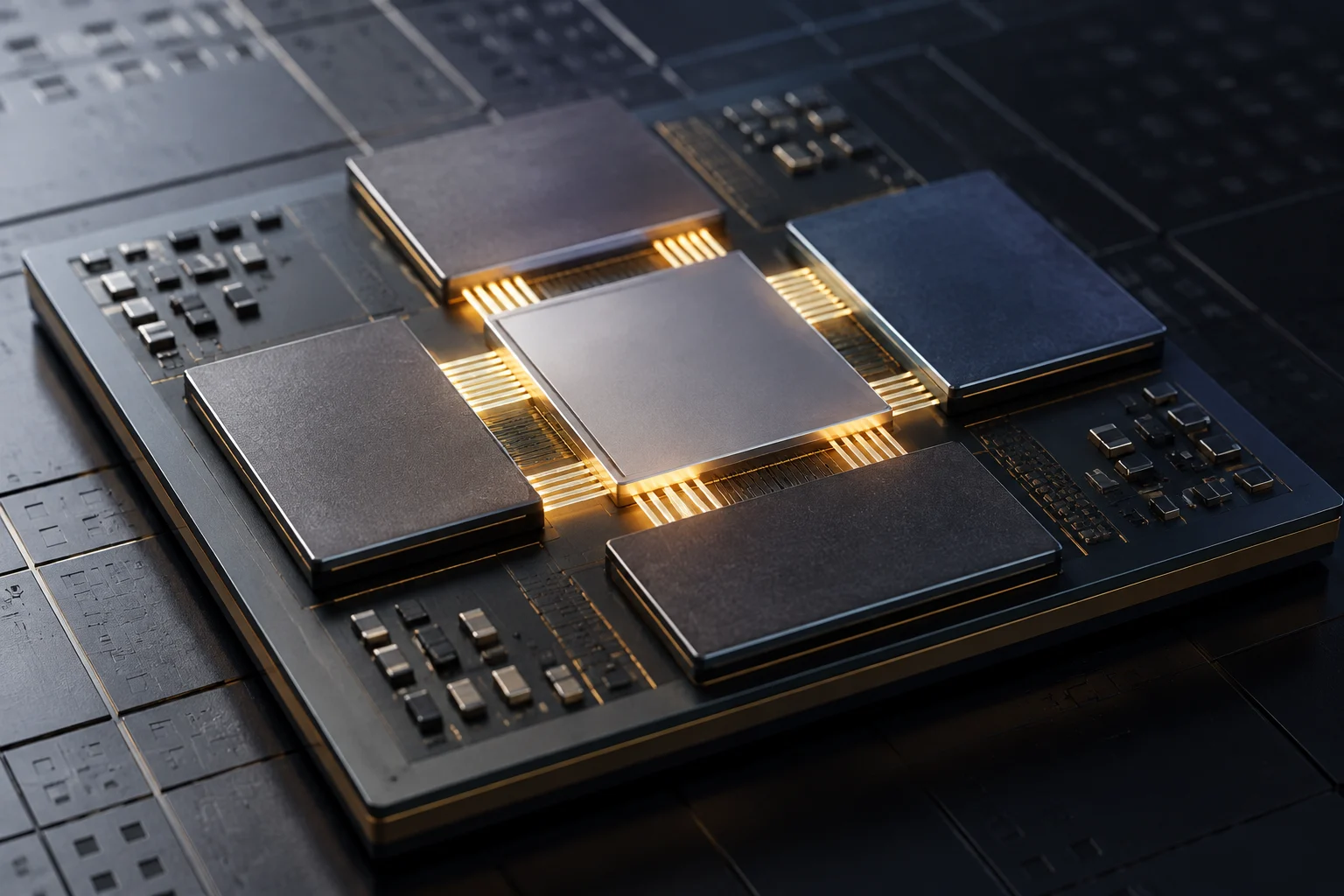
Universal Chiplet Interconnect Express, or UCIe, is an open standard for interconnecting chiplets within the same package. Its purpose is not to define an entire processor or communications system, but to establish common rules for connections between dies. It covers the input/output physical layer, die-to-die protocols, and a software stack that uses technologies such as PCI Express and Compute Express Link.
The UCIe 3.0 specification was published on August 5, 2025. It is therefore not a recent announcement: the question now is what it offers designs considering a higher-speed interconnect, and which integration work remains each manufacturer’s responsibility. The consortium presents this evolution as a way to expand bandwidth and improve link management, not as an automatic solution to every challenge in a multi-chip system.
The motivation for using chiplets is to divide a complex design into specialized dies that are then integrated into a package. In principle, this makes it possible to choose different manufacturing processes for blocks with different requirements and to overcome certain limits of integrating everything on a single die. Modularity does not remove complexity: it shifts some of the work to interface design, packaging, and validation of the complete system. UCIe aims to standardize one specific part of that work: communication between chiplets.
What Changes in UCIe 3.0
The most visible change is the transfer rates specified for UCIe 3.0: 48 and 64 GT/s. This figure represents transfers per second, not a direct measure of application performance or a guaranteed rate of useful data. Effective throughput also depends, among other factors, on the number of connections, encoding, and implementation characteristics.
The specification adds recalibration while the link is operating, a function intended to adjust its parameters while the system is running. The aim is to help maintain the link’s electrical behavior and manage its power consumption; this is not a promise of a specific energy saving. Quantifying the effect would require data from a particular implementation and workload, which the available sources do not provide.
The available reporting also describes greater reach for the sideband channel, used for control and management signals, along with additional management functions. The auxiliary channel and the main link have different roles: extending sideband reach may provide more flexibility in certain configurations, but does not itself increase the main data bandwidth. A reach of up to 100 mm appears in secondary technical coverage; the linked official documentation presents specifications, but does not allow the full normative detail to be verified here.
Some descriptions of UCIe 3.0 also mention a raw mode, which allows data to be transported without using the full functionality of the die-to-die adapter layer. This should be treated as a design option, not as a guaranteed latency reduction in every system: the result would depend on the protocol and how each device uses it. The available sources offer no comparative latency measurements that would make it possible to translate this feature into a quantified improvement.
What the Standard Covers—and What It Does Not
The consortium describes UCIe as a specification covering the physical interface, die-to-die protocols, and software stack. It also includes compliance testing and architectural elements intended to facilitate interoperability. This gives designers shared rules for connecting components; it does not mean that any compatible chiplet can be combined without adjustments in any package or system.
The practical distinction is between interface compatibility and product compatibility. The standard can define how two dies communicate and which aspects are subject to verification, but it does not determine what functions each chiplet provides, how tasks are divided, or what performance the system will achieve. Integration still requires teams to agree on configurations, electrical characteristics, protocols in use, and validation requirements.
UCIe does not set manufacturing costs or guarantee a particular level of thermal efficiency either. The outcome depends on die design, substrate, packaging technology, power delivery, cooling, and other elements. A maximum link rate is not a system-performance figure: a switch or network processor may be limited by its compute blocks, memory, architecture, or software even when its interconnect supports a high rate.
When assessing a UCIe-based proposal, it is worth asking for more than the GT/s figure. Useful questions include: which specific link configuration is implemented; which protocols and management mechanisms are used; which interoperability tests have been completed; and what power, temperature, and performance results have been measured in the final package. Without that information, the standard describes connection possibilities, not the verifiable behavior of the product.
What It Could Mean for Communications Equipment
In network processors, switches, and accelerators, an interconnect between chiplets can provide a way to integrate different functional blocks in the same package. UCIe supplies a common framework for die-to-die communication, but does not by itself demonstrate an improvement in telecommunications equipment. The sources consulted do not present tests of specific network products based on UCIe 3.0 or latency or throughput figures for that use case.
The potential value for a designer lies in being able to evaluate a modular architecture without having to define every aspect of the interface between dies from scratch. Even so, the benefit depends on compatible chiplets being available for the required functions, and on the package being able to support the electrical and thermal demands of the complete system. The standard can reduce some integration work; it cannot replace system engineering.
For latency-sensitive applications, it is especially important not to confuse link speed with end-to-end latency. The latter includes the path through adapters, protocols, and processing blocks. Likewise, a higher transfer rate does not guarantee lower power consumption: it may change the energy balance, but determining whether it improves it requires comparing implementations under equivalent conditions.
The practical decision for a communications team, then, is not to adopt UCIe 3.0 simply because it offers a higher figure. It is worth first checking whether the architecture needs multiple dies, whether suitable IP and components are available, and whether packaging and validation can meet the project schedule. Without those elements, the specification is a design option, not an already realized product advantage.

Industry Adoption: Signals and Limits of the Evidence
Publication of a specification shows that a common definition exists; it does not show that commercial products using it have been deployed. Available industry coverage indicates that adoption of UCIe 3.0 may be gradual. It also notes that companies in the sector participate in the consortium, but membership is not confirmation of a compatible product and does not demonstrate interoperability among implementations from different suppliers.
There are signs of activity across the ecosystem. Synopsys, for example, has published information about IP solutions related to UCIe 3.0. That announcement is an indication that design tools are available, but it is not enough to claim that a specific chip has completed validation, manufacturing, or commercial deployment. The difference between an IP offering and a finished product matters when assessing actual maturity.
Advanced packaging is also part of the equation. The interconnect may rely on 2.5D or 3D configurations, each of which brings manufacturing, integration, and testing requirements. Without comparable data on cost, manufacturing yield, and available capacity, it is not possible to attribute a general cost reduction to UCIe 3.0 or to claim that packaging has already ceased to be a constraint.
To track maturity carefully, it is useful to look for evidence at several levels: publication of the specification, IP availability, announcements of specific designs, compliance-test results, and, finally, manufactured products. Each stage answers a different question. The existence of the standard explains how chiplets are intended to connect; commercial availability and performance require additional evidence that the specification alone does not establish.
Conclusion: How to Read the UCIe 3.0 Promise
UCIe 3.0 expands the options for a standardized chiplet interconnect and adds functions aimed at link management. Its publication in 2025 and the announced rates of up to 64 GT/s are relevant information for assessing new designs, but they do not in themselves amount to a performance result or a guarantee of lower power consumption.
For engineers and product managers, the useful conclusion is to distinguish specified capability from measured results. The standard provides a common foundation for the interface; final performance depends on implementation, connected components, and the package. Before adopting an architecture, teams should ask for the specifications of the exact configuration and validation data under the intended operating conditions.
In communications, UCIe’s value lies in enabling modular integration options, not in guaranteeing that future switches or network processors will be faster or more efficient. The reasonable approach is to treat it as a design tool whose value must be demonstrated through system, interoperability, and manufacturing tests. Standardization is a useful step; it does not replace product validation.