What available sources allow asserting
A claim about a graphics card can refer to different things: the architecture declared by the manufacturer, performance in a game, the existence of units in stores, or the price a buyer pays. These are not the same type of data and they are not verified with the same source. A product page can confirm announced features, but it cannot by itself demonstrate how the card behaves under real conditions or how much inventory remains in a country.
The material gathered for this analysis contains official pages from NVIDIA and Intel, as well as articles from retailers and tech media. For example, NVIDIA presents the GeForce RTX 50 series as based on Blackwell and describes hardware and software features; Intel documents its XeSS technology family. These pages support what each company declares, not an independent comparison between manufacturers. Third-party guides and news can guide research, although their conclusions need dates, methods, and traceable data before being used as market evidence.
It also matters when each source was published. A guide dated May 2026 or a news item updated during that year does not by itself constitute a complete record of the market as of October 18, 2026. And a page being recently updated does not necessarily mean all its data has been re-verified. The publication date, update date, and observation date must be distinguished; without that separation, an old figure may appear current.
Official documentation: useful for features, limited for results
Manufacturer documentation is the appropriate reference for identifying product names, architecture, and technologies the company claims to support. NVIDIA describes its RTX 50 series with Blackwell, fifth-generation Tensor cores, and features like DLSS; Intel lists XeSS Super Resolution, frame generation, and Xe Low Latency. This accredits announced characteristics, not that all are available in every model, game, driver version, or configuration without checking specific compatibility.
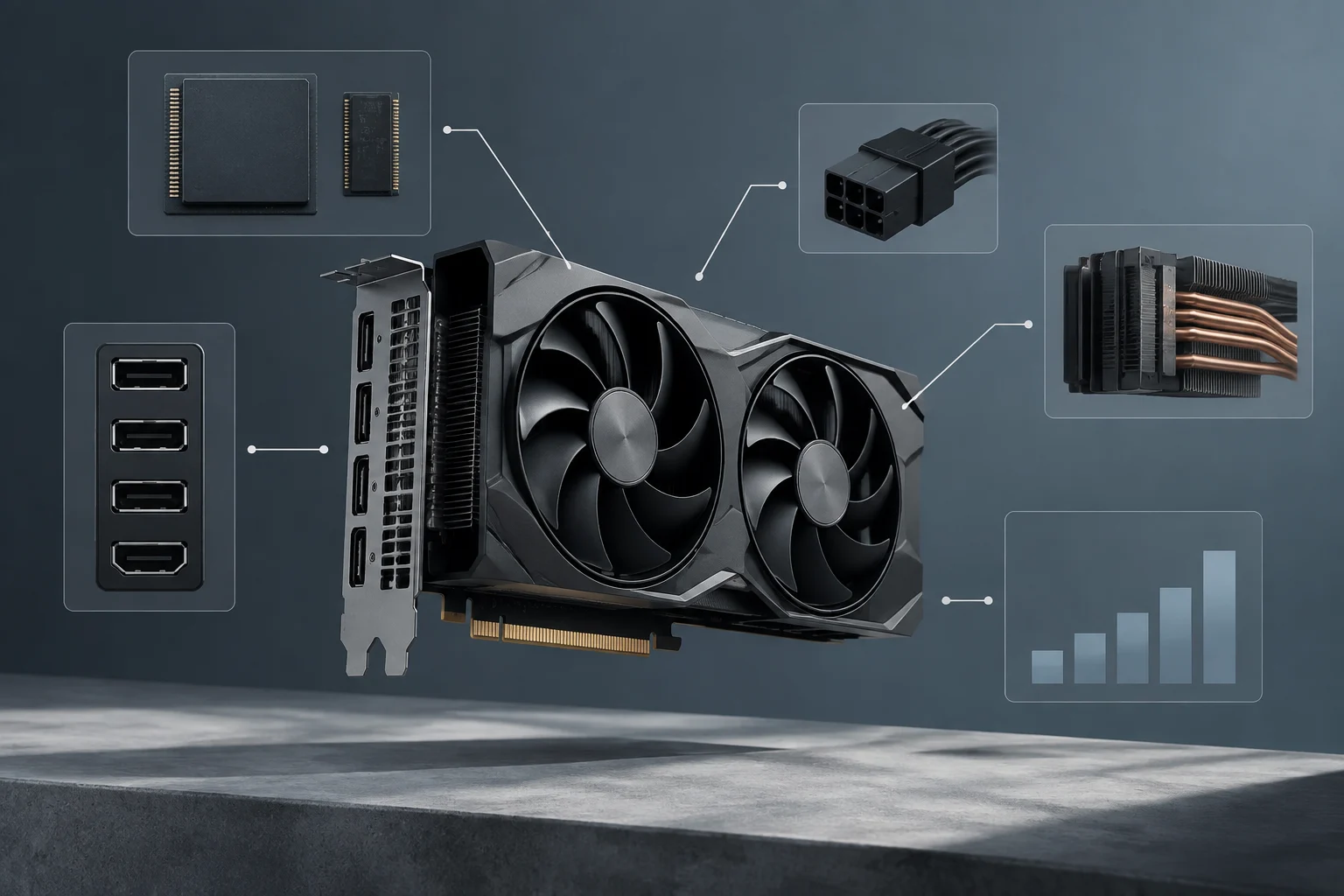
A technical sheet can serve to cross-check declared data, such as memory, connectors, or compatibility, provided the page corresponds to the exact model. Knowing the name of a family is not enough: specifications can vary between models and assemblers. The buyer should contrast the official sheet of the specific product with the sheet of the commercial card manufacturer, because a GPU family does not by itself determine the dimensions, cooling, power consumption, or video outputs of each board.
The same caution applies to promotional language. Expressions like “faster” or “better performance” are only comparable if it is known against which product, with which application, resolution, graphic quality, and settings. The NVIDIA page includes comparisons relative to specific games and conditions; they should not become a universal ranking. A specification answers what the product declares; a test answers how it performed in a defined scenario.
What is needed to compare performance
To sustain a performance comparison, independent measurements with a reproducible protocol are required. In games, the result depends on the title and its version, resolution, settings, processor, system memory, driver, and enabled features. Publishing only a frames-per-second figure does not allow knowing if two cards were tested under equivalent conditions. The measurement context is part of the data.
A useful review must identify the test equipment, software, and methodology; include more than one workload when the conclusion intends to be general, and clarify if the result comes from native rendering or from reconstruction and frame generation features. The latter can change the displayed figure, so it is incorrect to present the total generated frames without explanation as if equivalent to those rendered by the GPU.
The Geeknetic article indicates that its buying guides rely on reviews and tests, but the news page included in the material does not offer a homogeneous set of results for all 2026 cards. Buying lists from other sites do not replace a common methodology either. For the reader, the practical decision is simple: look for tests of the exact model, the usage of interest, and published conditions; if the media does not explain how it measured, treat the conclusion as indicative, not as a conclusive comparison.
Availability and prices: data with date and place
A manufacturer announcing a model does not confirm it is available to buy in a specific store. Availability is a localized commercial observation: it depends on the country, seller, variant, and moment. To document it, one must register a verifiable offer, its stock status, and when it was consulted. A news item about scarcity is not equivalent to a store census.
In the received material, a HardZone news item mentions the disappearance of the RTX 5090 from stores and rumors about the end of its production. The formulation itself distinguishes a report and rumors; it does not prove the model has disappeared from all shops nor confirms a manufacturer decision. Therefore, it is not valid to present that content as general proof of supply problems. To assert something more specific, one would have to check identifiable stores and distributors, in specific markets, and on a given date.
Price requires the same discipline. A useful figure must specify currency, market, seller, variant, product condition, and observation date; shipping, taxes, or a promotional offer can alter the comparison. Without those details, the price is not a reproducible reference. Guides incorporating prices can help locate offers, but the reader must verify the current announcement before making a purchase decision.

How to read a claim about a GPU
The most practical way to evaluate a claim is to first separate its object. If it deals with architecture or compatibility, it is advisable to go to the official documentation of the responsible company. If it asserts superiority in performance, comparable independent tests are needed. If it claims availability or price, it must lead to an identifiable seller and indicate when it was checked. The correct source depends on the specific question.
Before accepting a recommendation, check these points:
- Exact model: distinguish the GPU from the complete card and its commercial variants.
- Scenario: identify game or application, resolution, settings, and enabled features.
- Method: look for test equipment, driver version, and reproducible results.
- Market and date: verify seller, currency, inventory, and consultation time.
- Scope: separate what the manufacturer declares from what is measured by third parties.
This list also avoids confusing a technology with a guarantee of result. A card supporting a feature does not prove all programs use it, that the experience improves equally in each case, or that the improvement compensates the cost. Compatibility is a technical fact that can be documented; the benefit for a user depends on usage and must be evaluated with pertinent tests.
Conclusion: what is missing for a market analysis
With the gathered sources, part of the technological offer announced by manufacturers can be described, but a general conclusion on relative performance, prices, or availability of GPUs in 2026 cannot be sustained. The NVIDIA page supports data for its RTX 50 series and Intel documentation describes technologies of its platform; neither constitutes an independent market study. The limit is evidentiary, not an assertion that products or data are missing across the sector.
To build a defensible market analysis, one would have to gather official sheets per model, independent tests with transparent methodology, and dated commercial observations for a defined market. It would also be advisable to limit the question: for example, compare cards for a specific resolution and set of applications, or document prices offered in Spain during a certain period. That scope allows answering something useful without extrapolating isolated results to the whole category.
The editorial decision and the buyer's coincide in one principle: not to turn the lack of gathered evidence into an assertion about the entire market. To choose a card, use manufacturer documentation to confirm features and an independent review to value performance; then, check offer and price directly with the seller. Each conclusion must carry the type of proof that can actually support it.