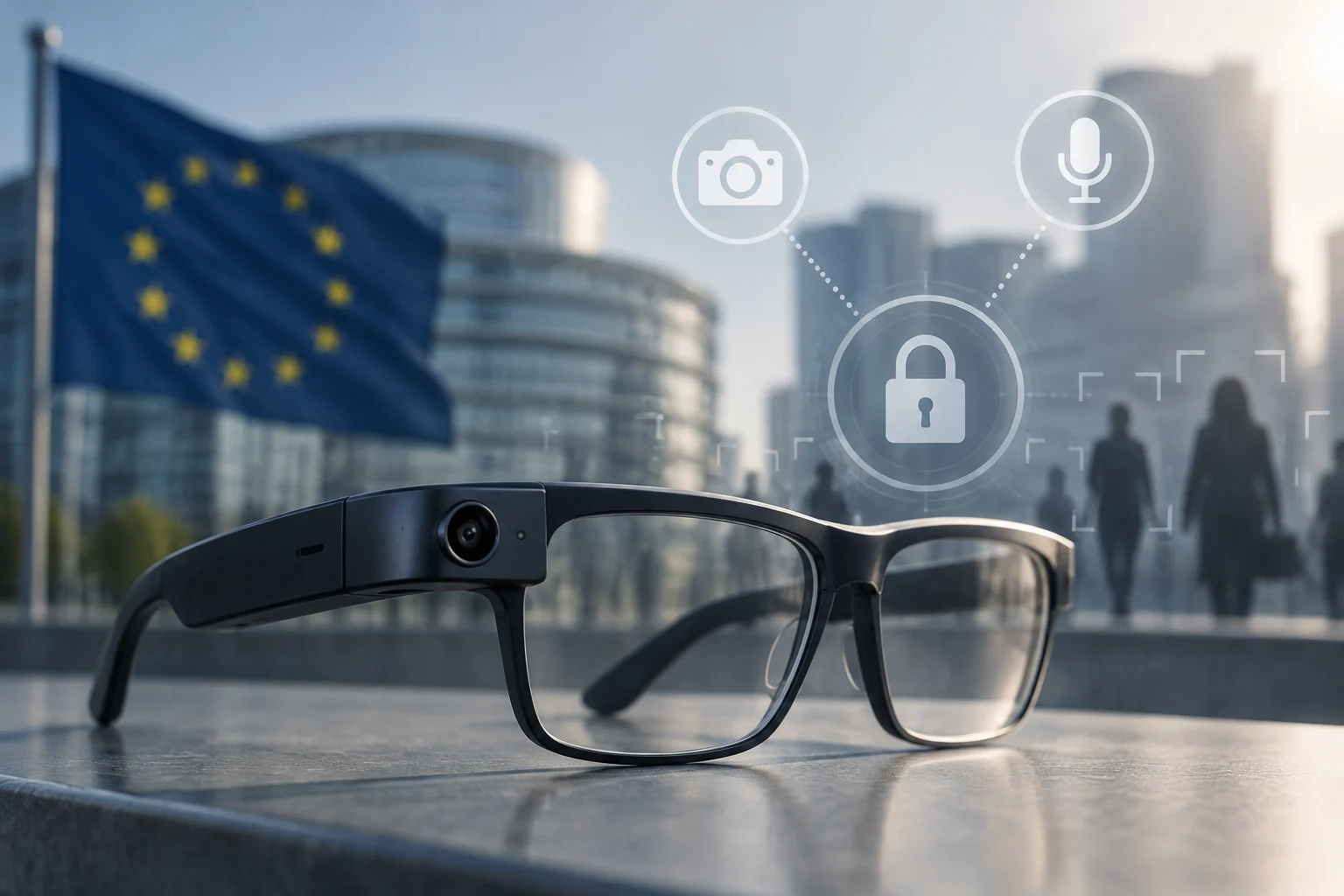
A regulatory milestone for wearable devices
On 13 October 2026, the European Data Protection Board (EDPB) adopted an official statement on smart glasses. The document marks a turning point by explicitly addressing how these wearable devices, which combine cameras, microphones and artificial intelligence systems, affect the protection of personal data under the GDPR framework.
The initiative is not a binding rule, but a set of preliminary reflections intended to guide manufacturers, users and supervisory authorities. Its significance lies in the fact that this is the first time the European coordination body has devoted a specific document to this category of hardware, recognising its ability to process information in ways that data subjects may neither notice nor control.
Definition and scope of smart glasses
The EDPB defines smart glasses as wearable devices that usually resemble sunglasses or prescription glasses but incorporate computing capabilities. These include cameras, speakers and microphones, as well as software with AI systems for functions such as real-time translation or object identification.
These devices can connect to the internet, other external devices or mobile applications to extend their functionality. They may be operated using voice commands or other input technologies, such as wristbands that detect hand gestures. This broad definition covers everything from mass-market models to more specialised devices, establishing a clear perimeter for the application of privacy rules.
Specific risks and use cases
The statement identifies several common use cases that create privacy risks: listening to music, making calls, taking photographs or recording video, accessing real-time translation services and broadcasting live. Some models also offer augmented reality experiences by displaying information to the user.
The central risk identified is the unintentional capture of data about third parties. When the glasses capture, collect, record, adapt, store or process any information relating to an identified or identifiable person, they are processing personal data. The GDPR therefore applies, except in the exceptional cases provided for in Article 2(2), such as processing by a natural person in the course of a purely personal or household activity.
Context: the AEPD and technological innovation
In Spain, the Spanish Data Protection Agency (AEPD) has maintained an active agenda on innovation and technology. Its news page, last updated on 2 October 2026, reflects growing attention to artificial intelligence, neurodata and video games. This line of work complements the EDPB statement, showing convergence between European regulation and national supervision.
The AEPD has recently published documents on offensive AI and its data protection risks, as well as recommendations for using video cameras in the homes of older people. These efforts show that supervisory authorities are anticipating the challenges raised by emerging technologies, including wearable devices that capture data in public and private spaces.
Implications for manufacturers and users
For manufacturers, the EDPB statement serves as guidance for proactive compliance. Although it does not impose direct penalties, it sets clear expectations around transparency, data minimisation and security. Companies designing smart glasses will need to consider these principles from the design stage (privacy by design) to avoid future penalties or having their products withdrawn from the market.
For users, the document provides a basis for demanding greater transparency and control. The ability of glasses to record audio and video in public spaces raises ethical and legal dilemmas that the statement helps clarify. Users should be aware that using these devices can affect other people’s privacy, not only their own.
Outlook and European coordination
Adopting this statement reinforces the EDPB’s role as coordinator of supervision in the EU. By issuing a unified position, it reduces regulatory fragmentation and helps ensure consistent application of the GDPR across all Member States. This is crucial for devices sold and used throughout the European single market.
The statement is expected to provide a basis for more detailed future guidance, or even a review of the rules if the technology evolves significantly. Coordination between the EDPB and national authorities, such as the AEPD, will be key to adapting regulation to the new challenges posed by smart glasses and other wearable devices with AI capabilities.