The steepest annual decline since 2013
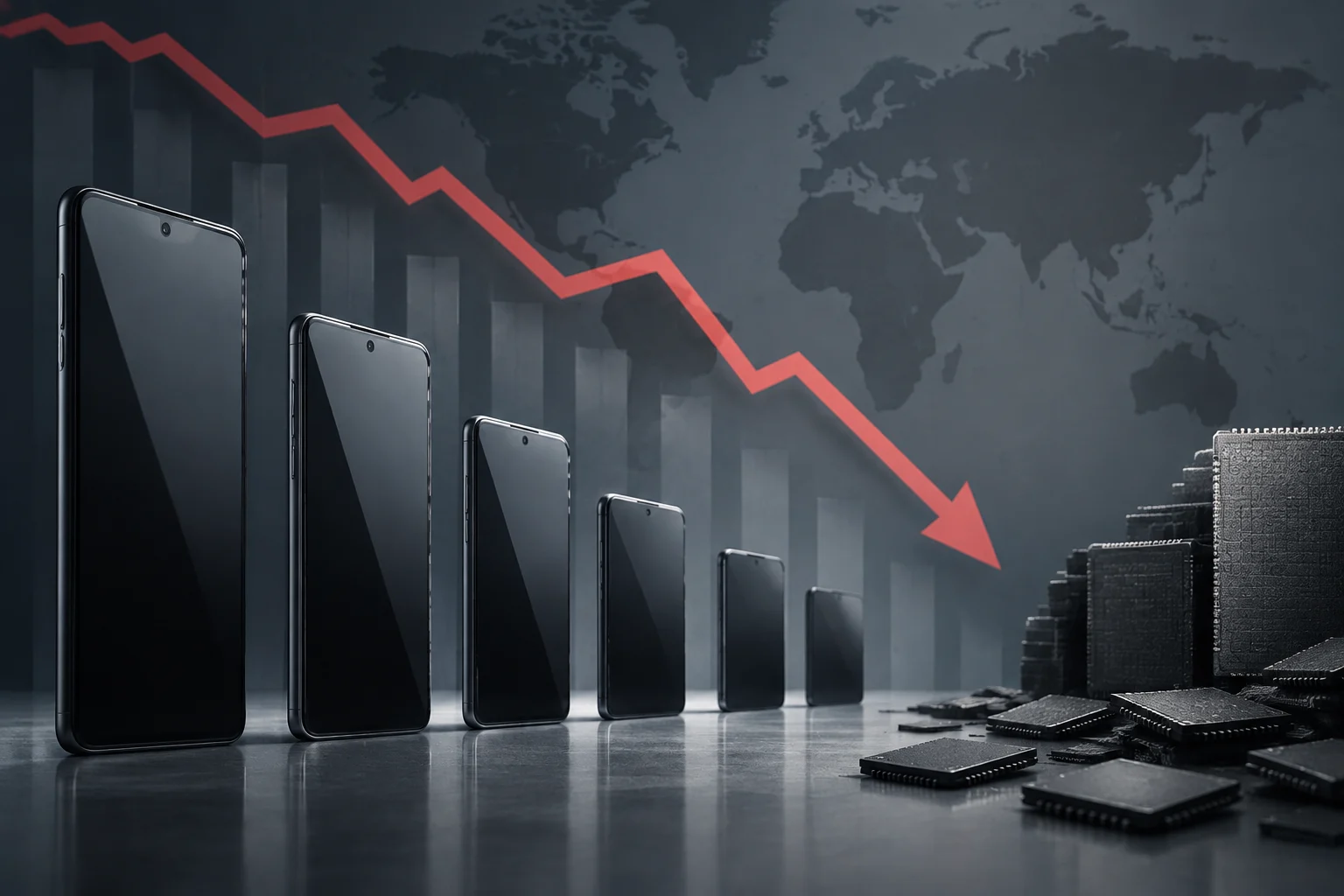
The global smartphone market is facing its sharpest contraction in more than a decade. According to the latest update from Counterpoint Research, worldwide shipments will fall 14.3% year over year in 2026, to around 1.08 billion units. This is worse than the initial February forecast, which estimated a 12.4% decline, and confirms that the structural adjustment is deeper than anticipated.
Omdia offers a slightly different but consistent outlook: it projects a 12% drop in volume, to 1.097 billion units. Yet total market value will grow 12% to $651.6 billion, driven by a 27% increase in average selling prices. Volume is falling while spending per device is rising, marking a shift in the sector’s economics.
The memory crisis is driving the adjustment
The decisive factor is not demand but supply. Manufacturing capacity has been reassigned from DRAM to HBM memory for artificial intelligence, creating a critical shortage of LPDDR4/5. According to Counterpoint data, memory prices tripled in the second quarter of 2026 compared with the fourth quarter of 2025. In entry-level devices, memory already accounts for more than 65% of total manufacturing costs, making production unviable for many manufacturers.
This pressure has forced brands to pass costs on to consumers. Retail prices have risen steadily since the final quarter of 2025. In the under-$150 segment, supply has shrunk sharply, with LPDDR4 memory availability down by more than 40%. For consumers, this means cheap phones are disappearing from emerging markets, pushing buyers toward higher price brackets.
Samsung regains global leadership
Amid the turmoil, Samsung has managed to reclaim the number-one position worldwide. In the second quarter of 2026, the Korean brand captured 23% of the market, growing 9% year over year while the market overall declined. Its advantage lies in a robust supply chain and a broad portfolio, allowing it to defend volumes without excessively sacrificing margins.
Apple has also shown notable resilience, reaching its highest-ever second-quarter share, at 21% of the market. The iPhone 17 series and consumers’ concern about future price increases have supported sales. By contrast, major Chinese brands such as Xiaomi, OPPO and vivo face declines of between 15% and 34%, reflecting their greater exposure to low-priced devices and emerging markets that are more sensitive to inflation.
Regional divergence and market segmentation
The crisis is not affecting every region in the same way. North America was the only region to record growth, up 6% year over year, thanks to high premium-market penetration and carrier financing. Western Europe was broadly stable, with a minimal 1% decline. Southeast Asia, India, the Middle East and Africa, by contrast, are suffering double-digit declines, with affordability the main constraint.
The market is being reshaped toward premium products. The share of models priced below $200 will fall from 40.6% in 2025 to 25.6% in 2027. At the same time, devices priced above $800 will expand their share from 21.1% to 28.4%. The market is splitting in two: a resilient premium segment and a mass-market segment contracting at an accelerating pace.
Recovery outlook
Analysts do not expect an immediate improvement. Counterpoint estimates that the contraction will continue into 2027, with a further 1.4% decline. A meaningful recovery is not expected to begin until 2028, when the commercialization of 6G networks is expected to boost demand and cost pressures to stabilize. By then, the market could return to the shipment volumes seen in 2024–2025.
For consumers, the practical lesson is clear: replacement cycles are lengthening and entry prices are higher. Availability is limited and prices have risen for those seeking a mid-range device. Manufacturers are now focused on profitability per unit, rather than gaining market share at any cost. The era of the cheap phone as a global commodity is over, at least until the next technological decade.