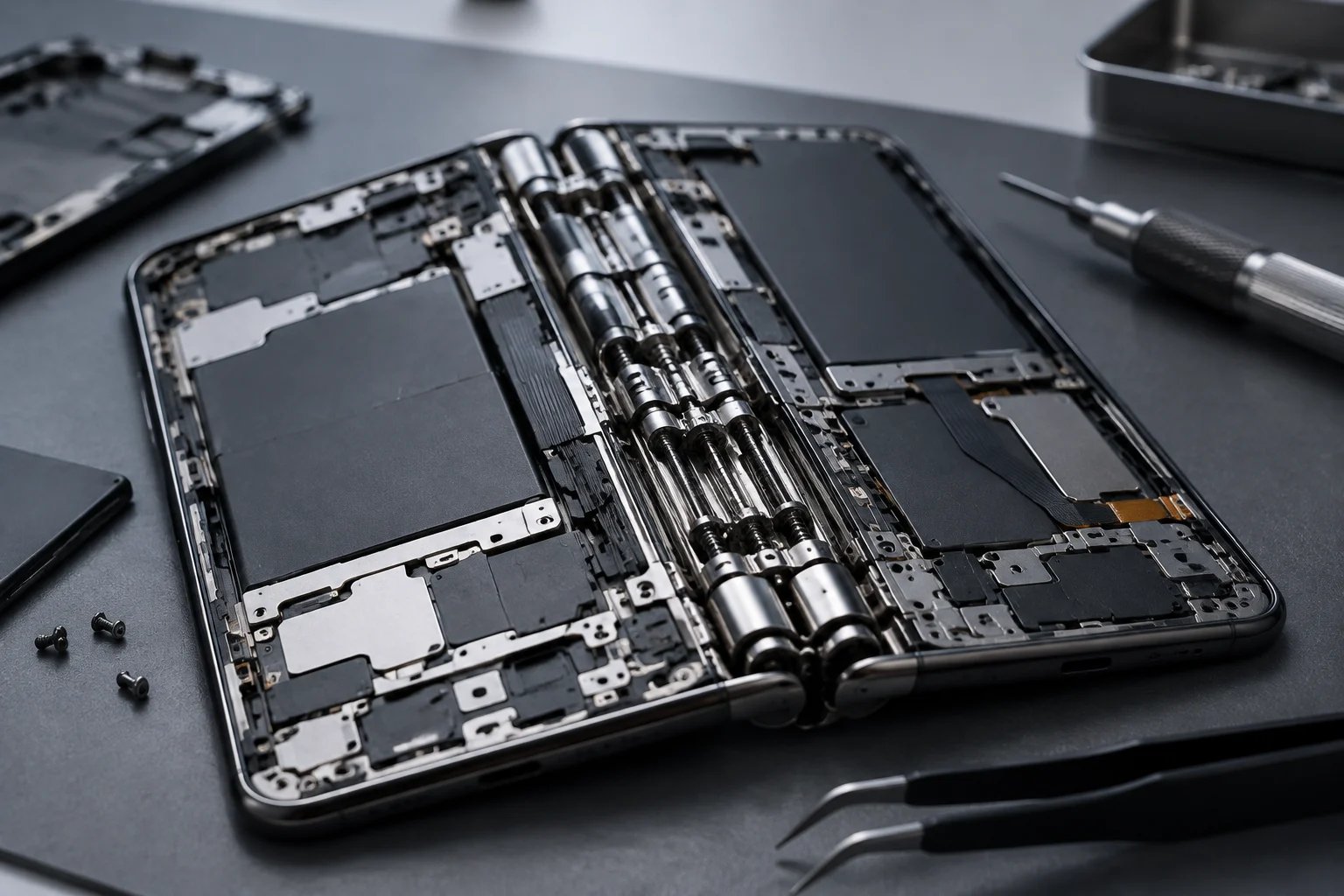
A teardown offers clues, not a verdict on all foldables
Public information about the Galaxy Z Fold8 includes an iFixit teardown and a bend test covered by 9to5Google. These are different kinds of material: the teardown lets readers observe internal parts of the unit examined, while the test describes how one sample responded during a specific demonstration. They are not equivalent tests and should not be presented as a single assessment. (iFixit; 9to5Google )
The distinction matters when considering a purchase. An observation of the interior is not a certification, and the result of a one-off test does not establish how other units will respond or what may happen after months of use. Neither publication provides a representative failure rate for the model. Conclusions should be limited to what was described and shown, without extrapolating to the entire product line.
The bend test: what the result describes—and what it leaves out
9to5Google reports that the Galaxy Z Fold8 shown survived the bend test featured in its article. The result applies to that demonstration and the unit subjected to it; it does not guarantee that the phone will withstand every kind of pressure, impact or accident. The coverage does not present a standardized protocol or results from multiple units that would make it possible to treat the test as a comparable laboratory measurement. (9to5Google )
A bend test does not automatically measure other aspects of durability, such as repeated opening cycles, particle ingress or exposure to moisture. Those are different conditions and require specific tests. Without a detailed protocol and repeated trials, the result should be understood as a particular demonstration, not as a prediction of service life or a guarantee against damage during normal use.
What the teardown contributes, and how to interpret its observations
iFixit published a teardown of the Galaxy Z Fold8 and raised a question related to the hinge. That is a relevant observation for examining the internal design, but it does not replace accumulated failure data from users or, on its own, determine the probability that a particular unit will develop a fault. (iFixit )
Separately, 9to5Google highlights the use of titanium in the inner display assembly and comments on the placement of the Qi wireless-charging coil. These are details about materials and internal layout; the comment about the coil is an editorial assessment, not a documented measurement of charging performance. The observations describe the unit examined, but are not enough to claim that all units behave the same way or to quantify the durability of the assembly. (9to5Google )
It is useful to distinguish three levels: what can be seen when the phone is opened, the interpretation offered by the outlet publishing the teardown, and what would require a repeatable measurement. A visible component does not, by itself, reveal its service life or the practical effect of its position. A teardown allows more precise questions to be asked; it does not answer them all.
What cannot be concluded about the hinge and display
Neither the bend test described by 9to5Google nor a teardown of one device establishes how many cycles the hinge can withstand, how the display changes over time, or how resistant the phone is to dust and moisture. They also provide neither an average service life nor a failure rate. Surviving a bend-test demonstration does not prove immunity to other kinds of damage. (9to5Google; iFixit )
iFixit’s headline points to a hinge-related problem, but its coverage does not allow that observation to be turned into a statistical estimate of failures. Claims about long-term wear would require cyclic-use testing, clear criteria for identifying a fault and data from more than one unit. An internal inspection also does not, on its own, prove that particles cause a failure or allow conclusions about the display’s long-term behavior.
A cautious reading does not diminish the value of these reports; it places them within their proper scope. They describe specific observations and can help guide further checks, but they do not replace long-term testing or service records. Based on the cited evidence, the Fold8’s general day-to-day reliability has not been quantified.
Repairability: what is visible is not enough to assess a repair
Opening a phone can reveal how its components are arranged, but assessing repairability requires more information: service procedures, adhesives, connectors, parts availability, and the steps needed to replace the display or hinge. The iFixit teardown helps readers understand the interior and discuss the design; on its own, it cannot calculate repair costs or characterize the phone’s overall practical repairability. (iFixit )
Replacement-part prices, availability by market and official service documentation specific to the Fold8 have not been verified here. It is therefore not possible to estimate potential costs from the bend test or a visual inspection. The absence of those data does not prove that the phone is easy or difficult to repair: the question remains unresolved.
When assessing a foldable, it helps to distinguish between a component being visible in a video and there being a documented, economically viable replacement procedure. The latter requires practical information that a durability test does not provide. The coverage helps explain some internal aspects, but it is no substitute for an official repair guide or parts catalogue.
What would be needed to compare durability across foldables
A conclusive comparison would require equivalent tests on multiple units, with defined conditions for bending, folding cycles and particle exposure. Service records collected using a transparent methodology would also be useful, separating manufacturing defects, accidental damage and normal wear. A single demonstration and a teardown do not provide this body of data, so they cannot establish a reliability ranking among models. (9to5Google; iFixit )
The verifiable conclusion is limited: 9to5Google reports that one unit survived its bend test and describes elements of the teardown, while iFixit published a teardown whose analysis raises a hinge-related question. That does not establish a service life, a failure rate, or the cost or ease of repair. Answering those questions requires protocols and service data covering more than one sample.
For a purchasing decision, it may be useful to treat these reports as technical indications and also consult the official warranty and service documentation for the relevant market. The evidence gathered here does not allow a full comparison of official durability claims, warranty conditions and teardown observations; for that reason, this article does not attribute an IP rating or a durability specification to the manufacturer when the available sources do not support it.