A Useful Promise, Not a Universal Guarantee
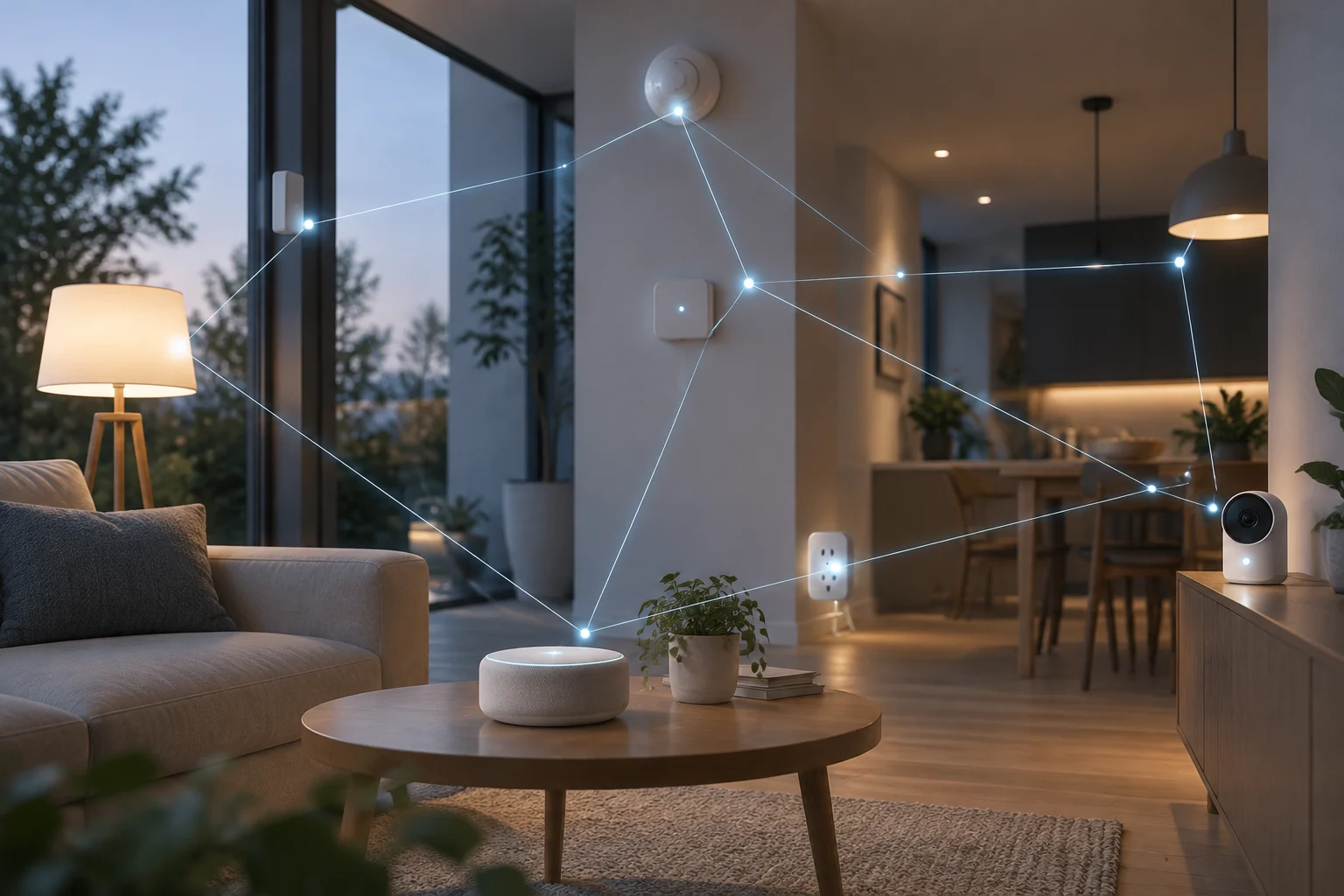
Matter was born to reduce one of the hidden costs of home automation: choosing devices based on a single platform because different brands did not understand each other. The Connectivity Standards Alliance (CSA), which maintains the standard, presents interoperability between manufacturers as one of its central objectives. The intention is concrete: that compatible devices can communicate without depending on all belonging to the same catalog or brand. Source: CSA.
However, "Matter compatible" does not equate to "all functions work in any application." The standard defines shared capabilities and behaviors; the device brand and the platform controlling it determine which options are exposed and how they are managed. Therefore, it is advisable to distinguish between basic interoperability —for example, controlling an accessory— and full equivalence with its original application, something the label does not promise on its own.
The nuance also matters when talking about versions. The CSA announced Matter 1.3 on May 8, 2024, with new categories and capabilities, including energy management functions and devices for water and appliances. This announcement describes what the specification allows manufacturers and platforms to implement; it does not certify that every existing device automatically received those functions or that all applications incorporated them. Source: CSA, Matter 1.3.
Consequently, the version number is not a list of universal features activated in all homes. A platform may support Matter and, nevertheless, not expose a specific category or its advanced controls. The version opens possibilities; the manufacturer's implementation, the product certification, and the platform's support decide which ones reach the user.
Matter and Thread Solve Different Problems
Matter is an interoperability layer for connected home devices and platforms. Thread, on the other hand, is a low-power wireless network technology that can transport communications from compatible devices. The CSA describes Matter as based on Internet Protocol and contemplates its operation via network technologies like Thread and Wi-Fi. They are not equivalent alternatives: one defines how products interact; the other is a way to connect them. Source: CSA.
This has a practical consequence: a Matter accessory does not necessarily use Thread. It may connect via Wi-Fi, while other low-power products may use Thread. The Matter label alone does not inform which transport a model uses, and the presence of Thread in a datasheet does not prove that the device offers Matter. To buy, one must review the two specifications separately and not treat them as synonyms.
Thread requires compatible infrastructure to join the device network with the platform that controls them. This role is often called a border router or Thread border router. It should not be automatically confused with a smart home hub: a device can perform one or both functions, but the consumer must check the specific model and platform support. Network compatibility does not replace the Matter controller.
CSA documentation emphasizes local control and cross-brand communication as part of Matter's design. This helps explain why the standard can reduce cloud dependencies in compatible functions, but it does not authorize claiming that every operation is local, that it never requires an account, or that a proprietary app becomes useless. Real behavior depends on the combination of accessory, controller, network, and service. Source: CSA.
The Label Does Not Allow Assuming Matter 1.3
A limitation of available sources is important: they do not provide official manufacturer documentation allowing the creation of a reliable list of products sold in Spain with native and complete compatibility with Matter 1.3 and Thread. The CSA note confirms that specification 1.3 was available for members and manufacturers to integrate, but also indicates that adoption required implementation, testing, and certification work. It is not a list of already compatible devices. Source: CSA.
Therefore, it would not be rigorous to attribute Matter 1.3 support to an entire category —such as appliances, electric vehicle chargers, or energy sensors— based on the announcement of a capability in the standard. Technical possibility and commercial availability are distinct issues. They can also vary between models of the same family, regions, and firmware versions.
The safest way to verify a product is to look for specific evidence for its variant, not settle for a general brand page. Before paying, check:
- That the exact model datasheet indicates Matter and, if needed, Thread; not just generic compatibility with a voice platform.
- Which categories and functions it supports in Matter, and which remain reserved for the manufacturer's application.
- If the model is certified and what version or capabilities the manufacturer documents.
- Which controller and, for Thread, which network infrastructure you need; verify that the equipment available at home is compatible.
- If the support page confirms updates, regional requirements, and procedures for joining more than one platform.
This review is more useful than looking for a universal list of "compatible" brands. Certification and the standard allow comparing capabilities, but they do not replace checking the datasheet and technical help of the specific product. If the manufacturer does not specify the functions of interest, the absence of detail should be treated as an unknown, not as an implicit guarantee.
Controllers and Ecosystems: Less Exclusivity, Not Total Independence
Matter is not a single application nor a central service that controls the whole house by itself. The device is usually incorporated via a compatible platform or controller; this interface allows configuring and managing it. The CSA describes interoperability between devices and systems, and also the configuration process as part of the standard. The standard connects ecosystems, but does not eliminate them. Source: CSA.
Hence, saying "hubs are no longer needed" is too broad. A Wi-Fi device may not require a Thread border router, but it does need a network and a compatible controller. A Thread accessory, for its part, needs access to a Thread network and a controller that can incorporate and administer it. Needs vary according to the product; they are not deduced solely from the Matter logo.
Incorporation into multiple platforms can reduce the cost of changing ecosystems, but it also does not imply that all functions are replicated in all of them. Automations, diagnostics, advanced settings, and updates may remain linked to the manufacturer's application or service. In shared basic functions, flexibility can be gained; in advanced ones, the user must still compare what each platform exposes.
The question for those who want to avoid lock-in is not whether a product mentions Apple, Google, or Amazon, but whether it allows incorporating it into the controllers they actually plan to use and what functions it delivers in each. A solution can be interoperable and retain specific dependencies. Independence is gradual: Matter can facilitate platform changes without making all ecosystems equivalent.

Lifespan and Updates: What the Standard Protects and What It Does Not
A common standard can improve interoperability options while a device and its platforms receive support. However, it does not guarantee by itself a specific lifespan, indefinite updates, or that a product continues receiving new capabilities from later versions. The CSA indicates that new functions must be integrated by manufacturers and platforms; the appearance of a new specification does not automatically update the installed base. Source: CSA.
It is also advisable to separate three questions that are often mixed: whether the device can remain connected to the local network, whether its manufacturer maintains the firmware, and whether a specific platform retains support. Matter addresses interoperable communication, it does not replace the seller's update policy or technical assistance. The standard reduces one class of dependency, but it does not eliminate risks of abandonment, security failures, or service withdrawal.
Before buying an accessory expected to be kept for years, consult the support page, update policy, and conditions for local control. If the essential function depends on a cloud or account, find out what happens if that service changes. For Thread-equipped devices, add a check of network and controller compatibility. It is not a prediction about the product's duration: it is a way to identify dependencies that the interoperability logo does not resolve.
A More Informed Purchase in 2026
Matter can indeed make it easier to combine products from different manufacturers, especially when the functions you need are implemented in the device and supported by the chosen controller. But it is advisable to avoid two extremes: treating it as a magic solution that erases all differences between platforms or discarding it because it does not guarantee total compatibility. Its value is practical, but limited: it provides a shared base and leaves important aspects in the hands of those who manufacture and operate each product. Source: CSA.
For a purchase in Spain, a brief and specific check is worth more than a general promise of a "universal home":
- Identify the model number and the variant sold by the local store.
- Look for official Matter and Thread compatibility documentation separately.
- Verify the functions available on the platform you will use, not just the capabilities announced by the manufacturer.
- Check if a controller or Thread border router is needed and if you already have a compatible one.
- Review which functions depend on the proprietary app, an account, or the cloud, in addition to the firmware policy.
The conclusion is not that Matter guarantees a future-proof investment. It is that it allows better evaluation of interoperability if the correct evidence is consulted. Buy based on documented functions, available infrastructure, and verifiable support; use compatibility as a potential advantage, not as a substitute for these checks.