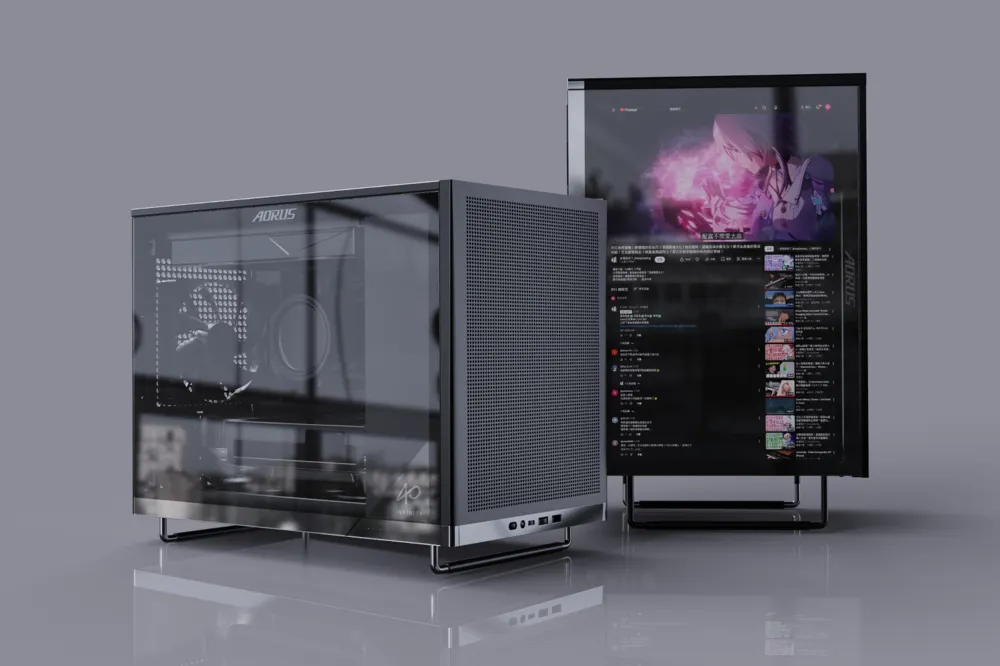
A micro-ATX case incorporating a 16-inch OLED display
GIGABYTE announced on November 12 that its AORUS C510 GLASS INFINITY had been recognized in the CES Innovation Awards 2027, in the Gaming & eSports category. The proposal combines a micro-ATX PC case with a 16-inch 240 Hz OLED display, which can serve as a primary monitor, secondary screen, or panel for displaying data and custom content. (CES)
The screen can be installed on either side of the case or detached and placed on its own stand for independent use. It can function as a primary monitor, secondary screen, or data display panel, allowing adaptation to different configurations. (CES)
The other modular component is the detachable metal feet. According to the CES spec sheet, they can be repositioned to support the case horizontally or vertically and also function as a top handle. In the horizontal configuration, they leave space under the unit; GIGABYTE relates this clearance to bottom air intake. Physical flexibility is the central design argument, alongside vented panels that aim to favor airflow. (CES)
What GIGABYTE's design adds—and what it does not prove
The case maintains the focus of a user-built desktop PC: the micro-ATX format and modular design are presented as compatible with standard component choices and future upgrades. The front and top vented panels aim to favor airflow. The practical promise is to combine conventional mounting with adaptable placement, so it is advisable to check space and necessary components before purchasing. (CES; Yahoo, GIGABYTE statement)
For those who already have a monitor, the added panel could serve as an auxiliary screen for telemetry, tools, or content; those seeking a compact unit with an integrated display might value the all-in-one configuration. Before choosing a configuration, it is advisable to check the price, availability, dimensions, motherboard compatibility, and video connections in the manufacturer's sales information. (CES)
VELOAT links construction documents with CAD and BIM designs
On November 13, Searchdoc announced that VELOAT had been named a honoree of the CES Innovation Awards 2027 in Enterprise Tech. The company describes the service as an enterprise AI platform that links contracts and technical specifications with 2D CAD drawings and 3D BIM models in architecture, engineering, and construction. Its goal is to connect written requirements with design elements, rather than limiting consultation to isolated documents. (Searchdoc statement distributed by PR Newswire)
According to the company's description, VELOAT structures clauses and tables from contracts and specifications, and links them with geometry and attributes from drawings and BIM models. Users can formulate questions in natural language and search for potential discrepancies or omissions between requirements and design. The system can also compare document revisions and help prepare review lists and reports. The proposed utility lies in the intersection of formats, especially when a contractual or design change requires reviewing multiple sources simultaneously. (Searchdoc statement distributed by PR Newswire)
Traceability is another component highlighted by Searchdoc: results can be linked to source documents and specific clauses so the team can review the basis of an AI-generated response. In compliance or engineering coordination tasks, this connection can help verify why a potential conflict is flagged. Professional review remains important when evaluating findings and deciding how to act. (Searchdoc statement distributed by PR Newswire)

Deployment and adoption: aspects that matter to teams
Searchdoc states that it offers VELOAT in the cloud, in dedicated customer environments, and through local installations, with configurations that can be adjusted to access controls and data export policies. The company also notes that it already supplies the solution to major South Korean construction firms. Deployment modes allow for different operational configurations; organizations can evaluate which fits their access and data management needs. (Searchdoc statement distributed by PR Newswire)
In practice, the potential value depends on the system's ability to interpret the documents and models each organization uses, maintain correct links between revisions, and provide evidence that specialists can validate. Before evaluating it, a team can contrast these aspects with their real workflows and data, in addition to reviewing how access controls and change management are configured.
The company initially positions VELOAT in construction and engineering and mentions plans to explore other sectors with complex technical documentation, such as semiconductors, manufacturing, and shipbuilding. It also reported prospecting activities in North America following a demonstration at Autodesk University 2026. These are expansion signals communicated by Searchdoc, not proof of general availability in new markets or that those applications are already deployed. (Searchdoc statement distributed by PR Newswire)
How to interpret the CES Innovation Awards
The recognition of both products is part of the program by the Consumer Technology Association (CTA), the organizer of CES. For 2027, CTA explains that a panel of external experts evaluates candidates based on engineering and functionality, aesthetics and design, and uniqueness and innovation. The organization distinguishes between honorees and the Best of Innovation awards, which correspond to participants with the highest scores in each category. Being a honoree does not mean winning Best of Innovation nor does it turn the award into a technical certification. (CTA, application information)
CTA itself specifies that it does not test or endorse the awarded products. Therefore, the recognition allows identifying proposals selected within a design and innovation program, but it does not replace an evaluation of compatibility, performance, security, or quality of results. For buyers and technical managers, the award is context, not evidence that a product meets their specific requirements. (CTA, application information)
The two proposals address different needs: AORUS C510 GLASS INFINITY modifies the physical layout of a PC and adds a configurable screen; VELOAT attempts to connect contractual information with technical models and drawings. In the first case, the practical decision involves checking dimensions, connections, and compatibility when GIGABYTE publishes that data. In the second, it involves validating formats, traceability, security, and accuracy with a specific workflow. The recognition puts them on the radar, but suitability depends on those operational details.