Gallium Is Not Always Liquid
Gallium is a metal with a melting point of 29.7646 °C. At 20 °C, the Royal Society of Chemistry classifies it as a solid, so describing it simply as a liquid at room temperature is misleading. It can be melted with moderate heating, but its state depends on the temperature and the sample’s composition.
Composition affects how a material behaves, including how its surface responds. In one example studied by NC State researchers, a gallium-indium alloy changed its surface tension when an oxide layer formed or was removed by applying a voltage in water. This finding applies to that alloy under those conditions, not universally to every liquid metal.
It helps to distinguish three roles that are often conflated in general explanations: liquid metal can act as a supporting surface or processing medium; a material such as molybdenum disulfide (MoS₂) is the semiconductor being formed; and the surface oxide is a third phase with its own composition and properties. Keeping them separate makes it easier to identify what material was actually produced in each experiment.
In the MoS₂ Study, Gallium Is the Support
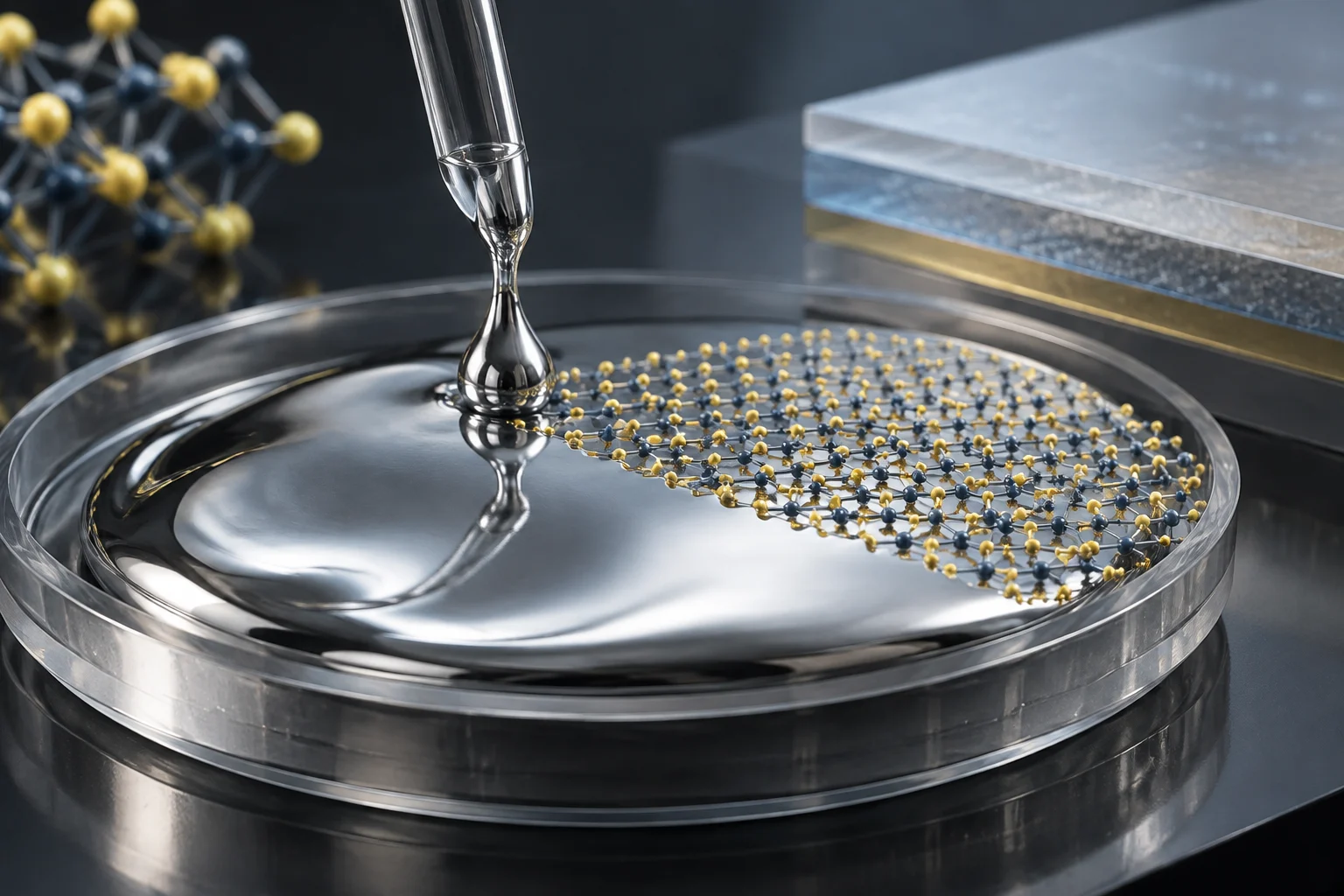
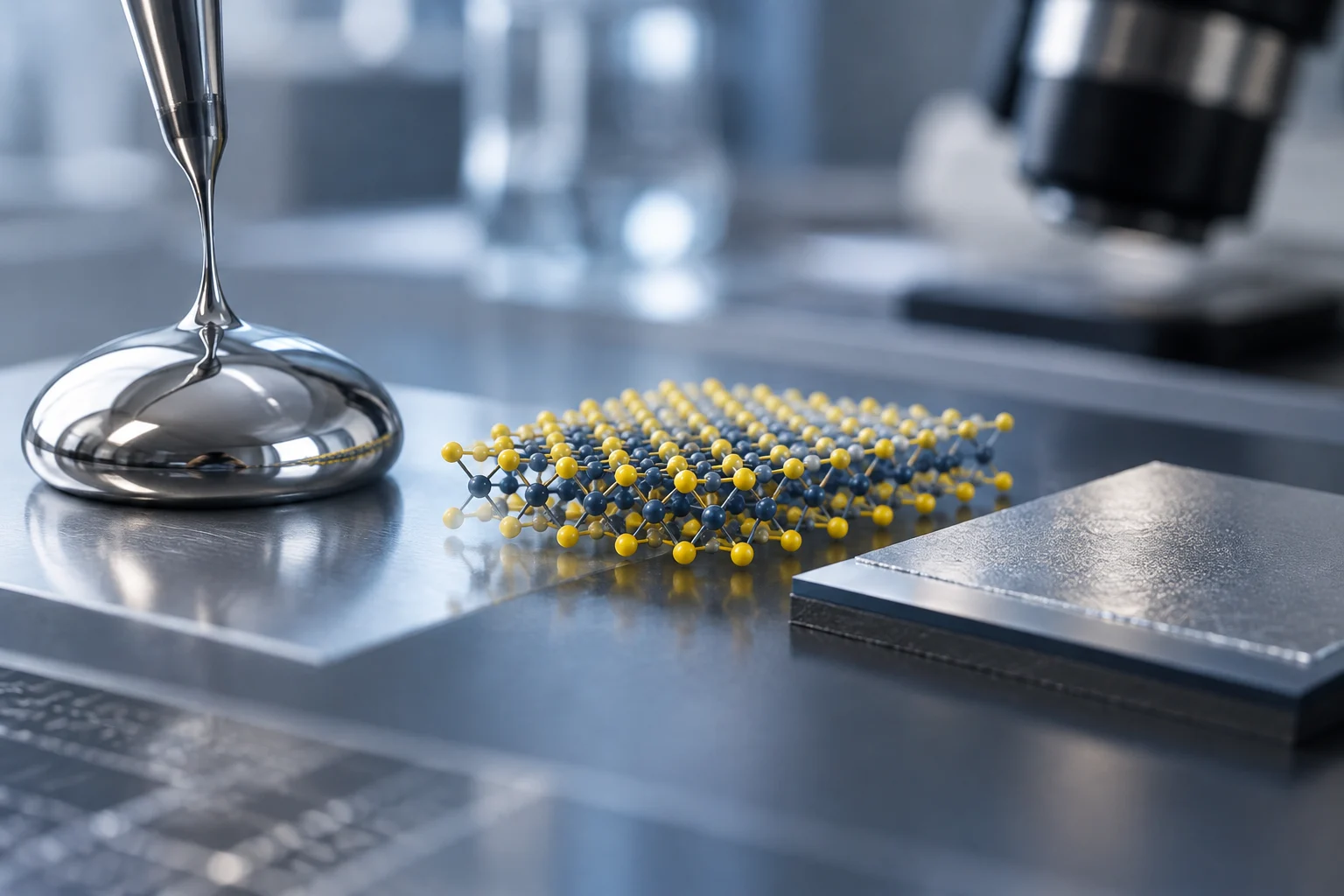
A 2020 UNSW study described depositing MoS₂ on liquid gallium. The interest lies in the possibility that a liquid surface can provide a smooth template for nucleating the two-dimensional material. The team said the layer formed on that surface could then undergo heat treatment to produce large areas with fewer grain boundaries than the deposition routes considered in the study.
The key point is that gallium is not the final semiconductor. In the process described, molybdenum and sulfur react to form molybdenum-sulfur bonds and produce MoS₂; gallium provides the surface on which the layer nucleates and organizes. The paper calls the method self-deposition, but that does not mean the material appears without precursors or that the process is a do-it-yourself recipe.
The conceptual sequence can be summarized without turning it into an experimental protocol: first, gallium is brought to a liquid state; then molybdenum and sulfur sources are brought near its surface; bonds form there to produce MoS₂; finally, an annealing step allows the material to expand, as described by the team. The approach is notable for combining a growth surface with the formation of a two-dimensional layer, not because gallium turns into the semiconductor.
The 2020 study presents a materials possibility, not a demonstration of commercially manufactured transistors at scale. A layer with fewer grain boundaries may be promising for studying electronic transport, but that alone does not prove circuit performance, uniformity across large batches, competitive cost, or manufacturing reliability. Improving one deposition step does not solve the entire production chain.
Surface Oxide Can Also Be a Functional Material
Contact between liquid metal and air can produce a surface oxide layer. That layer should not automatically be confused with the deposited semiconductor or with an insulator of a single composition: metal oxides encompass different materials whose electrical properties depend on their composition and structure. NC State’s 2014 research on a gallium-indium alloy showed that surface oxidation can dramatically change surface tension, and that the change could be reversed by altering the voltage polarity in water.
A later study, published by NC State in 2024, explored a different role: printing thin metal-oxide films from the meniscus of a liquid metal. Although liquid metal is used during the process, the deposited film is solid oxide, not a layer of liquid metal that remains on the substrate. The team described transparent, conductive films and flexible circuits made from them.
In that study, film thickness and thermal stability depended on the sample. NC State reported that 4 nm films retained conductive properties up to nearly 600 °C, while 12 nm films did so up to at least 800 °C. It also described flexible circuits that maintained their integrity after 40,000 folds. These are results reported for the study’s technique and samples, not guarantees of service life for every flexible circuit.
The practical takeaway is that “oxide” does not necessarily mean “insulator.” Some oxides are insulators; others can be conductive and transparent. Nor should the NC State example be generalized to a specific oxide such as Ga₂O₃: the cited study covers films made from different metals and alloys, and composition determines the properties obtained. Identifying the phase and its composition is essential before assigning it an electronic function.
Three Materials, Three Distinct Roles
This comparison helps prevent a common misconception: that the metal used to make a film is also the material that conducts or switches in the finished device. In these examples, liquid gallium can serve as a surface or part of the process; MoS₂ is the semiconductor investigated in the UNSW study; and the oxide films studied in 2024 are solid conductive materials. A role should be assigned to the phase that was actually characterized.
| Material or phase | State and role in the examples | Limitation to keep in mind |
|---|---|---|
| Pure gallium | Solid at 20 °C; liquid above 29.7646 °C. It can provide a surface for MoS₂ growth. | The melting point applies to the pure element; it does not automatically describe an alloy. |
| Gallium-indium alloy | Liquid metal studied for controlling its surface tension through electrochemical oxidation. | The reported behavior depends on the medium and applied voltage. |
| MoS₂ | Two-dimensional semiconductor formed on a gallium surface in the 2020 UNSW study. | The deposition result alone does not demonstrate a commercial device or mass production. |
| Metal-oxide film | Ultrafine solid; the 2024 NC State study reported transparent, conductive films. | In the study, some films retained conductive properties at elevated temperatures. |
The table does not establish a universal classification of materials. It summarizes their roles in three specific studies and explains why a property should not be transferred from one sample to another without checking composition, conditions, and structure. In particular, finding that an oxide is conductive in one study does not mean all oxides are conductive.
What the Results Show—and What They Do Not
The research demonstrates different strategies involving liquid metals: using a liquid gallium surface as a template for forming a two-dimensional layer, changing a gallium-indium alloy’s surface tension through oxidation, and printing solid metal-oxide films from a liquid-metal meniscus onto a substrate. These approaches explore ways to control interfaces and produce thin layers with specific properties.
But a laboratory demonstration does not establish industrial readiness. The 2020 UNSW study described the formation of MoS₂ on liquid gallium; the 2024 NC State study reported thin, transparent, conductive oxide films and flexible circuits. These are results for specific materials and processes, not proof that one material can replace silicon. A promising sample and a finished component are different outcomes.
For students, another useful distinction is between a material property and device performance. A film’s conductivity, the number of grain boundaries in a semiconductor, and an alloy’s surface tension are different properties, measured in different materials and experiments.
Liquid-metal research spans different materials and processes, so the relevant practical considerations depend on the particular setup. For example, the 2024 NC State study printed solid oxide films from a liquid-metal meniscus onto a substrate.
A Useful Way to Read Results in Class or in the Lab
When reading a paper about gallium-based electronics, a few quick checks can prevent several mistaken conclusions. First, identify whether the authors studied pure gallium or an alloy, and under what conditions it is liquid. Then track the identity of each phase: metal, semiconductor, oxide, or substrate. Finally, distinguish what was measured in a sample from what is proposed as a future application.
It can help to ask these questions when reading laboratory results: Which material remains in the final device? Is the oxide a separate film or just a surface layer? Was conductivity measured in the oxide, the metal, or a composite structure? Does the result concern one sample or a repeatable process? These questions help distinguish the material being studied from the proposed device or application.
The studies described here explore different roles for gallium-based liquid metals: a surface for forming MoS₂, control of an alloy’s surface tension, and printing solid oxide films. Each result applies to a specific material and process; none by itself establishes a replacement for silicon-based electronics.