Fast charging designed for port calls
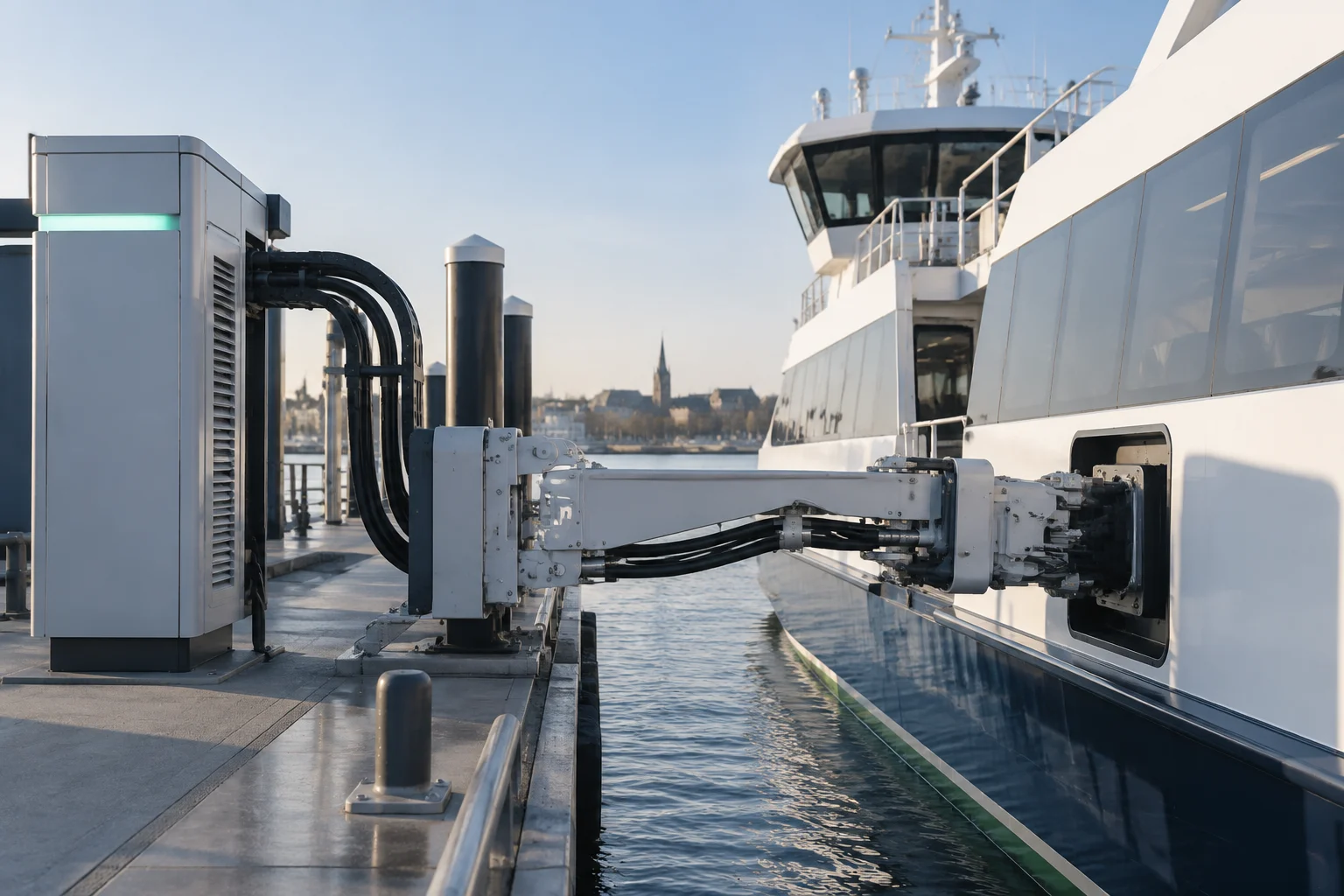
HYPOBATT, a European project coordinated by the technology center IKERLAN, developed and validated a high-power charging system for electric ships. Its purpose is to allow a vessel to recover energy while in port, without the connection and recharging becoming a bottleneck in operations. The full-scale test was carried out in Norddeich, Germany, on the ferry service connecting to Norderney.
The problem is different from charging a car. A ship can move relative to the quay due to wind, tide, and mooring tolerances; furthermore, the time available between trips can be short. The equipment must establish a high-power electrical connection safely and repeatably in a marine environment, compensating for the vessel's movement relative to the infrastructure. Automation aims to shorten that maneuver, not to eliminate other port tasks.
The project was developed under the Horizon Europe program and brought together technological, industrial, and maritime organizations from several countries. Its work combined electrical equipment, charge control, and connection automation. This matters because charging a ship depends not only on the charger: it also requires coordinating the vessel, the port, and the local electrical grid.
What the M-MCS system does
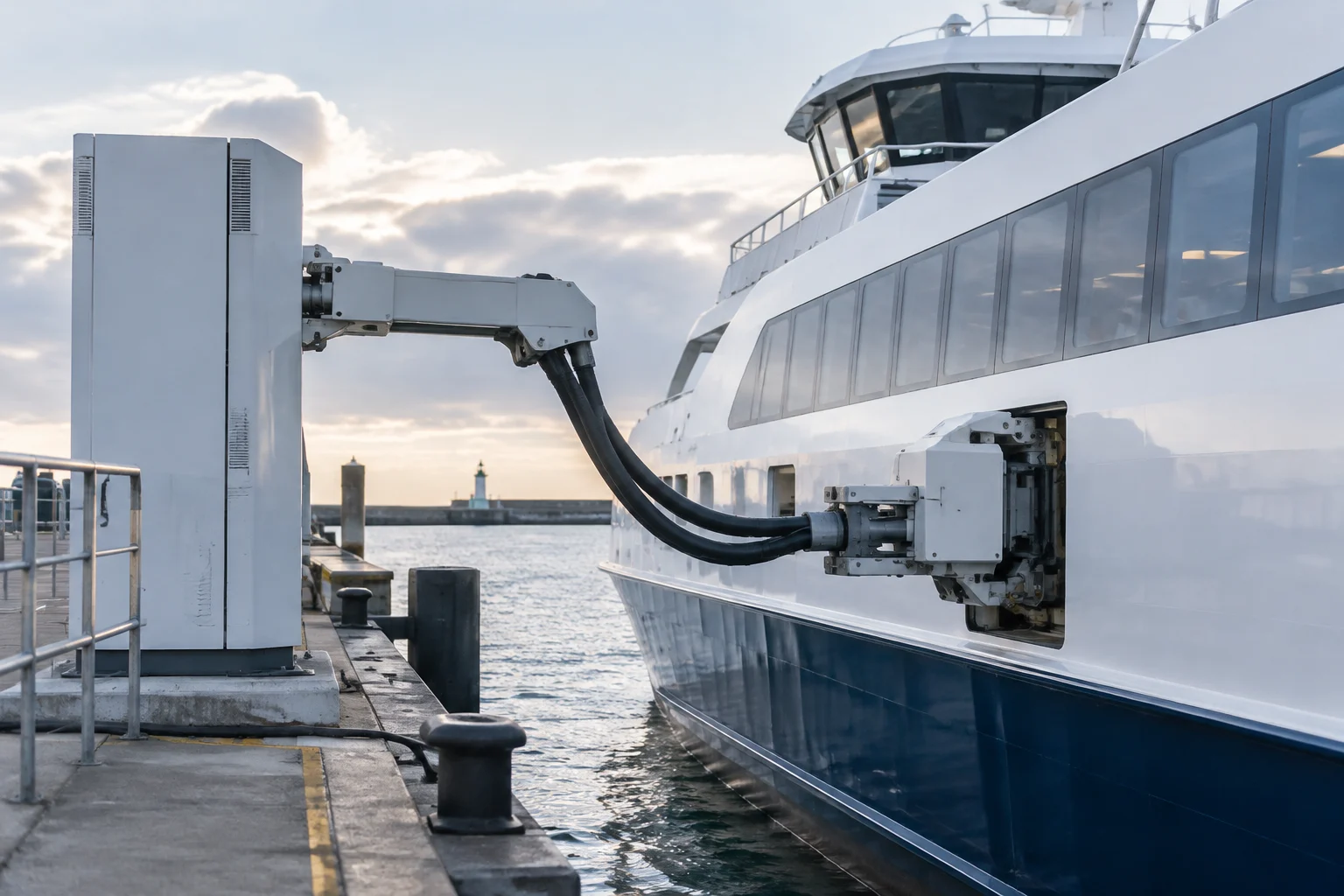
The solution is called the Marine Megawatt Charging System (M-MCS). It integrates energy conversion and supply equipment with a mechanism that connects the ship to the charging point. HYPOBATT tested automatic and manual connection modalities, so that automation is not the only form contemplated for operating the system. The pilot allowed validating both modalities in the context of a real port installation.
In automatic connection, the equipment must compensate for position differences between the vessel and the fixed infrastructure. The connection also requires adequate contact surfaces and communication between the ship's and charger's systems. The difficulty is not simply bringing a larger plug to the quay: a secure union must be maintained against movement, and the supply of high currents must be enabled reliably.
The project also addressed the control of the energy supplied. According to the synthesis published by CORDIS, the system adapts the charging profile to the battery's state, its temperature, and the available capacity of the grid. Maximum power is not the only design criterion: management must balance speed with battery protection and the port's electrical constraints.
The difference between 1 MW tested and 2.25 MW projected
The most important figure for interpreting the result is the power of the demonstration installation: the pilot operated at 1 MW. The capacity of up to 2.25 MW refers to what the modular design of the M-MCS contemplates, not to a power that has been demonstrated in those tests. Keeping this difference clear avoids presenting a projected capacity as performance measured in the port.
To estimate a full charge, data such as battery capacity, its initial state, the charging profile, and the effective connection time are needed. Therefore, 2.25 MW does not equate to a specific recharging time nor guarantee that any vessel can accept that power.
It is also worth distinguishing the charger's power from the energy that actually reaches the batteries. Charging can be reduced by battery limits, thermal management, or the available capacity of the grid. Nominal power describes a possibility of the system; the operational result depends on how those limits combine during each session.
What the test demonstrates and what remains to be resolved
The validation in Norddeich provides a practical demonstration that manual and automatic connections can be integrated into a fast-charging installation for ships. The system was tested in real port conditions, not just as a laboratory design. This credits technical viability in the tested scenario, but it does not equate to a widespread commercial deployment or a test of operation on any type of ship or port.
The difference is relevant for operators: a demonstration shows that certain components can work together in a specific case; adoption also requires adapting the infrastructure, verifying compatibility, defining protocols, and evaluating costs. The Fundación Valenciaport participated in replicability and technical-economic viability studies to analyze how to bring the proposal to other port environments. Transfer to another port requires its own evaluation, not a simple copy of the German installation.
The result should be read as a technological validation and an analysis of possible applications, not as proof that the system is already deployed at market scale.
The port must also be prepared
A megawatt charger needs an electrical connection capable of supplying that power, and the port must integrate it with its other loads and the conditions of its grid. The project itself considered adaptation to electrical constraints and the coordination of recharging. Land infrastructure is part of the system: having an automatic connector does not by itself resolve supply capacity, installation, or the port's energy operation.
Modularity may allow adjusting the configuration to different ships and needs, but it does not make compatibility universal. Electrical and communication interfaces, mooring configuration, safety requirements, and battery characteristics must match. The schedule of calls and the energy the ship needs for its route also count; a port with little connection margin may require management solutions or grid reinforcement.
Standardization is another component of that transition. CORDIS notes that the demonstration applied the industrial standard Megawatt Charging System and highlights interoperability as a condition to avoid exclusive infrastructures for each operator. In parallel, sector coverage links the HYPOBATT experience with the development of IEC/IEEE 80005-4, on direct current electrical connections between ships and land installations. That standard is described as future, not as a standard already published and applicable.
What the closure of HYPOBATT means
The project concluded after developing the system and completing its demonstration in Germany. IKERLAN, the coordinator of the initiative, places the test in Norddeich and describes the automatic connection as capable of being established in less than 30 seconds; CORDIS summarizes the work as a full-scale validation. This data refers to the establishment of the connection, not to the time needed to recharge the battery. Connecting in seconds does not mean completing a charge in seconds.
The next practical value of the project lies in the transfer of results: viability and replicability analyses can help ports, shipping companies, and suppliers decide if an installation of this type fits their operations. The decision requires checking available power, compatibility with the intended vessels, and the cost of adapting the infrastructure. The results of a pilot provide a technical basis, but they do not replace that local analysis.
For those evaluating maritime electrification, the conclusion is concrete: HYPOBATT reduces a technical uncertainty by showing an automated and manual fast-charging connection in a real port environment. It does not yet demonstrate a universal solution or a tested 2.25 MW capacity. The interest for each operator will depend on the energy their fleet needs, the duration of their calls, and the electrical capacity of their ports.