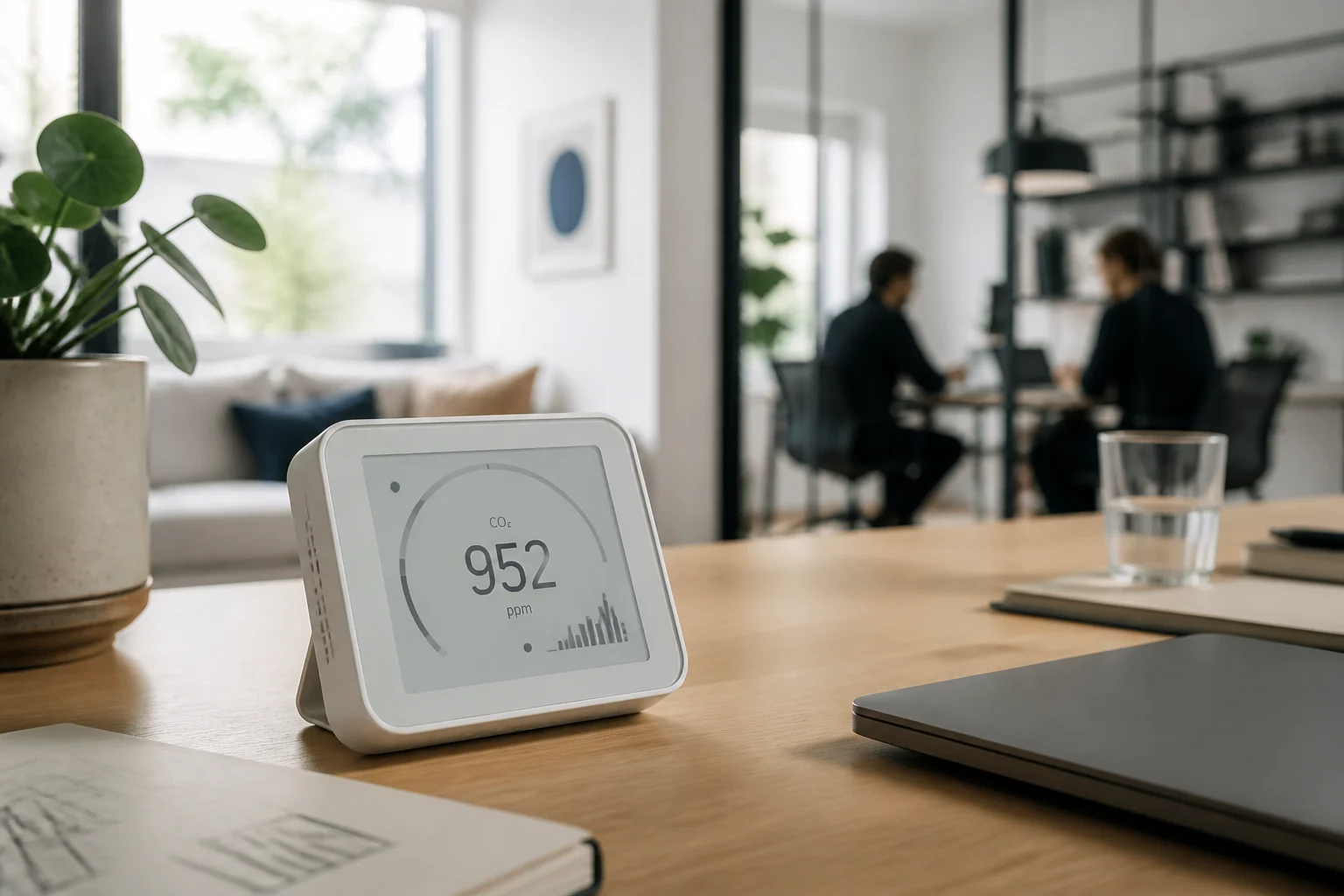
What a CO₂ monitor can tell you
A CO₂ monitor is most useful as a ventilation indicator in an occupied room. People exhale carbon dioxide, so a rise in indoor concentration can indicate that exhaled air is building up and fresh-air supply may need attention. It does not measure every indoor pollutant, and a CO₂ reading is not a general verdict on air quality or safety.
That distinction matters when choosing a device. A monitor can help you spot patterns and compare conditions in a room, but the reading depends on occupancy, ventilation, where the device sits and how measurements are taken. Treat it as one useful signal, not a substitute for ventilation assessment or other relevant controls.
Why NDIR is a useful specification
For portable workplace monitors, the UK Health and Safety Executive recommends non-dispersive infrared (NDIR) devices. NDIR measures CO₂ using infrared absorption; the National Institute of Standards and Technology describes how gases absorb light at characteristic wavelengths and how infrared measurement can be used to determine gas concentration.
The label alone does not tell you how well a complete monitor performs. Sensor modules from Sensirion and Senseair illustrate why specifications matter. Sensirion’s SCD30 is an NDIR module with a stated CO₂ range of 400–10,000 ppm and accuracy of ±(30 ppm + 3% of measured value) over that range. Senseair specifies Sunrise at ±30 ppm plus ±3% of reading, with a note that accuracy is ±75 ppm in the 1,500–2,500 ppm range for ANSI/ASHRAE compliance. Those are manufacturer specifications for sensors, not independent test results for every finished monitor that incorporates them.
When comparing devices, look for the stated measurement range, the conditions attached to the accuracy figure, and whether the product provides calibration instructions. A sensor’s stated accuracy is not the same as repeatability, and neither guarantees that a finished device will perform identically in every room or enclosure. Sensirion notes that design-in, heat exchange and the surrounding environment can affect the SCD30’s response and the accuracy of its temperature and humidity measurements.
Placement and measurement habits
A well-specified monitor can still give a misleading snapshot if it is poorly placed or used only once. HSE advises placing workplace monitors around head height, more than 50 cm from people, and away from windows, doors and air-supply openings. Exhaled breath can produce an artificially high reading when the monitor is too close to someone.
Take several readings while the room is occupied, at different times and under typical use. Record the number of occupants and the ventilation in operation alongside the measurements. HSE also advises repeating monitoring when weather or natural ventilation changes, since open windows, wind and changing door use can affect results. Larger spaces may need more than one monitoring location; readings in high-ceiling or poorly mixed spaces can be less representative.
Interpreting readings without overclaiming
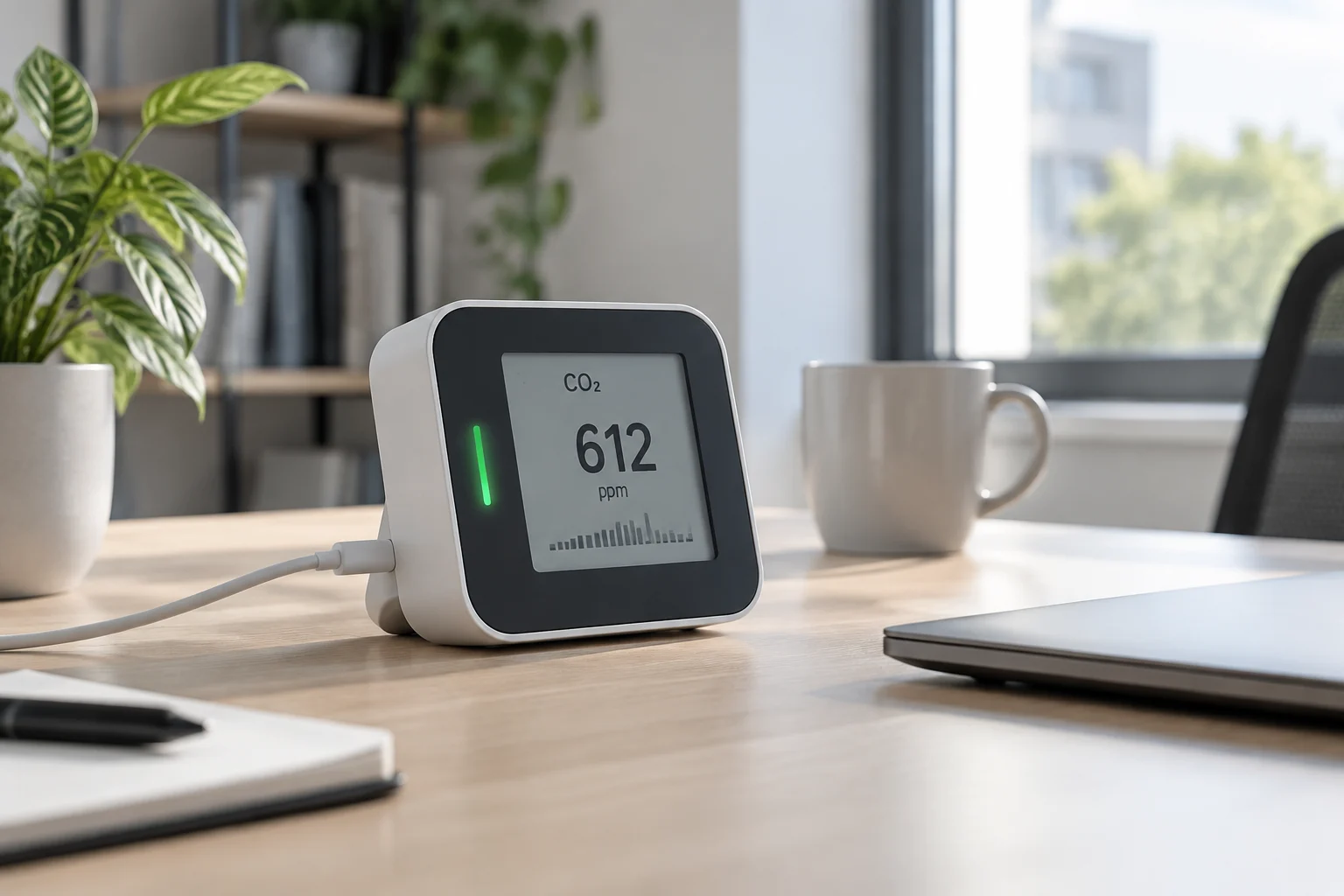
Concentration is usually shown in parts per million (ppm). HSE says that 1,000 ppm is equivalent to about 10 litres of fresh air per second per person, and that readings consistently above 1,500 ppm in an occupied room indicate poor ventilation and call for action. These are workplace ventilation guideposts, not universal health or safety thresholds.
CO₂ is only a broad guide to ventilation. It does not identify all pollutants. HSE says CO₂ monitors are not suitable for assessing spaces with processes that produce CO₂, and may be of limited use where occupancy is sparse, highly variable, or spread through a large, high-ceiling space. HSE also notes that air-cleaning units remove contaminants but do not remove CO₂ or improve ventilation, so CO₂ monitors are unsuitable in areas with those units.
The US National Institute for Occupational Safety and Health lists a revised immediately dangerous to life or health concentration of 40,000 ppm for carbon dioxide. That figure addresses an acute occupational hazard, not the ordinary interpretation of indoor ventilation readings. It should not be confused with the much lower workplace guideposts used to assess ventilation in occupied rooms.
A practical buying checklist
- Choose a monitor that identifies its sensing method; NDIR is HSE’s recommended type for portable workplace CO₂ monitoring.
- Check the accuracy figure alongside its measurement range and any stated operating conditions. Do not assume a sensor-module specification automatically describes the finished monitor’s performance.
- Look for clear instructions on placement, calibration and repeated measurements. Correct use is part of getting meaningful readings.
- Consider the room: occupancy patterns, air mixing and ventilation can affect how representative a reading is. A single monitor may not characterize a large space.
- Use CO₂ readings to investigate ventilation patterns, not as proof that all aspects of indoor air are safe or clean.
For a home office, meeting room or other regularly occupied space, a clearly specified NDIR monitor used consistently can help reveal whether ventilation needs attention. Reliable interpretation depends on context as much as the displayed number.