What an AI Agent Means
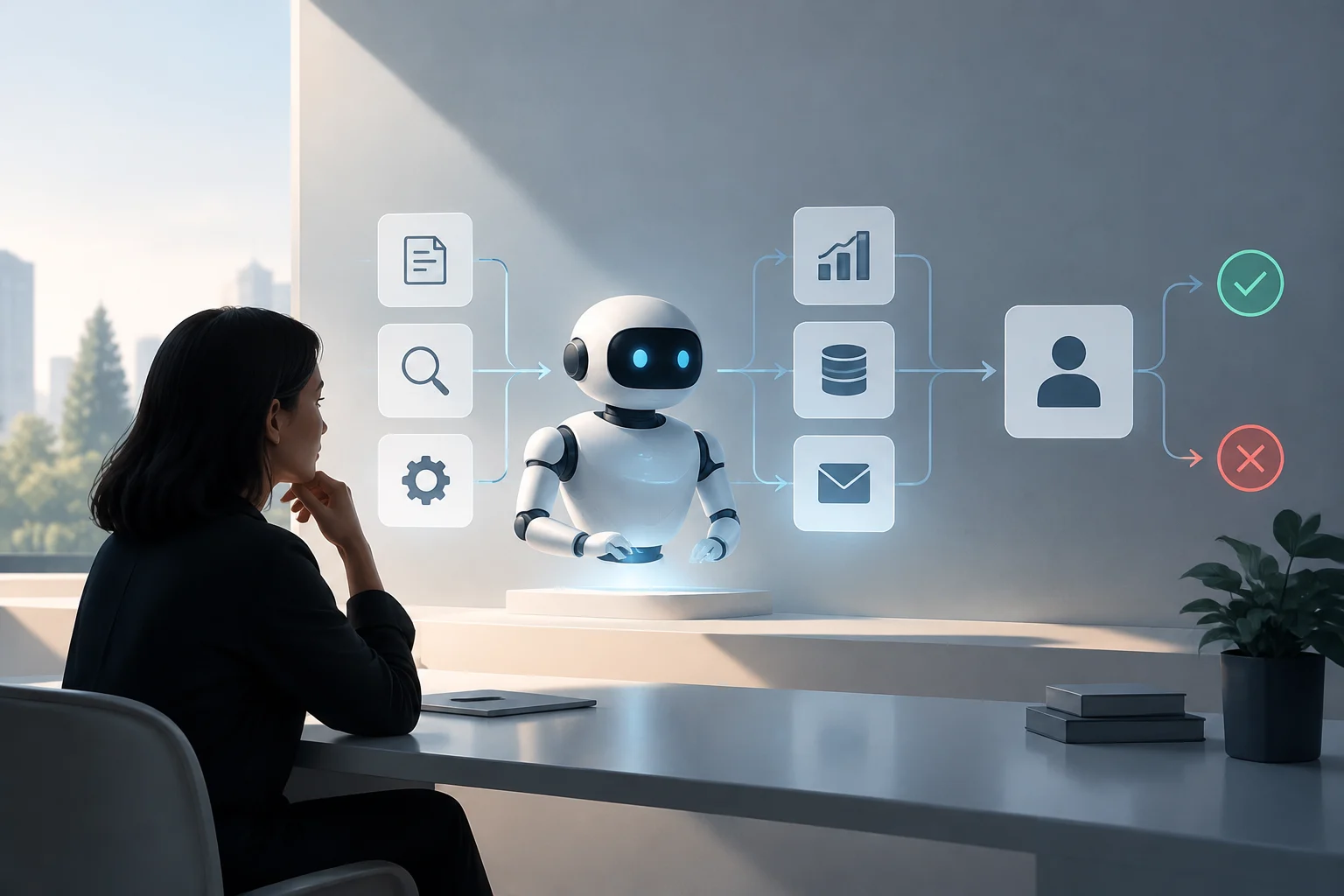
An AI agent is a system that receives a goal, interprets the context, and can choose a sequence of steps to attempt to achieve it. In the formulation of the Spanish Data Protection Agency (AEPD), these systems use language models and can perceive their environment, decompose tasks, and perform operations through interfaces or tools. The word agent therefore describes a complete system: it is not necessarily the name of a specific model.
A language model generates or transforms content based on an input. An agent can use that model as part of a broader process, along with instructions, data, memory, tools, and execution rules. The practical difference appears when the system does not limit itself to responding, but selects actions and chains them to meet a goal. An isolated model does not thereby acquire permissions to query a database or modify a calendar.
The boundary with a chatbot is not absolute. A chatbot may limit itself to conversational responses and predefined flows, but it can also connect to tools and execute operations; at that moment, some of its functions behave in an agentic manner. Therefore, the conversation channel does not define the category. To understand what a system does, it is advisable to review its capabilities and permissions, not just its interface or commercial label.
Differences Between Model, Chatbot, and Agent
A useful comparison distinguishes three levels of operation. The model is the component that processes or generates an output; the chatbot is an application for conversation, which can use rules or models; and the agent is a system configured to move toward a goal through decisions and actions. In real products, these levels can be combined: a chatbot can integrate an agent, and an agent can rely on one or several models.
| System | Usual Autonomy | External Tools | Task Execution |
|---|---|---|---|
| Language Model | Produces an output from an input; does not imply external actions by itself | Not necessarily | Generates or transforms content |
| Chatbot | Responds in an interaction; can follow rules or use generative AI | Optional, depending on implementation | Can limit itself to conversation or delegate actions to other systems |
| AI Agent | Can decide intermediate steps within configured limits | Can invoke connected tools | Chains operations to attempt to complete a goal |
The table compares possible functions, not guarantees: calling a system an agent does not prove that it plans well, learns from each interaction, or completes tasks without supervision. The AEPD guide focuses on agentic systems that use language models. In a technical evaluation, check which components are active and what results they can produce.
How the Agent Cycle Works
Operation usually begins with a goal expressed by a person or another system. The agent receives pertinent information—for example, the status of a request or authorized data from an application—and determines which steps could lead to the result. It can divide a complex request into subtasks, choose a tool for each, and review the responses received before continuing. Planning is an operational sequence, not a guarantee that the reasoning is correct.
A simple cycle can be represented as follows:
- Interpret: Convert the request into a goal and recognize relevant constraints.
- Plan: Propose subtasks and decide what information is missing.
- Select: Choose an available tool and the data it needs.
- Act: Send a query or request an external operation.
- Evaluate: Examine the response and continue, correct the plan, or stop.
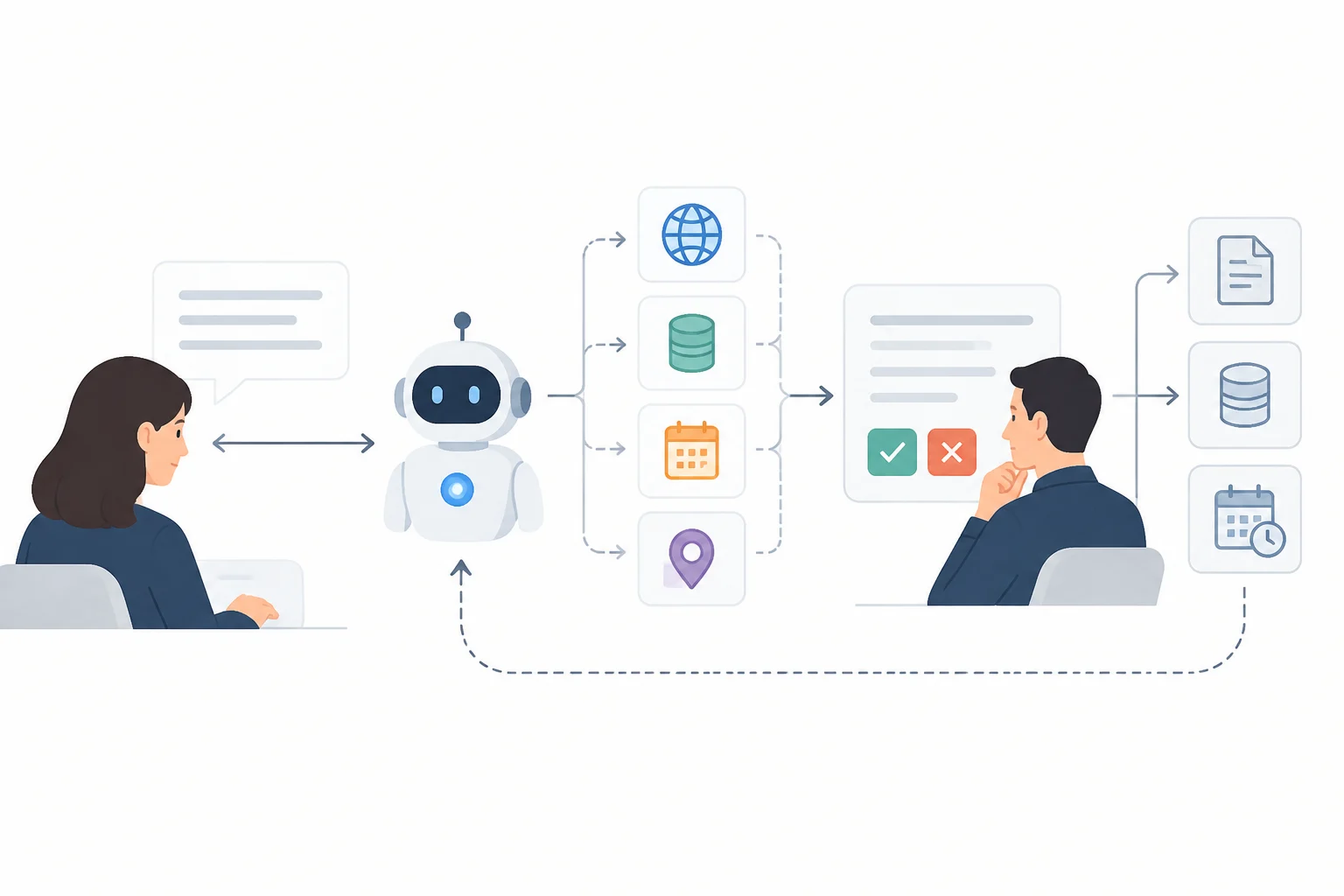
This cycle can repeat, but it does not have to occur in a completely autonomous manner. The architecture determines whether the agent can act directly, whether it only proposes an action for approval, or whether it must stop under a specific condition. In Google Cloud's reference architecture for itineraries, for example, a coordinator agent distributes tasks among agents specialized in places, routes, and calendar; the document also recommends human review for critical operations. It is an example of design, not a universal property of agents.
In systems with multiple agents, a coordinator can assign tasks and gather results while specialized agents use different tools. Google Cloud’s reference architecture, for example, uses an orchestrator alongside agents for places, routes, and scheduling. The exact roles and connections depend on the design.
What External Tools Contribute
Tools connect the agent to functions that the model does not perform on its own: querying an API, retrieving information from a database, checking a route, or proposing changes to a calendar. The model can decide which to request and with what parameters, but effective access depends on the integration and the assigned permissions. A tool turns a suggestion into a possible operation; it also opens a path to query or modify data outside the conversation.
The architecture published by Google Cloud illustrates this difference through a travel planner with specialized agents: the system can obtain geographical and schedule information and, with access to the calendar, manage events. The same design contemplates observability components to log events and review actions. The utility of the example lies in showing that behavior depends on specific interfaces, data, and controls, not on a magical capacity of the model.
For those implementing an agent, the central criterion is to grant only the necessary access. If the task is to draft a document, reading access to documents may suffice; if it must send messages or modify records, those actions require explicit permissions and safeguards. It is advisable to separate querying, proposing, and executing, and to require approval before actions with significant consequences, such as a non-reversible reservation or communication to third parties.
Autonomy, Errors, and Supervision
The autonomy of an agent is bounded by its design: instructions, available tools, accessible data, permissions, and stopping conditions. The system can choose among permitted options, but it should not be treated as an independent authority nor assumed to understand all the consequences of an operation. An agent that can query information does not necessarily have the ability to modify it; one authorized to execute an action can do so incorrectly if it misinterprets the goal or receives inaccurate data.
The AEPD warns that interaction with internal and external services can change the scope of a personal data processing. Among the risks it addresses are the exposure of information when interacting with the environment, dependence on integrated services, inadequate retention in memory, and decisions based on imprecise or irrelevant data. Effective human supervision is especially important when actions can significantly affect people or rights.
Traceability helps monitor a system’s operations and review events. Google Cloud’s reference architecture uses logs and an event viewer to monitor and debug agent operations. The AEPD recommends considering data protection throughout the system’s lifecycle, including governance, risk assessment, and appropriate safeguards.
Human intervention does not equate to someone being able to look at a screen without real capacity to influence. A useful control defines which decisions require approval, who can pause or cancel an operation, and how errors or rights requests are managed. In routine and reversible tasks, a subsequent review may suffice; in sensitive or hard-to-reverse operations, prior approval offers a clearer barrier.
Data Protection and European Framework
The AEPD guide, published in February 2026, addresses agentic AI from the perspective of personal data protection. Its purpose is to help controllers and processors evaluate how a processing changes when an agent is incorporated. The Agency points out that the agent can perform part or the entirety of a process and that its integration can alter purposes, information flows, stakeholders, and risks. Adding an agent can change the processing, even if the organization already used the data before.
In practice, an evaluation must identify what data the system queries, what providers or services participate, where memory and logs are stored, and what operations it can execute. It must also check whether the new configuration respects purpose and minimization: giving access to more repositories than necessary increases the potential scope of the processing. The guide recommends reviewing obligations and risks when incorporating the system, rather than assuming that the previous evaluation still covers the new flow.
The AEPD guide focuses on personal data protection when agentic AI is incorporated into a processing. To determine what obligations may apply under the European AI Regulation, one must attend to its definitions and requirements, as well as the system and the specific use. The commercial term agent is not sufficient by itself: the function, deployment context, and responsibilities of the actors involved also matter.
For an organization handling personal data, an initial review can raise these questions:
- What specific goal must the agent fulfill and what data does it need for that?
- What tools can it query or modify, and with what permissions?
- What operations require human validation and how are they stopped?
- What logs allow reviewing decisions and attending to people's rights?
- What providers intervene and how are data flows documented?
The practical answer is not to avoid all automation, but to adjust autonomy and permissions to the risk. If a repetitive task can be solved with simple rules, an agent with broad access can add unnecessary complexity. If the process requires combining information and coordinating actions, the design must include limits, supervision, and traceability from the start.