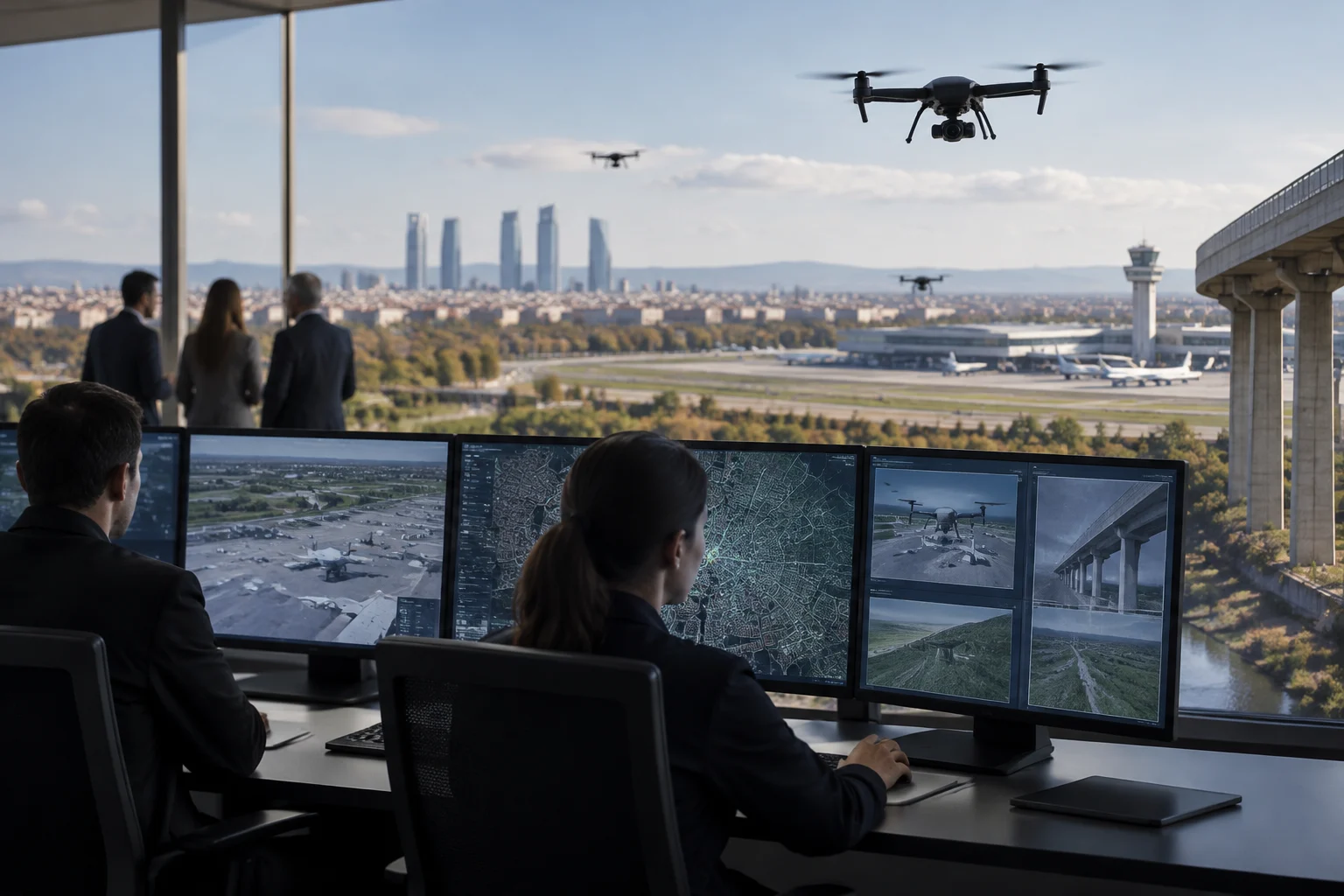
A fair focused on security and unmanned systems
The fifth edition of TECNOSEC DRONExpo is scheduled for November 5 and 6, 2026, at the Crystal Pavilion in Casa de Campo, according to event information. The meeting covers security and intelligence technologies, protection of critical infrastructure, drones, and counter-drone systems. The fair is held alongside DRONExpo, combining public security areas with unmanned system applications.
The technological interest of the event is better understood through concrete examples than a broad list of trends. Among them stands out the participation of Integración Tecnológica Empresarial (ITE), which announced it would present C2LYNX, CANARD, and ATONDrone. These three proposals relate to drone operations or technical inspection, but they respond to different tasks: operational coordination, airport inspection, and evaluation of maritime navigation aids.
Information disseminated by the organization and companies describes capabilities that were shown or expected to be shown during the event. This does not allow concluding that each system has been implemented in a specific body, nor that the announced functions have the same degree of maturity. It is advisable to distinguish the presentation at a fair, the development of a solution, and its sustained operational use.
C2LYNX: Gathering aircraft and data in one operation
ITE described C2LYNX as a command and control platform to manage operations with multiple drones and information sources. The company noted that the system can integrate vehicles, sensors, and data, and present that information in a common view to support real-time decisions. It also announced capabilities for integration with counter-unmanned aircraft systems and air traffic management functions.
A relevant point for potential users is that ITE defines the communications architecture as agnostic: the platform can work, according to the company, over 5G networks, fiber optics, satellite, or other IP infrastructures. Connection flexibility can facilitate use in different environments, but it does not guarantee by itself an available, secure, or interoperable connection. Those conditions depend on the infrastructure, integrated equipment, and configuration of each deployment.
The company also explained that it adapts C2LYNX for a command post associated with the Drone Unit of the Military Emergency Unit. The description includes remote posts for operators and management of telemetry, video, and images from unmanned systems. This is an application aimed at coordinating information during emergency operations; the communication does not demonstrate that the complete solution has entered service nor does it detail results of an operational evaluation.
CANARD and ATONDrone: Airport and port inspection
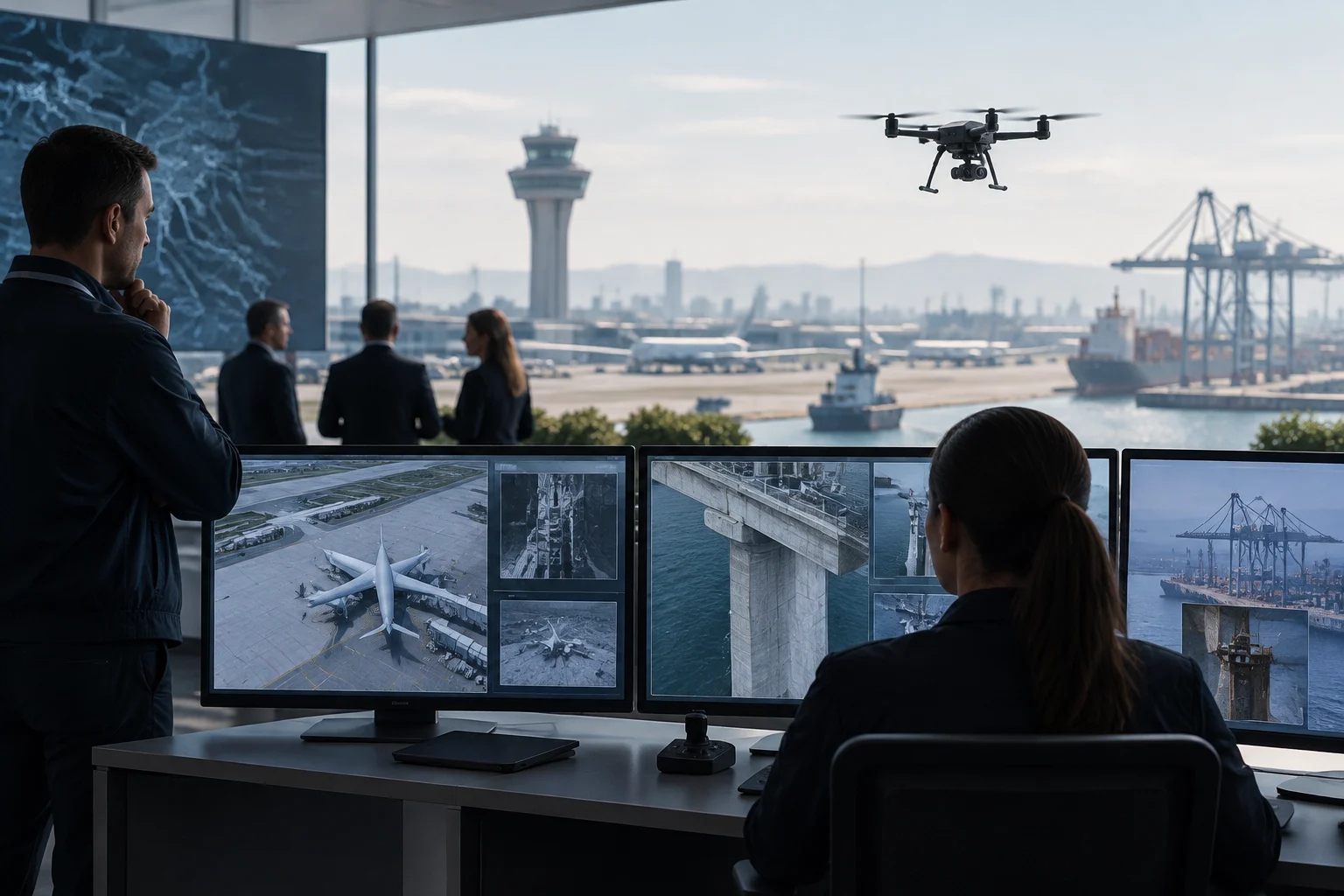
CANARD is ITE's line for airport inspection using unmanned systems. The company claims that it combines drones, software, sensors, and data processing to review air navigation aids, including ILS and VOR, as well as visual systems like PAPI and ALS. The stated objective is to obtain measurements and technical information for inspection and maintenance tasks.
This application may be relevant for airport operators because drone inspection can reduce the need for physical intervention at certain points or affect airport activity. The practical advantage must be verified by procedure and location: the type of aid inspected, flight permits, required accuracy, and data validation condition its utility. The company indicates that CANARD is used in airport inspection in several countries, but the communication does not identify those countries nor provide performance figures.
ATONDrone transfers that experience to the port environment and maritime navigation aids. ITE presented it as a tool in development to capture and analyze georeferenced data; among the functions described are the verification of light sectors and the digitization of inspections. Its development status matters: the presentation of progress does not equate to a finished product, a certification, or a widespread port deployment.
What critical infrastructure operators can assess
In airport, port, or emergency facilities, the utility of a drone system does not depend only on the aircraft. The adoption decision requires assessing the task to be replaced or complemented, the necessary accuracy, service continuity, and how to integrate results with existing systems and procedures. In an inspection, for example, the captured information must be interpretable and traceable for those authorizing maintenance.
For command and control platforms, the main criterion is whether they can combine data from equipment and networks already present without creating a difficult-to-sustain dependency. ITE presents C2LYNX as modular and compatible with different IP infrastructures, but real interoperability is verified in each integration, including data formats, permissions, latency, communication continuity, and operational procedures. A broad compatibility claim does not replace tests with the operator's specific systems.
It is also advisable to separate automation advantages from human responsibilities. Audiovisual and telemetry information can support decisions, but the operator must know its origin, quality, and possible interruptions. For a purchase or pilot, it is reasonable to request acceptance criteria, usage limits, incident management, and documentation on maintenance, training, and cybersecurity, in addition to a functional demonstration.
Security, privacy, and interoperability are not extras
A system that gathers video, telemetry, and sensor data centralizes information from multiple sources. The evaluation must include who accesses that data, how long it is retained, and how it is protected, in addition to the authorized purpose for its collection. Specific needs will depend on the operator, the location, and applicable regulations.
In the technical dimension, the architecture described for C2LYNX offers transport options over 5G, satellite, fiber, or other IP connections, but not an end-to-end security guarantee. Before integrating a platform, the operator must check authentication, access control, encryption, activity logging, update management, and response to connection loss, according to the mission risk.
For drone inspection, flight authorizations, separation from other operations, and validation of data incorporated into maintenance decisions are also important. Useful interoperability must be verifiable and maintainable: it is not enough to connect equipment once; clear responsibilities, update tests, and criteria for removing or replacing components are needed.
Key applications for the 2026 edition
The program for TECNOSEC 2026 highlights a set of specific applications: coordination of multiple drones through command and control, inspection of air navigation aids, and development of inspection procedures in ports. ITE's contribution illustrates how a common technological base—unmanned platforms, sensors, data, and software—can adapt to different operations without turning them into the same product or problem.
For security forces, emergencies, and infrastructure operators, the practical conclusion is to evaluate each capability by mission and maturity level. C2LYNX is presented as an operation platform; CANARD, as an airport inspection solution that the company claims to use in several countries; ATONDrone, as a development for the maritime field. The difference between declared use, demonstration, and proven deployment should guide any purchase or pilot decision.
The fair serves as a showcase to know proposals and establish contact with suppliers, but the commercial presentation does not replace an independent technical evaluation. To move from interest to a decision, the next useful step is to require a test linked to a real task, with agreed metrics, security requirements, documented compatibility, and defined operational responsibilities.