A new generation already translating into commercial devices
Intel Core Ultra Series 3, codenamed Panther Lake, moved from presentation to sold laptops during 2026. Launch information in January identified initial devices and pre-order/availability dates; subsequently, commercial models with these processors appeared in stores and independent reviews. For buyers, the question is no longer just what the chip promises, but what configuration each laptop mounts.
The family does not equate to a single processor. It gathers chips with different CPU core counts and graphics, and the commercial name alone does not determine that a device includes the Arc B390. For example, MSI's Spanish store lists Prestige laptops with various Core Ultra Series 3, including models with different integrated graphics. You must check the full SKU and manufacturer's spec sheet, not infer the GPU from the Panther Lake label.
The announced sales dates for the series do not imply that every laptop is available in all countries. MSI's Spanish store shows local configurations, with prices and inventory varying by model and timing. For a corporate renewal, it is advisable to check availability, installed memory, and service/warranty conditions in the market where the device will be purchased.
Hybrid cores: the total number doesn't tell the whole story
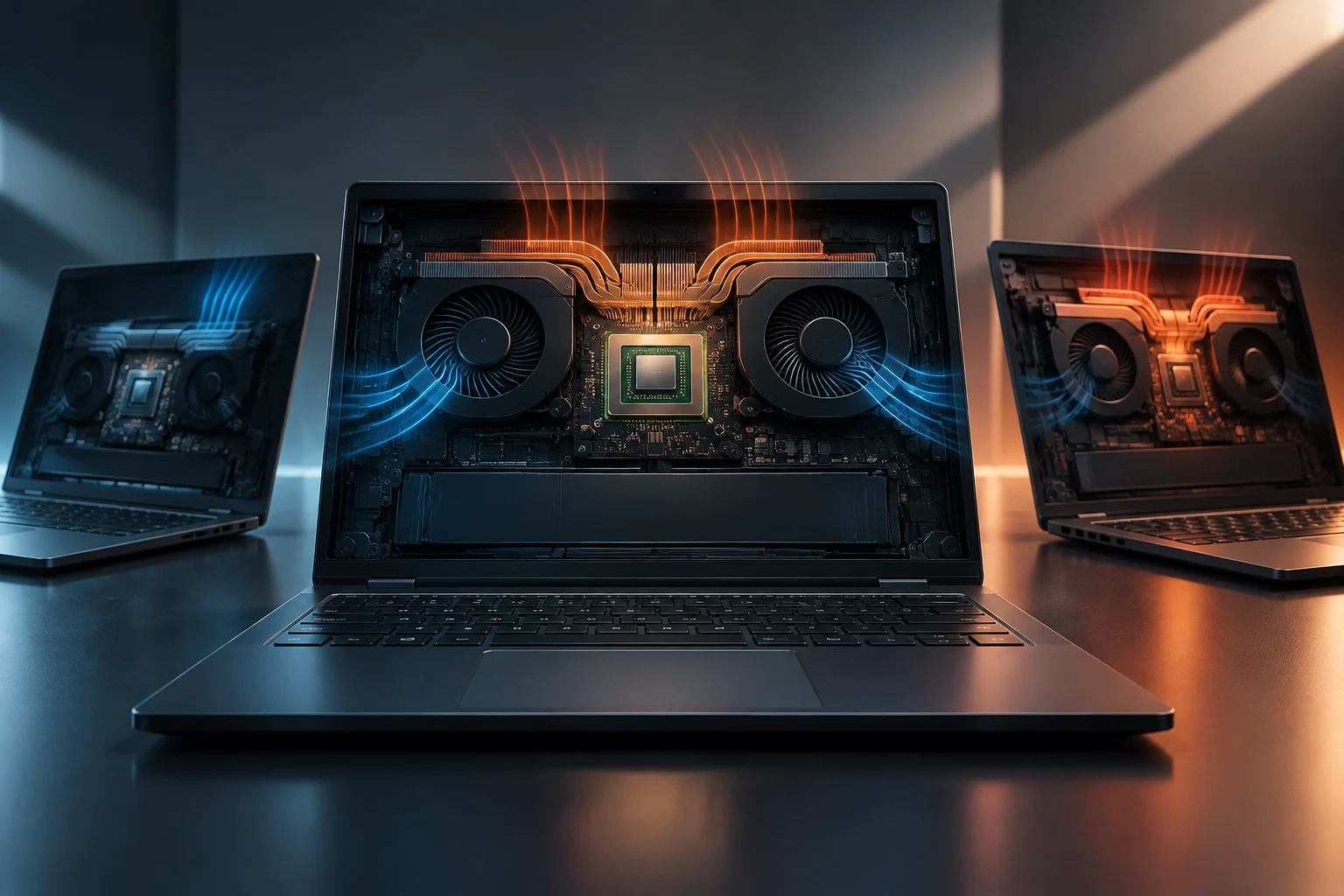
High-end Panther Lake configurations described combine P-cores for performance, E-cores for efficiency, and LP E-cores for low power. A 16-core configuration can be distributed as 4 P + 8 E + 4 LP E; other models have fewer cores. This combination aims to assign different loads to different blocks, but the real result also depends on power limits, cooling, and operating system management.
Comparison with previous generations helps understand the change. Meteor Lake already used a heterogeneous architecture, with P, E, and low-power cores; Lunar Lake and Arrow Lake presented different configurations and capabilities within the previous series. Technical coverage of Panther Lake highlights that Series 3 unifies more platform capabilities across its variants, though CPU and GPU differences remain. It is incorrect to describe it as a step from a homogeneous to a hybrid architecture: it is a new iteration of an approach Intel had already been using.
In a professional laptop, additional cores can benefit parallel tasks like compilation, export, or simultaneous loads, but they do not guarantee a perceptible improvement in every application by themselves. The result also depends on the device and specific use, so the core count serves to filter options, not to replace tests of the chosen configuration.
Panther Lake configurations: what to verify
These examples show why the Series 3 name alone does not identify a laptop’s processor or integrated graphics. Check the complete SKU and device specifications.
| High-end X9 example | 16 CPU cores · Arc B390 · 12 Xe cores |
|---|---|
| Series 3 example | 16 CPU cores · Intel Graphics · 4 Xe cores |
| MSI Spain listing | X7 358H · Intel Arc · 32 GB RAM · 1 TB SSD |
| MSI Spain listing | 9 386H · integrated graphics · 32 GB RAM · 2 TB SSD |
The MSI listing reflects configurations shown by the store when checked; stock and prices can change. Processor specifications do not describe every laptop design or its performance.
Arc B390: integrated graphics, but not in all Series 3
The Arc B390 is the most powerful integrated graphics option associated with certain Panther Lake configurations: it integrates 12 Xe3 cores according to technical reports on the family. Other variants use lower-capacity Intel graphics or an Xe3 GPU with fewer resources. Therefore, claiming that any Core Ultra Series 3 incorporates a B390 leads to a wrong choice; you must verify the specific processor installed.
A powerful integrated GPU can expand the margin for light editing, multimedia acceleration, and gaming without a dedicated graphics card. However, its performance is not summarized by comparing it to a discrete GPU from another era: allowed power consumption, laptop cooling, memory, and available bandwidth intervene. In a thin system, these limits can change sustained behavior compared to a larger machine with the same chip. The practical advantage is reducing the need for a separate GPU in certain loads, not automatically turning an enterprise laptop into a graphics workstation.
Performance figures from announcements and comparisons correspond to specific scenarios, not a universal guarantee. Resolution, graphic quality, drivers, and power can change results. Those who edit video should review codecs and software used; those who game, look for tests of the specific laptop model and not just the processor. For 3D loads or applications with certification requirements, it is advisable to check software requirements and tests of the exact configuration.
NPU and AI features: chip capability vs. everyday utility
Panther Lake incorporates an NPU to accelerate certain artificial intelligence loads on the device itself. Technical materials for the family cite up to 50 TOPS of NPU in certain models and higher figures when CPU, GPU, and NPU are summed. These metrics should not be mixed: NPU TOPS and total platform performance describe different scopes, and do not indicate by themselves the speed of a specific application.
Local execution can be useful for compatible camera, audio, video call effects, or AI tools that leverage processor blocks. But utility depends on whether the software supports that NPU and whether the task is designed to run there. Having dedicated acceleration does not make every AI function local, private, or instant.
For a professional purchase, the relevant question is not just how many TOPS the chip announces, but which applications will be used, what system requirements they have, and whether data policy allows processing them locally. Check the requirements of the specific software and distinguish Windows features from third-party tools.
What the first commercial laptops teach
The MSI Prestige 14 Flip AI+ D3MTG-051ES, for example, appears in the manufacturer's Spanish store with a Core Ultra X7 358H and Intel Arc graphics. The same collection offers other Prestige models with Core Ultra Series 3 processors and different configurations. The listed models vary in processor, graphics, screen, and memory, so consult the specifications for the exact model before choosing.
The Dynabook Portege Z40L-P series has been described in coverage published in July 2026 with Core Ultra X7 and X9 options and configurations of up to 64 GB of LPDDR5X. That coverage also describes a 14-inch WUXGA screen and a 56 Wh user-replaceable battery. These specifications concern this particular enterprise laptop, not the Panther Lake platform as a whole. For a purchase, the exact variant matters more than the processor family.
Announced battery life does not necessarily equate to the duration each user will get: screen brightness, refresh rate, applications, network, and power profile can vary the result. The announced figure does not guarantee battery life in any use. Before buying, check installed memory and specific specifications of the model.
Efficiency and comparison: what can decide a buyer
Intel presented performance-per-watt and battery life improvements as part of Panther Lake's positioning. These are platform claims and depend on the selected comparison and the device used. An independent evaluation of a laptop with Core Ultra X9 388H described good performance and efficiency results in that unit, but also warned that it was a sample of a single device. That test supports that the chip can perform well in a specific design; it does not establish the battery life of all Panther Lake.
To compare Panther Lake with Meteor Lake, it is advisable to review equivalent devices and loads. Tests of a specific configuration do not by themselves predict the performance of all laptops with those processors. To evaluate a renewal, compare complete laptops with equivalent workloads.
A brief list helps turn specifications into a practical decision:
- Identify the exact processor and confirm if it incorporates Arc B390, another Xe3 GPU, or lower-level Intel graphics.
- Check installed RAM, memory type, maximum capacity, and if it can be expanded or replaced.
- Look for tests of the specific laptop in the applications and working conditions that matter.
- Contrast battery, screen, weight, ports, support, and local availability along with performance.
- For AI features, verify software compatibility and privacy requirements before considering them a decisive benefit.
Conclusion: choose the laptop, not just the Panther Lake name
Core Ultra Series 3 gathers processors with different CPU, Xe3 graphics, and NPU configurations. The maximum of 16 cores and the Arc B390 describe the high end of the family, not a specification common to all Panther Lake laptops. The purchase decision must start from the exact commercial model and variant.
The Arc B390 is the most powerful integrated graphics option associated with certain Panther Lake configurations, but the family also includes variants with lower-capacity graphics. Check the processor and GPU of the exact model and consult tests of the applications you will use. In the purchase, also review installed memory and device features relevant to your use.
The improvement over Meteor Lake should not be judged by an isolated efficiency promise or a name comparison. It is advisable to review measurements of the complete device and the specifications of the configuration that will be sold in the local market. Laptop tests describe that specific configuration, not necessarily the behavior of the entire platform.