
Canonical Definition: What Constitutes an AI System
Artificial intelligence is defined as the field of computer science dedicated to creating systems capable of performing tasks that traditionally require human intelligence, such as perception, reasoning, learning, and natural language understanding. This definition, supported by bodies like the European Union and tech companies, establishes that it is not a single technology, but a set of methods that allow machines to process information and make decisions.
The European AI Act, which entered into force in February 2025, offers a legal framework to classify these systems according to their risk level. The regulation distinguishes between general-purpose and specific systems, establishing obligations for providers and users. This regulation aims to ensure that AI development is transparent, safe, and respectful of fundamental rights, marking a global standard for the industry.
Difference from Traditional Programming
Unlike a traditional program, where each rule is explicitly preprogrammed by a developer, an AI system learns patterns from data. In classic programming, if the criterion changes, the code must be manually modified. In AI, the system adjusts its internal parameters when exposed to new examples, allowing it to adapt to situations not foreseen in its initial design.
Functioning Mechanisms: From Data to Decision
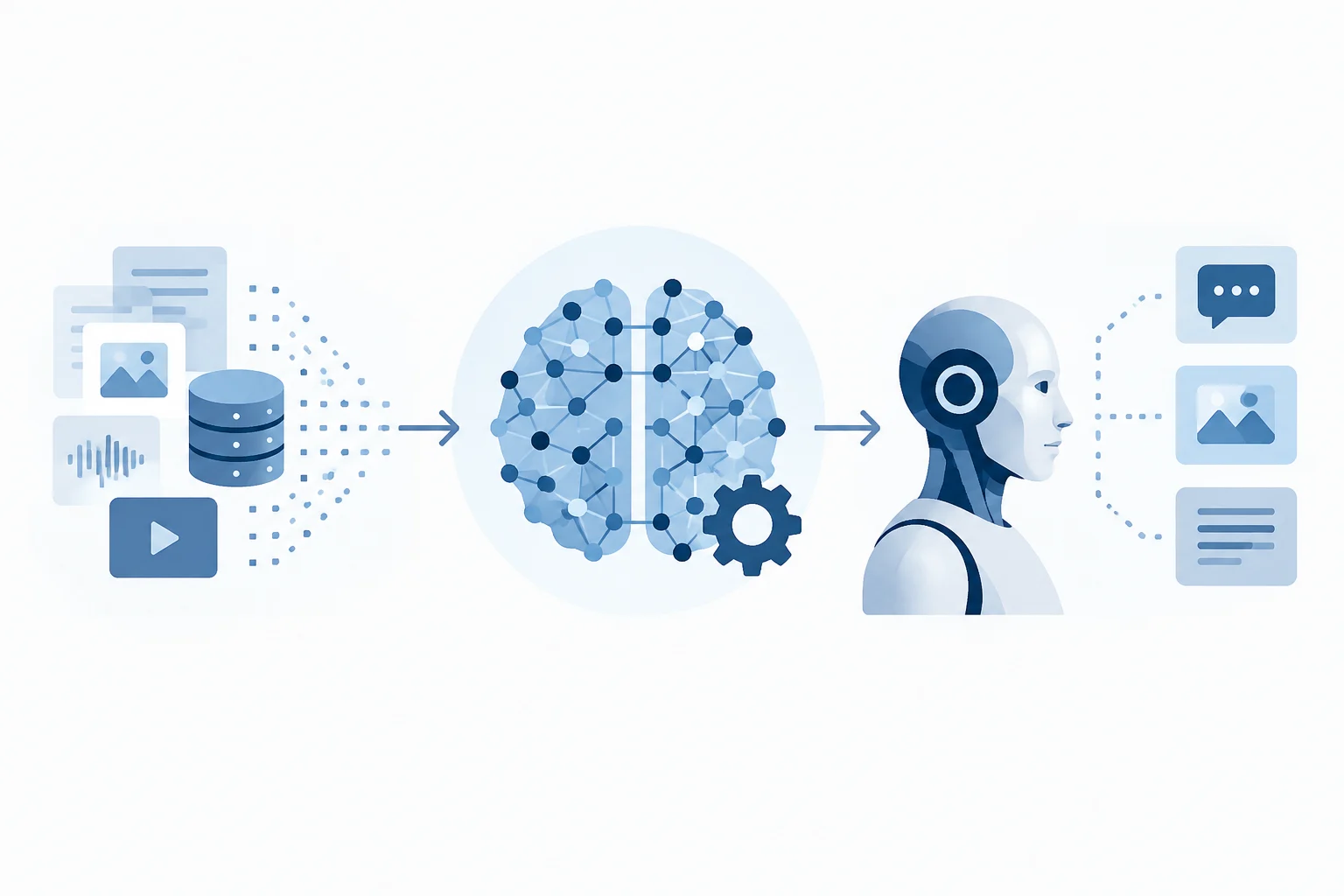
The functioning of an AI system is based on machine learning, a subset of AI where systems identify patterns in large volumes of data without being explicitly programmed for each case. The process begins with data collection, which is used to train a mathematical model. This model adjusts its internal parameters until its predictions align with the expected results in the training dataset.
Once trained, the model enters the inference phase, which is the moment when the system applies the learned patterns to new data to generate a response or decision. For example, a model trained with animal images can identify a dog breed in real time, even if it has never seen that specific image before. The quality of inference depends directly on the quantity and relevance of the data used in training.
The Model Lifecycle
The development of an AI system follows an iterative cycle that includes data collection, training, validation, deployment, and feedback. Validation is crucial to measure the model's accuracy on data it has not seen during training, avoiding overfitting. Feedback allows updating the model with new data, improving its performance over time.
Types of Machine Learning
Within machine learning, there are three main approaches that differ by how data is structured and how the model receives its instructions. The choice of method depends on the nature of the problem and the availability of labeled data. Each approach has specific applications and distinct requirements regarding the quality and volume of input information.
The following table compares the three main types of machine learning, highlighting their characteristics, application examples, and data requirements:
| Learning Type | Description | Application Example | Data Requirements |
|---|---|---|---|
| Supervised | The model learns from data labeled with the correct answer. | Spam detection in emails. | Labeled data (input and expected output). |
| Unsupervised | The model identifies patterns or clusters in unlabeled data. | Customer segmentation in marketing. | Unlabeled data, large volumes. |
| Reinforcement | The model learns through trial and error, receiving rewards or penalties. | Navigation robots or chess games. | Simulated or real environment with continuous feedback. |
Supervised learning is the most common in commercial applications, as it allows objective evaluation of model accuracy. Unsupervised learning is useful when the data structure is unknown or hidden relationships are sought. Reinforcement learning is employed in dynamic environments where the agent's action has immediate, measurable consequences.
Weak AI, Strong AI, and Generative AI
The field of AI is traditionally divided into two branches: weak artificial intelligence (or narrow) and strong artificial intelligence (or general). Weak AI is designed to perform specific tasks, such as voice recognition in a virtual assistant or product recommendation in an e-commerce platform. Most current applications belong to this category, as they are easier to develop and evaluate.
Strong AI (AGI, for its English acronym) aspires to emulate human intelligence in its entirety, allowing the machine to reason, adapt, and learn similarly to a person. This type of AI is still in the research phase and has not been achieved by any commercial system. The distinction is important to avoid unrealistic expectations about the current capabilities of the technology.
Generative AI vs. Analytical AI
In recent years, generative AI has gained prominence, a subset of AI that creates new content (text, images, code) from learned patterns. Unlike analytical AI, which classifies or predicts, generative AI produces creative outputs. Models like OpenAI's GPT-4 are examples of generative AI, used to write texts, generate code, or create images. This capability has expanded the reach of AI in creative sectors and software development.
Practical Uses and Explained Examples
Artificial intelligence is applied in various sectors, from health to industry. In the medical field, AI systems help in image diagnosis, analyzing X-rays or MRIs to detect anomalies that might be missed by the human eye. These systems do not replace the doctor, but act as a support tool that streamlines the process and reduces workload.
In the financial sector, AI is used for fraud detection, analyzing transactions in real time to identify suspicious patterns. In e-commerce, recommendation engines suggest products based on purchase history and user behavior. In industry, AI optimizes the supply chain, predicts machinery failures, and automates quality control processes.
Example: Medical Diagnosis
An AI system trained with thousands of retinal images can detect signs of diabetes or glaucoma with accuracy comparable to a specialist. The model analyzes the image and generates a probability of disease, which the doctor reviews and confirms. This approach allows scaling diagnostic capacity in areas with a shortage of specialists, improving access to healthcare.
Limits, Risks, and the Need for Supervision
Despite its advantages, AI presents significant risks that must be managed. One of the most notable is hallucination, a phenomenon where a generative model invents information that does not exist or is incorrect, presenting it with the same confidence as real data. This occurs because the model predicts the next most likely word or element, without verifying the truthfulness of the information.
Another important risk is bias in training data. If the data used to train a model is not representative of the target population, the system's recommendations may favor or harm certain groups. For example, a hiring model trained with biased historical data may perpetuate gender or racial discrimination. Human supervision is essential to detect and correct these biases.
Dependence and Fading of Judgment
Excessive trust in AI systems can lead to technological dependence, where professionals adopt the system's suggestions without critically reviewing them. This is particularly concerning in critical sectors like health or justice, where an error can have serious consequences. User training and the implementation of verification protocols are essential to mitigate this risk.
Basic Glossary of Key Terms
To understand AI, it is useful to familiarize oneself with some technical terms. A model is the mathematical representation that the system uses to make predictions. A dataset is the collection of information with which the model is trained. Inference is the process of applying the trained model to new data to obtain a response.
Training is the phase in which the model adjusts its parameters to minimize error in the training data. Validation is the process of evaluating the model with data it has not seen during training, to measure its generalization capacity. Overfitting occurs when the model memorizes the training data instead of learning general patterns, reducing its performance on new data.
Importance of Data Quality
Data quality is determinant for the success of an AI system. Incomplete, noisy, or biased data can lead to inaccurate or unfair models. Data governance involves establishing processes to guarantee the quality, privacy, and security of the information used in training and inference. Without a solid database, even the most advanced algorithm will not function correctly.