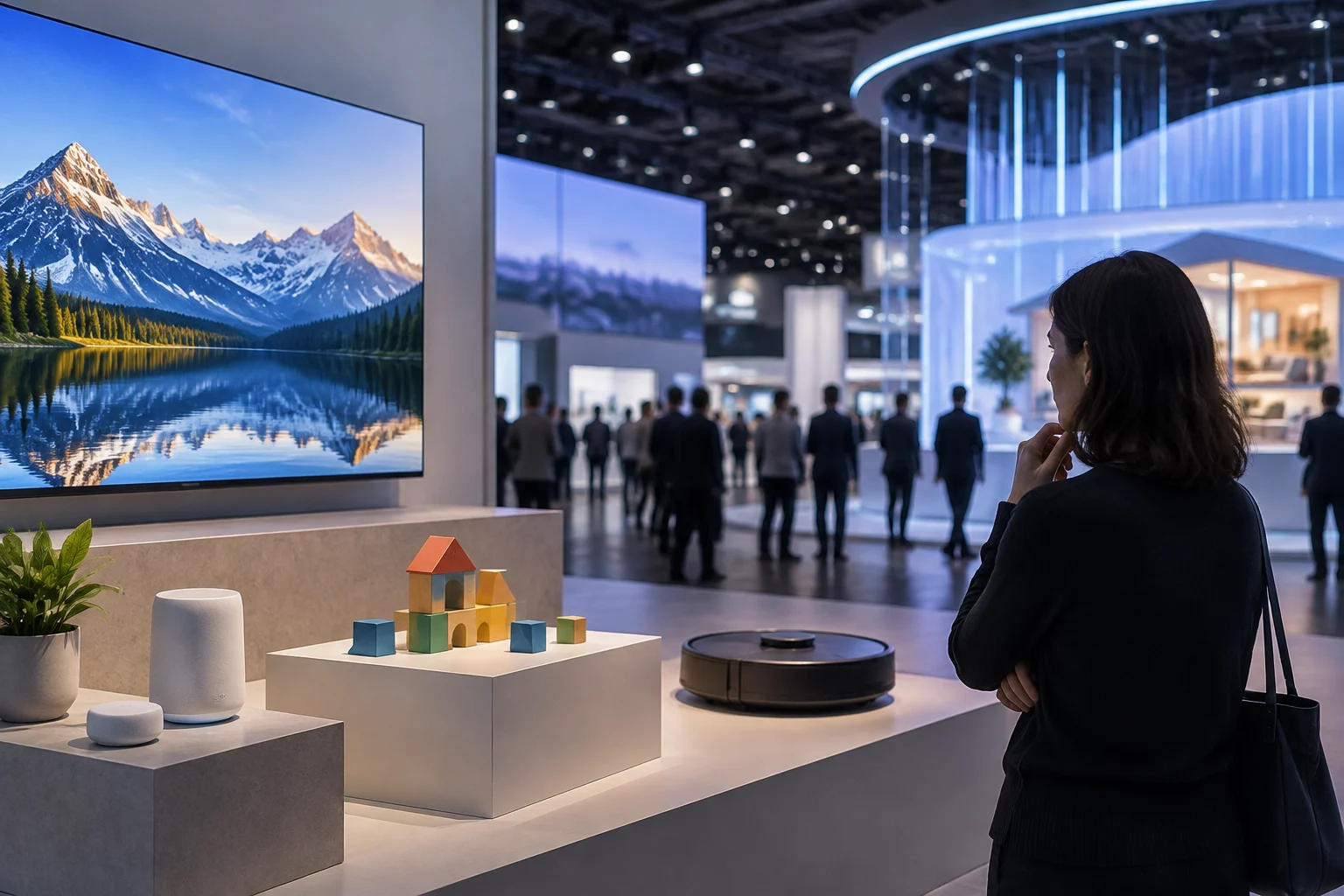
CES is not a catalogue of products for sale
CES serves as a showcase for announcements, demonstrations and technologies in development. So when a company presents something at the show, that alone does not confirm the product is ready to buy: it could be a future range, a demonstration or a concept with no sales date. A presentation and availability are different things.
The January 2026 edition offered useful examples of that distinction. Samsung announced a Micro RGB range for the year; LEGO described SMART Play as a new physical play experience; and Roborock showed the Saros Rover, a robot vacuum with legs and wheels. However, the available sources do not provide the same level of sales information for each case.
For shoppers, the useful question is not only what was shown, but what specific evidence exists that it is being sold in their country. An announced launch date is not the same as a store with stock, and the absence of a date in a press release does not prove a product will never go on sale. It helps to distinguish what was announced, what was dated and what is available.
Samsung Micro RGB: a future range with announced sizes
Samsung said it would expand its Micro RGB TV range during 2026 and listed sizes of 55, 65, 75, 85, 100 and 115 inches. The announcement also mentions improved colour reproduction and intelligent processing, but does not by itself establish that every model is on sale in every market. Samsung Newsroom Spain. The size list describes the announced range, not necessarily local stock.
The press release is dated December 2025 and refers to a launch in 2026. As of 15 October 2026, claiming that a particular size is on sale would require checking a current commercial listing from Samsung or an authorised retailer in the relevant country. The information provided for this article does not include such listings or verified prices; it would therefore be inaccurate to present the entire range here as available.
It is also important not to confuse the name of a technology with a purchase reference. “Micro RGB” identifies the technology family in the announcement, but is not enough to identify a particular TV: model names, reference numbers and market-specific sales details are missing. Without those identifiers, an offer or product listing cannot be checked reliably.
LEGO SMART Play: a system unveiled, with sales not verified here
LEGO describes SMART Play as an interactive play system intended to make builds respond without relying on screens. The company’s page explains the system’s purpose and development, and says it would arrive from 2026 onwards; that wording does not set an exact availability date or confirm which sets can be bought today. LEGO.
CES coverage reported the unveiling of SMART Play and the interaction between its elements. This helps explain why the proposal attracted attention, but a report about a presentation is no substitute for an official catalogue listing product references, prices and sales markets. This research contains no product listing with those details that would allow a purchase to be verified in October. A public unveiling does not mean confirmed availability.
When checking, distinguish between the system—the idea and its components—and any retail sets that might incorporate it. Once announced, a launch date will need to be tied to a specific reference and region. Until that information is available, it is more accurate to describe SMART Play as an initiative announced for 2026 than to claim that it is on sale in a particular market.
Roborock Saros Rover: striking demonstration, commercial status unconfirmed
Roborock presented the Saros Rover at CES 2026 as a robot vacuum combining wheels and legs, designed to handle changes in level and stairs. The announcement distributed by PR Newswire reports the unveiling, but gives no verifiable sales date or price for the Rover. Roborock announcement distributed by PR Newswire. The demonstration does not confirm a commercially available product.
A show report describes the mobility system and the capabilities demonstrated, but that does not establish availability either. The same announcement also mentions other Roborock products planned for the first half of 2026. Their schedules should not be conflated with the Saros Rover’s: several devices appearing in the same presentation does not mean they share a release date, status or markets.
In this case, the prudent classification is “announced”, with commercial availability unconfirmed by the sources gathered. This does not prove that it is a prototype with no commercial future; it only means there is not enough evidence here to say that it is already on sale. That is a documentary limit, not a prediction about what the company will do next.

How to check whether you can buy it yet
Before making a decision, look for evidence that applies to the exact product and the buyer’s market. A news page may confirm an announcement, but a purchase requires current commercial details: an identifiable model, country, seller and terms. If those elements are not published, the conclusion should remain “announced” or “availability unconfirmed”.
A practical check can follow this order:
- Search the manufacturer’s official website for the exact model or reference, not just the technology name or product family.
- Confirm that the page is for the country where you want to buy, and check whether it indicates a sale, preorder or product information only.
- Cross-check stock and price with an authorised retailer; record the date you checked, since inventory can change.
- Separate the announced launch date from actual availability: a future date does not prove the product is already in stores.
- If the only evidence is show videos, press releases or articles, treat them as evidence of an announcement, not proof of a sale.
This caution also helps avoid an equally misleading conclusion in the opposite direction: not finding a sales listing among the sources consulted does not prove that the product is unavailable everywhere. Availability can vary by country, date or sales channel. A dated, local check is more useful than a blanket claim about an entire market.
What can be concluded from CES announcements
The cases reviewed do not have the same level of detail. Samsung announced sizes for a range planned for 2026; LEGO explained a play concept and said it would arrive from that year onwards; and Roborock presented a mobility concept for a robot with no commercial date verified in the sources consulted. These are significant announcements, but they do not amount to three products confirmed as available in October.
The rule for reading CES is simple: an announcement confirms that something was communicated, not that it has reached stores. Moving from news to a buying decision requires later, specific evidence: an official listing for the model, a date applicable to the local market and a store where availability can be checked. If one piece is missing, it is better to say so than to fill the gaps with assumptions.
Ultimately, CES helps identify what might arrive and which companies are developing new ideas. To find out what can be bought, the standard must be stricter than a presentation: identify the product and variant, consult the relevant sales source and check the date. This avoids turning a technology demonstration into a promise of availability that the evidence does not support.