Where SiC Intervenes in the Traction Chain
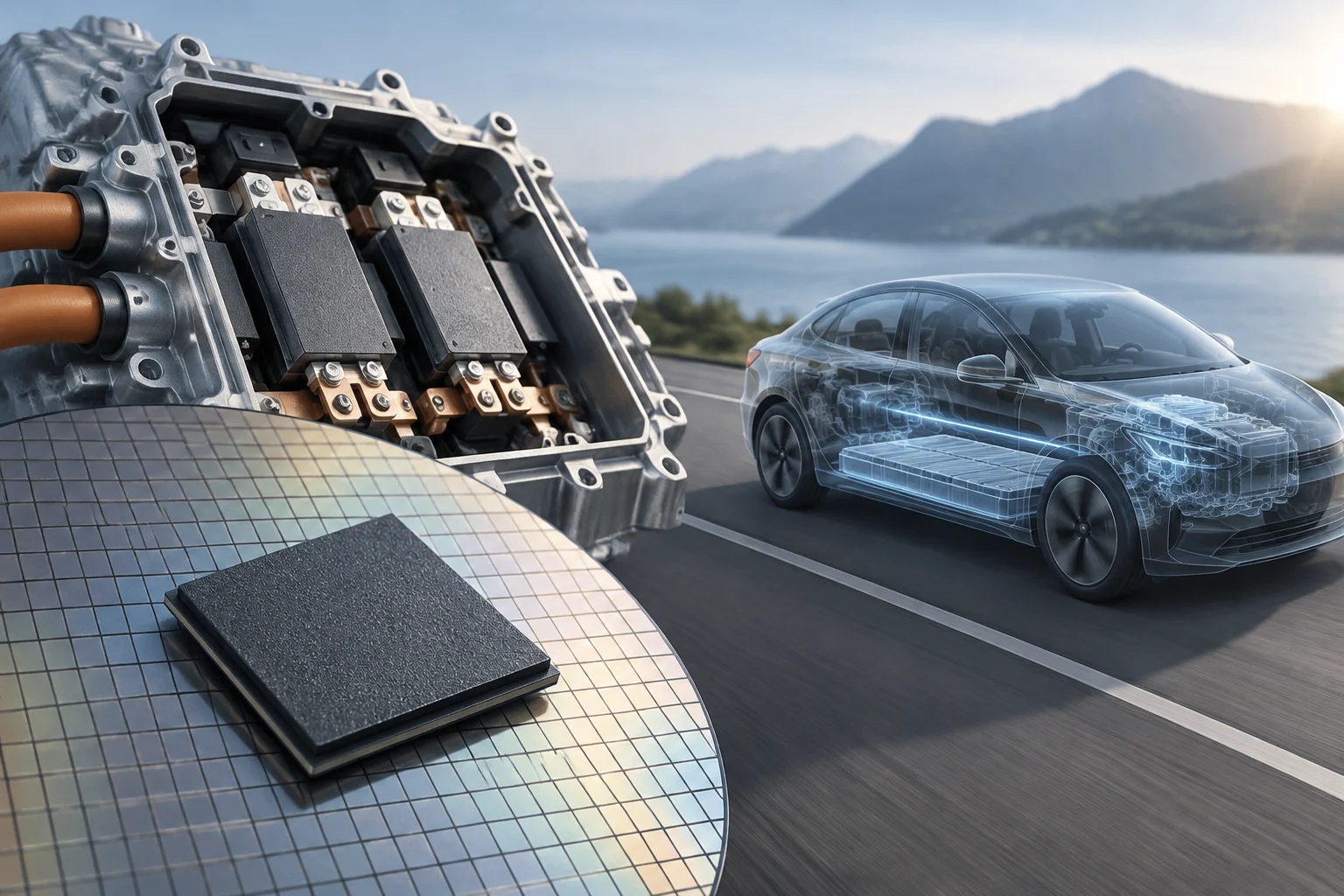
An electric vehicle battery delivers direct current, while the traction motor typically receives alternating current. The inverter converts and regulates energy between them: its semiconductors switch on and off to control the electrical flow. In this conversion, part of the energy is lost as heat. Silicon carbide, or SiC, is a material used in power devices to manage this stage.
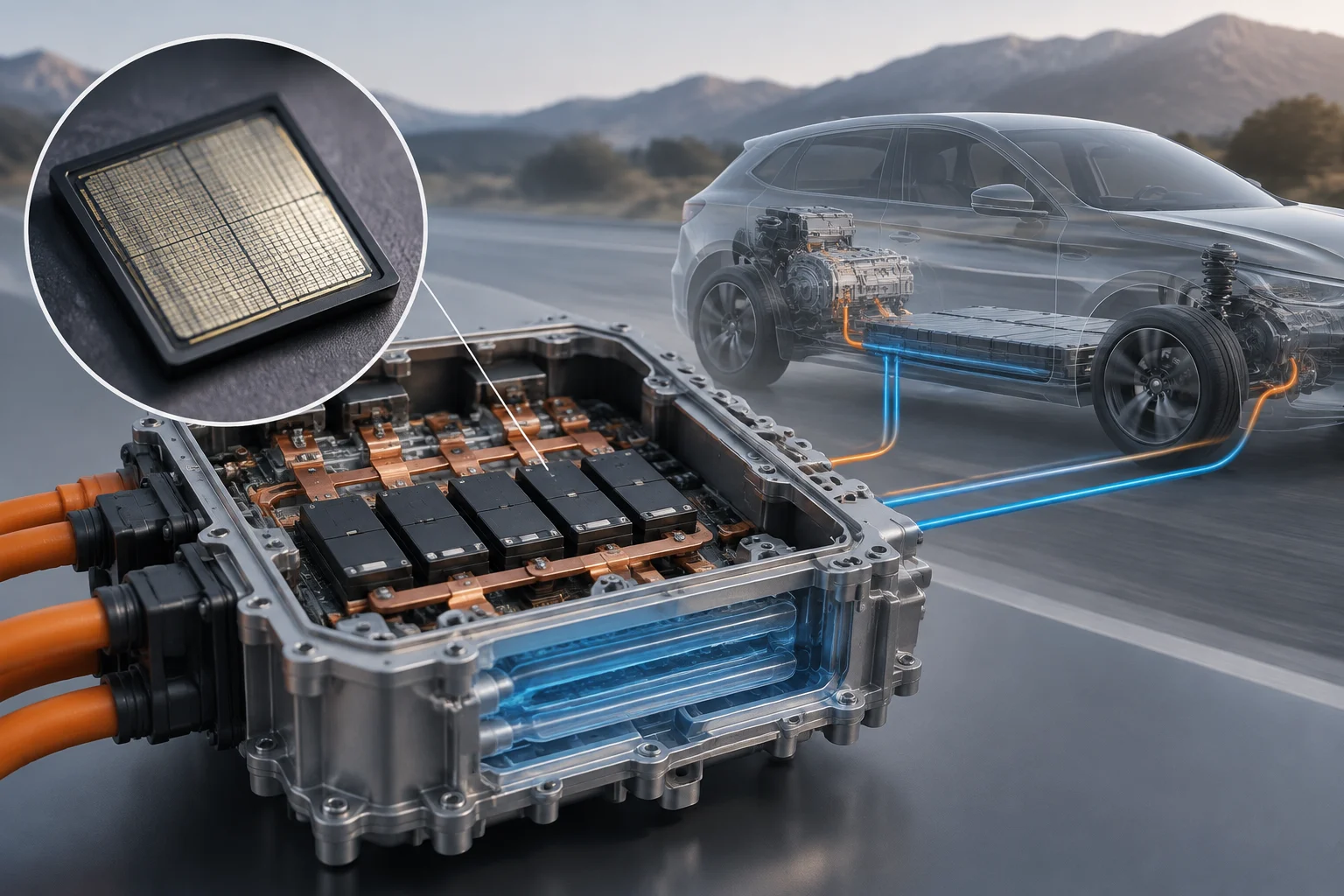
Bosch positions its SiC chips in the vehicle's power electronics, presenting them as a way to improve traction efficiency. Mitsubishi Electric, for its part, designs its SiC-MOSFETs for motor inverters and eAxle units, which integrate the motor, inverter, and transmission. Location matters: a transistor improvement can only influence the losses of the equipment where it is installed; it does not by itself describe the performance of the battery, the motor, or the complete vehicle.
Therefore, it is advisable to distinguish three scales often mixed in commercial communications: the electrical characteristic of the semiconductor, the inverter performance, and the homologated or measured consumption of the automobile. An improvement in the first scale does not by itself prove an equivalent improvement in the third. To move from one to the other, system data and comparable test conditions are required.
What Can Improve Compared to Silicon Devices
SiC is an alternative to silicon in power electronics, especially in high-voltage and high-power applications. The usual explanation is that its properties allow designing devices with lower losses under certain conditions and fast switching. This can help reduce the energy dissipated in the inverter, but the result depends on voltage, current, switching frequency, temperature, and circuit design.
Conduction resistance, called on-resistance, is a metric of the transistor when it is on. A reduction can decrease conduction losses under defined conditions; it is not a global efficiency measure nor a direct estimate of the vehicle's energy savings. Switching losses, diode behavior, the thermal resistance of the assembly, and electronic control also matter. The figure is only comparable if the nominal voltage and measurement conditions remain constant.
The material alone also does not establish the actual operating temperature of the assembly. This depends on the device, its packaging, connections, cooling system, and duty cycle. A greater material capacity to operate in demanding environments does not authorize concluding that any SiC inverter can work without cooling changes or that the car will weigh less. These consequences require module and system specifications, not just a comparison between materials.
What Bosch and Mitsubishi Electric Figures Say
Bosch has announced the introduction of its third generation of SiC chips and the supply of samples to car manufacturers. Electrive coverage, citing the company, reports an improvement of around 20% in performance compared to the previous generation and a smaller size. This description does not identify the 20% as a 20% improvement in range nor offers a vehicle consumption result that allows reading it that way.
The difference between chip 'performance' and vehicle efficiency is decisive. To value Bosch's figure, the metric definition, operating point, reference configuration, and results in a comparable inverter or vehicle are needed. Official communication confirms the third generation and sample shipment, but the information cited here does not detail a range test with production vehicles. The figure must be read as a component performance claim, not as a percentage of additional kilometers.
Mitsubishi Electric announced on June 4, 2026, that it would begin sending samples of two types of fifth-generation SiC-MOSFETs in bare die format. The company claims that its conduction resistance is approximately 25% lower than that of previous products, comparing devices with the same nominal voltage and adjusted threshold. The components are intended for motor inverters and eAxle units of electric, plug-in hybrid, and other electrified vehicles.
Mitsubishi's data is more specific regarding the compared magnitude, but it remains a semiconductor specification. The company links this lower resistance with lower losses and potential improvements in efficiency and range; it does not equate to a published measurement of kilometers per charge. Furthermore, the comparison is with the company's previous generation under adjusted conditions, not with any silicon MOSFET available on the market. It is a useful reference for component design, not proof of road savings.
From Chip Metric to Vehicle Consumption
To convert semiconductor properties into a consumption figure, the complete inverter must be evaluated under representative conditions. The result depends on how the device is driven, the converter architecture, cooling, and the loads the automobile goes through. The balance also includes losses outside the inverter, so a localized improvement may be diluted in total consumption.
A technically useful comparison should specify, at a minimum, operating voltage and current, junction temperature, switching frequency, load point, and reference configuration. To move to the vehicle plane, one would also need to know the driving cycle, ambient temperature, control strategy, tires, and other conditions affecting consumption. Without that context, percentages of resistance, performance, and range are not interchangeable.
In a validation program, the reasonable sequence is to first measure device and module losses, then inverter losses, and finally vehicle consumption under controlled conditions. To support a range claim, comparative vehicle tests are needed, not a linear extrapolation from conduction resistance. In real use, climate, speed, route, load, and cabin heating or cooling also influence.
Thermal control is part of this evaluation, not a benefit that can be taken for granted. Lower electrical losses can reduce the heat that must be evacuated at certain operating points, but the complete thermal system may be conditioned by other components and design objectives. For buyers and operators, the practical reference remains the consumption of the specific model in a comparable cycle; the semiconductor generation does not replace that figure.
Production, Market, and Limits of Forecasts
The advance of a chip generation to customer samples marks an industrial development stage, not necessarily its immediate availability in series vehicles. Bosch reports that it has begun supplying samples of its third generation to global manufacturers. Mitsubishi Electric scheduled the sequential shipment of samples of two device types during 2026. In both cases, adoption will depend on customer evaluation and integration into their systems.
SiC market estimates depend on which categories they include, the forecast period, and the analyst's method. Precedence Research estimates the global SiC semiconductor device market at $4.51 billion for 2026 and projects $29.14 billion for 2035. This is a commercial forecast, not a measure of sales already made nor an exclusive estimate of SiC for automotive. The scope itself includes uses and components from various sectors.
Manufacturing growth can be relevant for supply and costs, but it does not by itself determine the price a car manufacturer will pay or the savings for the end user. Device cost, manufacturing yield, wafer availability, packaging, and module design are part of the equation. Market forecasts serve to contextualize industrial investment; they do not prove that a specific technology will dominate all inverters.
Criteria to Decide if an Improvement is Verifiable
To compare supplier proposals, engineering teams should separate component specifications, module results, and automobile metrics. A generation name and a highlighted percentage are not enough if it is not explained what was measured and with what reference. In particular, a reduction in on-resistance must be read together with nominal voltage, temperature, and comparison method.
A useful technical sheet should allow checking these points:
- Metric and reference: what property improves and against which device, generation, or design.
- Test conditions: voltage, current, temperature, switching frequency, and measurement method.
- System level: results of the transistor, module, inverter, or vehicle, clearly differentiated.
- Thermal performance and durability: assembly data under relevant loads and temperatures.
- Intended application: type of inverter, system voltage, and supply stage, such as sample or series product.
For manufacturers and suppliers, this separation allows deciding if the improvement justifies redesigning the inverter, reviewing cooling, or accepting a different cost. For the reader comparing cars, the practical conclusion is simpler: SiC can contribute to more efficient power electronics, but range and consumption must be judged with vehicle data. The chip percentage does not replace the model's consumption figure.