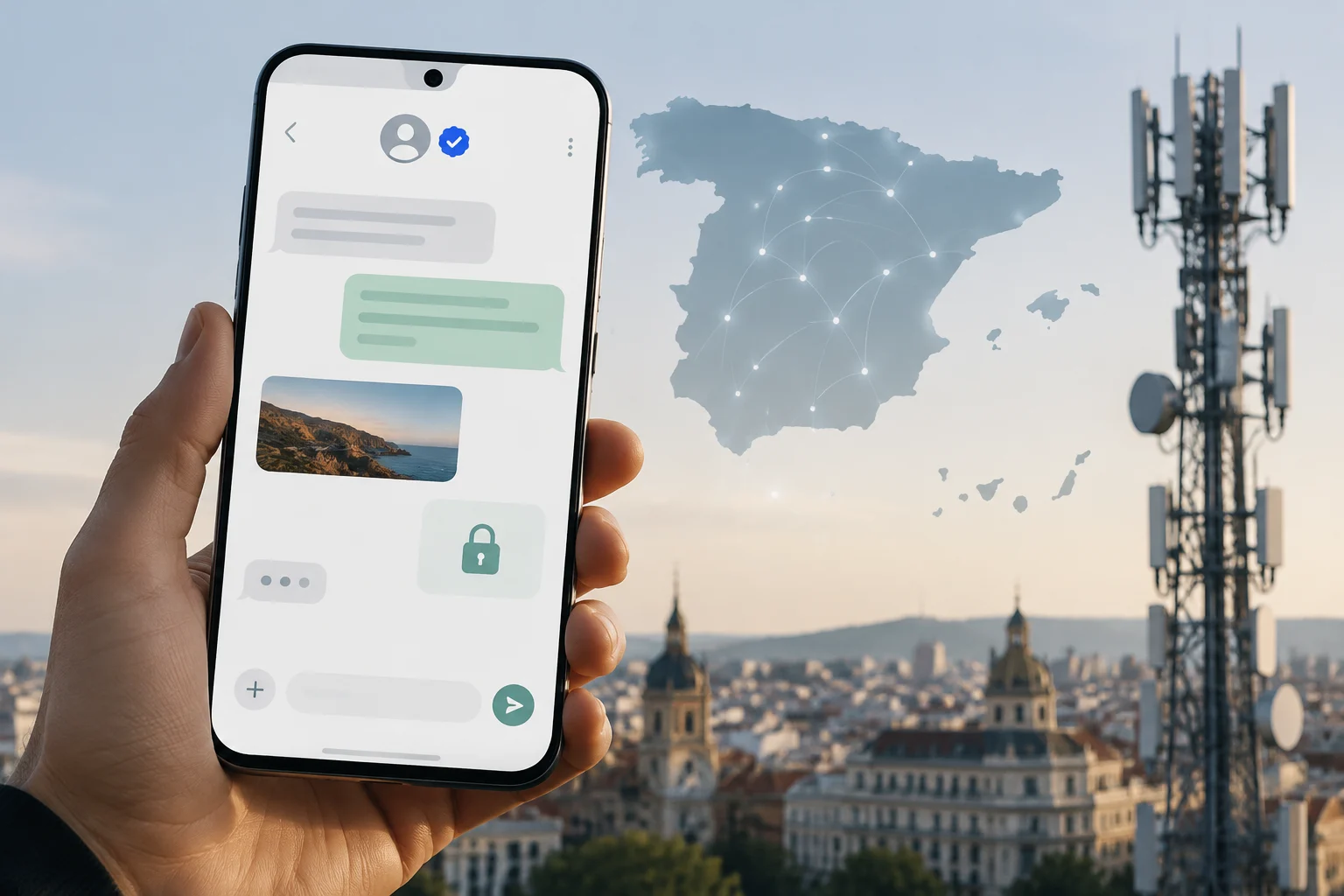
The current state of native messaging in Spain
The transition from SMS to Rich Communication Services (RCS) in Spain has been a gradual process dependent on coordination between manufacturers, operators, and standardization bodies. Unlike third-party applications, RCS operates within the device's native messaging app, eliminating the need for additional downloads and maintaining a direct link to the user's phone number.
Today, the protocol has consolidated itself as the technical successor to SMS, offering a layer of security and verification that the traditional system could not guarantee. Verified sender identity has become the fundamental pillar of this evolution, allowing users to distinguish between legitimate communications and identity spoofing attempts.
Operator deployment and regulatory framework
Major Spanish operators, including Movistar, Vodafone, and Orange, began activating RCS with verified sender identity in 2024 as a direct response to the increase in fraud through spoofing techniques. This implementation aligns with the GSMA Universal Profile, which standardizes security features and user experience globally.
A recent regulatory milestone has modified the operational environment: CNMC Circular 1/2026, published in the BOE on March 27, 2026, establishes the mandatory Alias Registry. From June 7, 2026, operators must filter or block SMS, MMS, and RCS messages that do not meet traceability requirements through an enabled Origin Provider.
This measure aims to reduce fraud and identity spoofing, ensuring that each alphanumeric alias is verifiably linked to a legitimate company. The impact on corporate messaging is significant, as sender identity has become a critical technical and regulatory element for message delivery.
Verified features and technical specifications
The latest version of the Universal Profile, 4.1 published in July 2026, introduces substantial improvements in stability and resource usage. This specification defines new technical bases for message transport and signaling, optimizing performance on both the device and the network.
Among the novelties are user profile exchanges in individual and group conversations, allowing contacts to be identified by name and photo rather than phone number. Additionally, end-to-end encryption capabilities have been reinforced to incorporate lessons learned from initial interoperability tests.
Basic features already active on most devices include the ability to create group conversations, see typing indicators and read receipts, and share high-resolution photos and videos. These features are available directly from the operators' messaging experience through the Android Messages app.
Device compatibility: Android and iPhone
In the Android ecosystem, activating RCS chats is a process that can be managed from the settings of the Google Messages app. The connection status can vary between 'Connected', 'Connecting', or 'Not compatible', depending on operator configuration and data network availability.
The situation on iPhone is more complex due to the integration of iMessage as the main protocol. Although RCS has been available on iOS since version 18, its adoption in Spain depends on enablement by local operators. From iOS 26.5, improvements have been introduced that allow end-to-end encryption in chats between iPhone and Android on compatible networks, although full interoperability remains a work in progress.
For iPhone users, the Messages settings allow managing sending and receiving preferences, but the experience can vary significantly depending on the operator. The lack of a unified app on iOS limits the visibility of RCS features compared to the native integration offered by Android.
Implications for privacy and interoperability
The technical comparison between RCS and closed messaging apps reveals fundamental differences in the privacy model. While third-party apps usually offer end-to-end encryption by default, RCS has been incorporating these capabilities progressively through Universal Profile updates.
The European regulatory framework, along with national regulations like those of the CNMC, is driving greater transparency in mobile messaging. Sender verification and corporate message traceability are now mandatory requirements, reducing the risk of scams and improving user trust in native messaging.
Interoperability between different networks and countries is one of the key objectives of the GSMA. By standardizing specifications, the goal is for users to communicate regardless of the operator or device they use, eliminating the barriers that existed in the traditional SMS system.
Outlook for 2026 and 2027
For the average user in 2026, RCS messaging presents itself as a native and secure alternative to SMS, with features approaching those of popular messaging apps. The activation of verified identity and compliance with new regulatory standards mark a turning point in mobile communication security.
Looking ahead to 2027, the GSMA roadmap points to greater global adoption and the integration of advanced conversational commerce and verified chatbot features. The total value of the mobile commercial messaging market is expected to increase significantly, driven by the trust generated by sender verification and improved user experience.
The practical decision for IT professionals and advanced users is to evaluate RCS interoperability in their device fleets, ensuring that devices are updated to the latest Android or iOS versions to take advantage of all available security and content enrichment features.