Regulatory Context: Two Interlinked Legal Frameworks
Battery regulation in the European Union does not rely on a single text, but on the interaction between Regulation (EU) 2023/1542 and the Ecodesign for Sustainable Products Regulation (ESPR). The former, published in July 2023, sets specific rules for the battery lifecycle, while the ESPR, in force since July 2024, extends the scope to the durability and repairability of complete devices.
This duality is crucial for understanding the timelines. While the ESPR introduces general sustainable design obligations, the Battery Regulation sets concrete milestones for removability. Confusion between both norms is common, but the obligation for users to change their phone battery without specialized tools stems specifically from Article 11 of Regulation 2023/1542.
The Key Milestone: February 2027
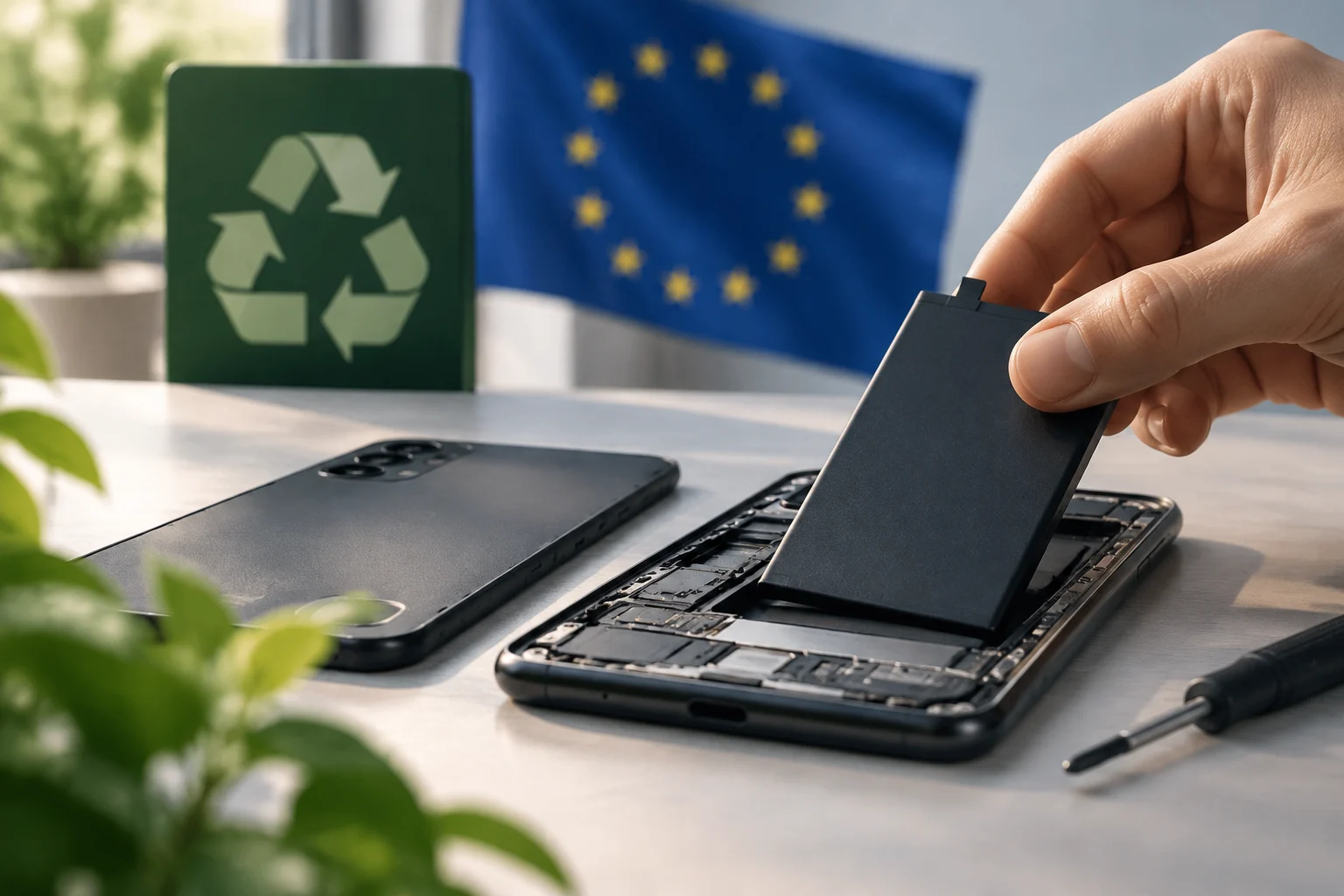
The date marking the structural change in the mobile sector is 18 February 2027. From that day, portable batteries incorporated into electronic products sold in the EU must be removable and replaceable by the end consumer. This means manufacturers can no longer design devices with permanently sealed batteries if they wish to remain in the European market.
The objective is clear: extend device lifespan and reduce electronic waste. By allowing battery replacement, it prevents a functional phone from ending up in the trash solely because its charging capacity has decreased. This measure aligns with the EU's circular economy strategy, which aims to multiply component reuse before 2030.
What 'User-Replaceable' Means
It is important to clarify that the law does not necessarily require a back cover that opens without tools. The requirement is that replacement be possible with tools available on the market and without advanced technical knowledge. This excludes the use of patented tools, thermal energy, or chemical solvents that only a professional technical service could handle.
In practice, this forces manufacturers to redesign the internal architecture of mobiles and tablets. They must ensure the battery is accessible and that the replacement process is quick and simple. Companies already anticipating this change, such as Nintendo with its Switch 2 console, are developing specific variants for the European market that meet these accessibility criteria.
Exemptions and Excluded Categories
Not all devices are subject to the same obligation. The European Commission has identified product categories where user removability could compromise safety. These include medical devices and 'wet appliances', such as electric toothbrushes or oral irrigators, which require airtight sealing.
Furthermore, in April 2026, the Commission opened a public consultation to expand the exemption list to six new categories. This includes smartwatches and activity trackers, electric toys, and equipment for explosive atmospheres (ATEX Directive). For these products, the battery must only be removable by independent professionals, not the end user.
This distinction is vital for consumers: if you buy a smartwatch or a toy, the direct repairability obligation does not apply in the same way as for a smartphone or tablet. The regulation seeks a balance between sustainability and the physical safety of the user.
Traceability and Carbon Footprint
Beyond repairability, Regulation 2023/1542 imposes environmental transparency requirements. Article 7 establishes the obligation to declare the carbon footprint of batteries, calculated throughout their entire lifecycle, from raw material extraction to final disposal.
For industrial and electric vehicle batteries, this requirement is linked to the implementation of the digital battery passport from 2027. Although portable mobiles have specific treatment, the trend is clear: manufacturers must provide verifiable information on the environmental impact of their products. This will allow consumers to compare not only battery capacity but also its real sustainability.
Practical Impact for the Consumer
For the end user, this regulation changes the purchasing equation. A device bought in the EU from 2027 must guarantee that the battery is a replaceable component. This increases the product's residual value and reduces long-term costs, as it will no longer be necessary to buy a new phone every two or three years.
When checking a device's technical sheet, consumers will be able to verify if the manufacturer meets removability requirements. The availability of spare parts and clear information on the replacement process will become purchase decision factors as important as the camera or processor. Repairability ceases to be an extra to become a basic legal requirement in the European market.