From prototype to sold-out commercial product
The Samsung Galaxy Z TriFold has completed its initial lifecycle as a limited-edition product. Although it was introduced to the general public at CES 2026, its commercial launch began months earlier, in December 2025, with a progressive rollout strategy across markets. This strategic decision aimed to validate real demand before a massive expansion, ensuring that technical support infrastructure was ready for such complex hardware.
Samsung's official US website indicates that the device is completely sold out. This situation confirms that it is not a trade show prototype, but a product that has fulfilled its market and technology validation objective before entering the history of the Galaxy Z series. The rapid sellout reflects sustained interest from innovators and professionals seeking multitasking capabilities superior to conventional foldables.
Verified technical specifications
Performance and memory
The heart of the device is the Qualcomm Snapdragon 8 Elite processor, manufactured on a 3 nm process, which manages 16 GB of RAM. This combination guarantees smooth performance even with multiple applications open simultaneously on the large screen surface. The storage configuration offers two variants: 512 GB and 1 TB, both with UFS technology and no slot for expansion cards, prioritizing native read and write speed.
Display and visualization
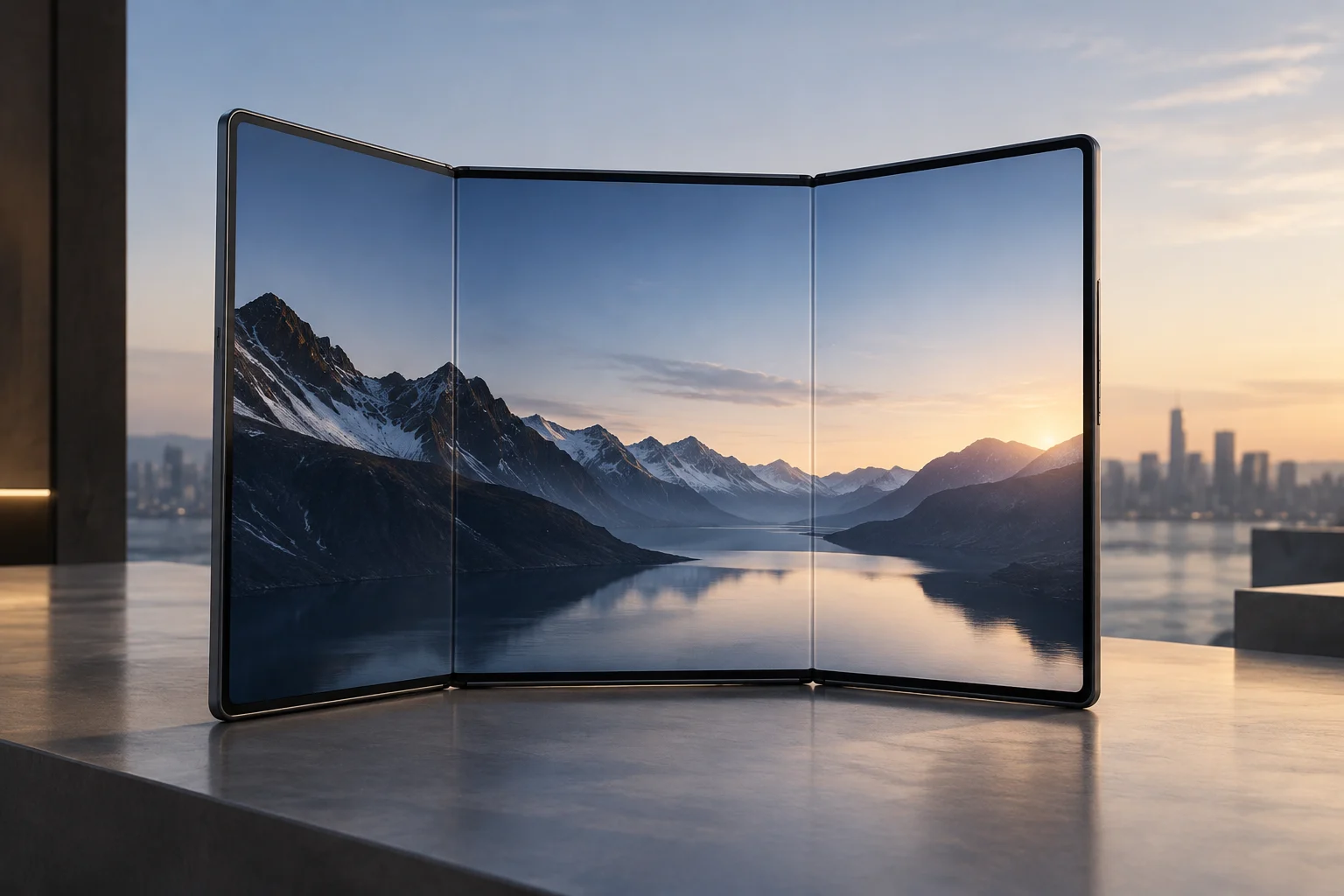
The main screen is a Dynamic LTPO AMOLED 2X panel measuring 10 inches with a resolution of 1584 x 2160 pixels and a refresh rate of 120 Hz. This technology allows adjusting the update frequency to optimize battery consumption. When folded, the device displays a 6.5-inch cover screen with a pixel density of 422 ppi, protecting the glass with Corning Gorilla Glass Ceramic 2 to maximize durability against scratches.
Design, durability, and weight
Weighing 309 grams, the TriFold maintains notable thinness: 3.9 mm when fully unfolded and 12.9 mm in its folded state. The structure combines an Advanced Armor aluminum frame with a titanium hinge housing to support the double fold. This balance between lightness and robustness is fundamental for a device that must withstand the mechanical stress of two mobile joints without compromising the daily user experience.
Water and dust resistance is certified under the IP48 standard, allowing immersion in fresh water up to 1.5 meters for 30 minutes. This level of protection is crucial for a device with two mobile joints that expose electronics to greater mechanical stress. The certification ensures that internal components remain effectively sealed, offering additional peace of mind to users working in variable environments.
Launch price and initial markets
The launch price in Europe was around 2,700 euros for the 512 GB variant and 3,100 euros for the 1 TB version. In the United States, the base price was $2,440, reflecting the device's premium position within Samsung's catalog. This pricing positions the TriFold as a high-level productivity tool, targeted at a specific market segment that values extreme innovation over initial cost.
Initial availability was selective: South Korea (December 12, 2025), Singapore and the United Arab Emirates (December 19), Taiwan (December 22), and the United States (January 30, 2026). This staggered approach allowed Samsung to manage demand and technical support in a controlled manner. By limiting initial access, the company could collect direct feedback from early users and adjust necessary software updates to optimize hardware performance.
Comparison with the previous generation
Unlike the Galaxy Z Fold7, which offers a 7.6-inch screen, the TriFold doubles the working surface to reach 10 inches. This positions it not only as a smartphone but as a portable alternative to mid-size tablets for productivity tasks. The larger visualization area allows splitting the screen into three simultaneous panels, facilitating workflow for professionals who need to consult documents, emails, and editing applications at the same time.
The main 200 MP camera with 24 mm optics and optical image stabilization (OIS) surpasses the resolution of most previous foldables, allowing high-quality crops without significant detail loss. This factor is key for users who value photographic versatility, as high resolution offers considerable post-processing flexibility. Integrating this camera into a tri-fold chassis demonstrates Samsung's ability to balance structural innovation with industry-standard photographic quality.
Current availability and recommendations
Given that the model is officially discontinued, users looking to acquire it today must turn to the second-hand market or authorized resellers with residual stock. Prices in the secondary market can vary significantly depending on the device's condition and storage variant. It is recommended to carefully verify the warranty and usage history before making any purchase, as Samsung's official support may be limited for units outside the main lifecycle.
For most consumers, the Galaxy Z Fold7 remains the recommended option due to its availability, guaranteed support, and more accessible price. The TriFold stands as a technological milestone for collectors and enthusiasts of extreme hardware innovation. Its legacy lies in demonstrating the commercial viability of tri-fold devices, paving the way for future iterations that could integrate even more features in a compact format.