Definition and Scope of Software Support
Software support is a service encompassing activities such as installation, updating, configuration, and troubleshooting to ensure programs and applications function efficiently. Unlike hardware support, which focuses on physical components like hard drives, memory, or graphics cards, software support addresses logical issues: configuration errors, application conflicts, performance failures, security vulnerabilities, and update needs.
This service covers activities like initial installation and configuration, applying security patches, resolving incidents, optimizing performance, and user training. Its ultimate goal is to minimize downtime and ensure that the technological infrastructure meets the business's operational objectives. In enterprise environments, software support is often outsourced to specialized providers offering maintenance contracts with defined service levels.
The distinction between software and hardware support helps allocate resources correctly. Hardware issues often involve physical components, while software issues are typically addressed through configuration, updates, or troubleshooting. Understanding this difference allows organizations to plan the maintenance of their technological infrastructure effectively.
Support Tiers: Service Structure
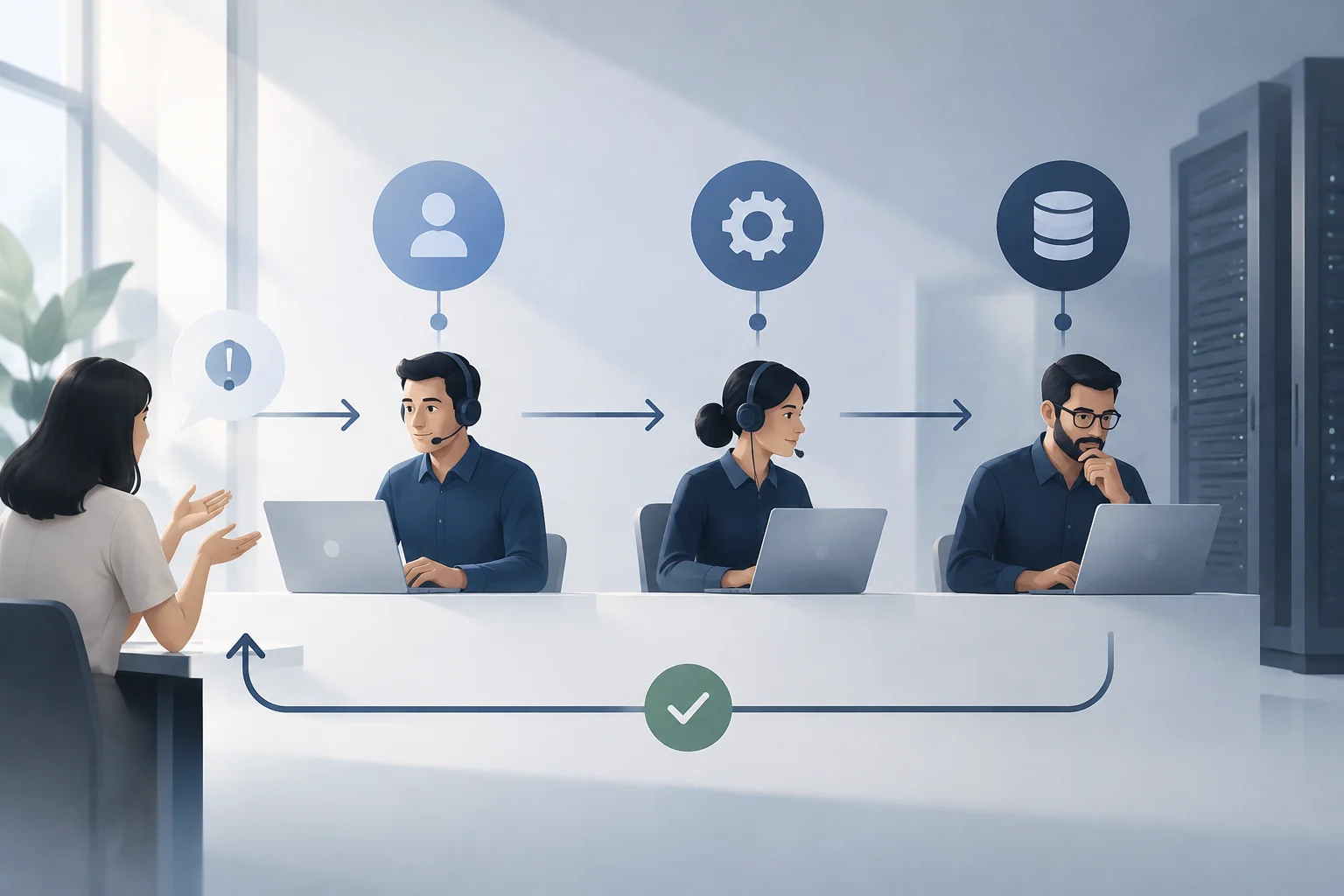
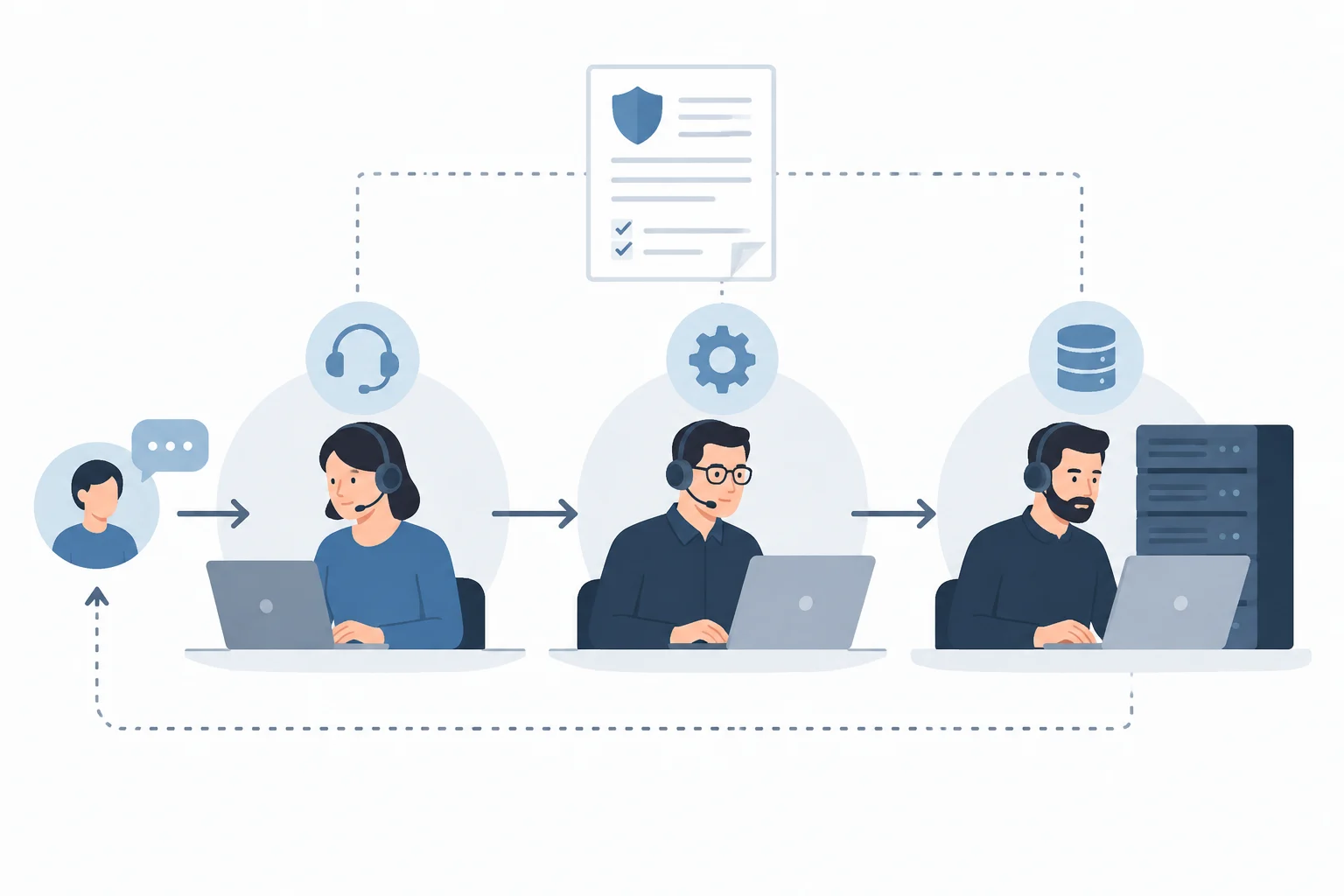
Software support tiers structure technical assistance based on the complexity of the incident and the profile of the responsible technician. Common models divide assistance into several tiers (N1, N2, N3), although some organizations incorporate a level 0 for self-service and a level 4 for external providers. This structure aims to ensure each problem is handled by personnel with the appropriate experience, optimizing resource usage.
Level 1: Initial Attention and Diagnosis
Level 1 is the first point of contact between the user and the support team. Technicians at this level manage low-complexity incidents, such as access issues, passwords, basic software installation, or usage queries. Their primary function is to diagnose the problem, apply documented solutions, and, if the incident is not resolved, escalate it to the next level with all collected information.
Level 2: Advanced Technical Resolution
Level 2 handles problems requiring deeper knowledge of systems, applications, or infrastructures. Technicians at this level have access to administrative tools, system logs, and backend configurations. They are responsible for investigating root causes, applying complex configuration changes, and resolving incidents that Level 1 could not close. They also document solutions to enrich the knowledge base.
Level 3: Specialized Engineering
Level 3 is usually the highest level of internal IT assistance. Engineers at this level possess advanced knowledge of system architecture, software development, and critical problem resolution. They intervene in incidents affecting the structural integrity of applications, requiring code modifications, or involving complex infrastructures. Additionally, they collaborate with lower levels to improve resolution processes and develop solutions for recurring problems.
Level 4: External Support and Manufacturers
In some models, a Level 4 is included, corresponding to the intervention of external providers or original manufacturers. This level is activated when the incident requires specialized knowledge that the company cannot cover internally, such as access to proprietary components or the resolution of specific product failures. Most companies do not maintain internal Level 4 technicians but contract third-party services to meet these needs.
Service Channels and Official Documentation
Software support channels determine how users access technical assistance. Common channels include phone, email, live chat, and self-service portals. The choice of channel may depend on the urgency of the incident and the provider's policies. A good support service offers multiple channels to adapt to different user profiles and problem types.
Official documentation is a key component of software support. It may include user manuals, installation guides, and knowledge base articles. This documentation allows users to resolve problems on their own (Level 0) and provides support technicians with a reference for diagnosing and resolving incidents. Manufacturers like Apple, Dell, and Synology maintain publicly accessible download centers and documentation for their products.
Self-service portals and knowledge bases enable users to resolve simple incidents without contacting a technician. By offering documented solutions to frequent problems, these resources help reduce the volume of tickets reaching the support team, facilitating the management of incoming requests.
Service Level Agreements (SLAs)
A Service Level Agreement (SLA) is a contract establishing performance, availability, and support expectations between the provider and the client. In the context of software support, SLAs define metrics such as response time, resolution time, service availability, and incident priority levels. These agreements serve as a reference for evaluating the compliance of the service provided.
SLAs usually include response times differentiated by priority. For example, a critical incident may require a faster response than a low-priority query. Additionally, SLAs may specify service availability and the penalties applicable if the provider fails to meet the established commitments.
The correct definition of SLAs allows organizations to measure support service performance and make informed decisions about improving their technological infrastructure. Indicators derived from SLAs provide insight into the efficiency of the support team and areas requiring attention.
Comparison of Support Tiers
The following table compares the three main software support tiers based on their scope, technician profile, and examples of incidents they resolve. This comparison helps organizations design support strategies suited to their needs and helps users understand what to expect from each level of attention.
| Tier | Main Scope | Technician Profile | Incident Examples |
|---|---|---|---|
| N1 | Initial diagnosis and basic problem resolution | Technician with general IT knowledge | Access issues, basic installation, usage queries |
| N2 | Advanced technical resolution and complex configuration | Technician specialized in systems and applications | Data recovery, network configuration, log analysis |
| N3 | Specialized engineering and critical problem resolution | Engineer with advanced architecture and development knowledge | Architecture failures, code modifications, complex infrastructure issues |
The tier structure allows for efficient scalability of support. Most incidents are resolved at Level 1, reducing the workload for higher tiers. Only the most complex or critical incidents escalate to Levels 2 and 3, helping to use specialized resources more appropriately.
Support Limits and Coverage Verification
The scope of software support is often defined in the contract or license. Not all incidents are covered by the standard service, so it is essential to review the agreement terms to understand what is included and what is not.
Verifying support coverage is an important task for organizations. They must ensure the contract covers all critical applications and systems, that response times are adequate for their operational needs, and that support tiers are well-defined. Additionally, it is recommended to establish periodic reviews of the support service to evaluate its performance and adjust SLAs if necessary.
In summary, software support is an important component of technological infrastructure. Understanding its definition, tiers, channels, SLAs, and limits helps organizations manage system maintenance. Proper management of software support contributes to resolving problems and maintaining the operability of computer systems.