The renewal interval is not a specification
Technical figures for new models describe their features, but they do not indicate how long each person keeps their phone. Comparing batteries alone is not enough to draw that conclusion.
What can be evaluated is what some recent models offer: higher capacity batteries, fast charging, and specific processors. These features can improve comfort for certain uses, but they do not prove by themselves that users are delaying purchases or that a phone lasts more years before needing repair or replacement. The distinction matters: battery life between charges, battery health over time, and software support are different aspects.
More mAh: a larger reserve, not a measure of hours
The POCO X8 Pro Max incorporates an 8,500 mAh battery and 100 W charging. The POCO X8 Pro sits at 6,500 mAh, also with 100 W charging. These are high capacities compared to many phones, but mAh do not equal hours of use: screen brightness, connectivity, apps, and the type of activity affect consumption.
The Xataka Móvil spec sheet indicates the Max model weighs 218 grams and is 8.2 millimeters thick; the X8 Pro weighs 201.47 grams and is 8.38 millimeters thick. This shows one of the design compromises: a larger battery can coexist with a relatively thin body, but its capacity does not fully describe weight, ergonomics, or daily performance. The practical choice depends on whether you value the margin between charges more than a lighter device.
Comparativa de especificaciones de batería en móviles de gama media 2026
Tabla que resume la capacidad de la batería, la potencia de carga rápida y la tecnología de celda de los modelos POCO X8 Pro Max, vivo Y700 Pro y POCO X8 Pro, basándose en las especificaciones oficiales citadas en el artículo.
| POCO X8 Pro Max | 8.500 mAh / 100 W |
|---|---|
| vivo Y700 Pro | 10.200 mAh / 90 W |
| POCO X8 Pro | 6.500 mAh / 100 W |
Las especificaciones corresponden a los modelos específicos mencionados; la vida útil real varía según el uso.
Recent models show several strategies
Mid-range specifications do not point to a single solution. The POCO X8 Pro Max raises capacity and uses the Dimensity 9500s; the POCO X8 Pro combines 6,500 mAh with the Dimensity 8500-Ultra. La Razón attributes a 7,000 mAh battery and 120 W charging to the realme GT 7. Capacity and charging speed address related but distinct needs: one can space out recharges, while the other shortens the wait when the phone is plugged in.
| Model | Battery | Indicated Charging |
|---|---|---|
| POCO X8 Pro Max | 8,500 mAh | 100 W |
| POCO X8 Pro | 6,500 mAh | 100 W |
| realme GT 7 | 7,000 mAh | 120 W |
POCO figures come from the Xataka Móvil comparison sheet; realme GT 7 figures come from La Razón. They are not results from a common test: they do not allow ranking real battery life of the three phones. To compare duration, equal usage conditions are needed, such as brightness, network, apps, and screen time.
The processor matters, but nanometers do not solve the comparison
The POCO X8 Pro Max uses the MediaTek Dimensity 9500s, described by Xataka Móvil as a 3 nm chip; the X8 Pro uses the Dimensity 8500-Ultra, a 4 nm chip. Process size is a chip design data point, not a direct measurement of the whole phone's consumption. It does not allow deducing by itself how many hours the battery will last or how much capacity it will retain after several years.
Consumption also depends on the screen, mobile signal, workload, and system management. A demanding game, GPS navigation, or video can demand different resources than messaging and reading. Therefore, the useful comparison is not choosing the smallest nanometer number, but looking for tests under comparable scenarios and considering the tasks actually performed.
Incremental innovation and the value of renewing
A high maximum brightness, a 120 Hz screen, or artificial intelligence features can be useful, but their value depends on usage and the difference from the current phone. The Xataka Móvil spec sheet attributes a 120 Hz AMOLED panel and up to 3,500 nits of maximum brightness to both POCO X8 Pro models. A striking figure is not a universal reason to buy: it matters if it solves a daily limitation, such as outdoor visibility or lack of performance.
The specifications of some models are not enough to describe mobile innovation as a whole. To decide whether to renew, it is advisable to first identify what fails in the current device and compare improvements related to that problem. If the phone still covers routine tasks, a technical novelty that will not be used hardly justifies the expense on its own.
Support and wear: two distinct pieces of longevity
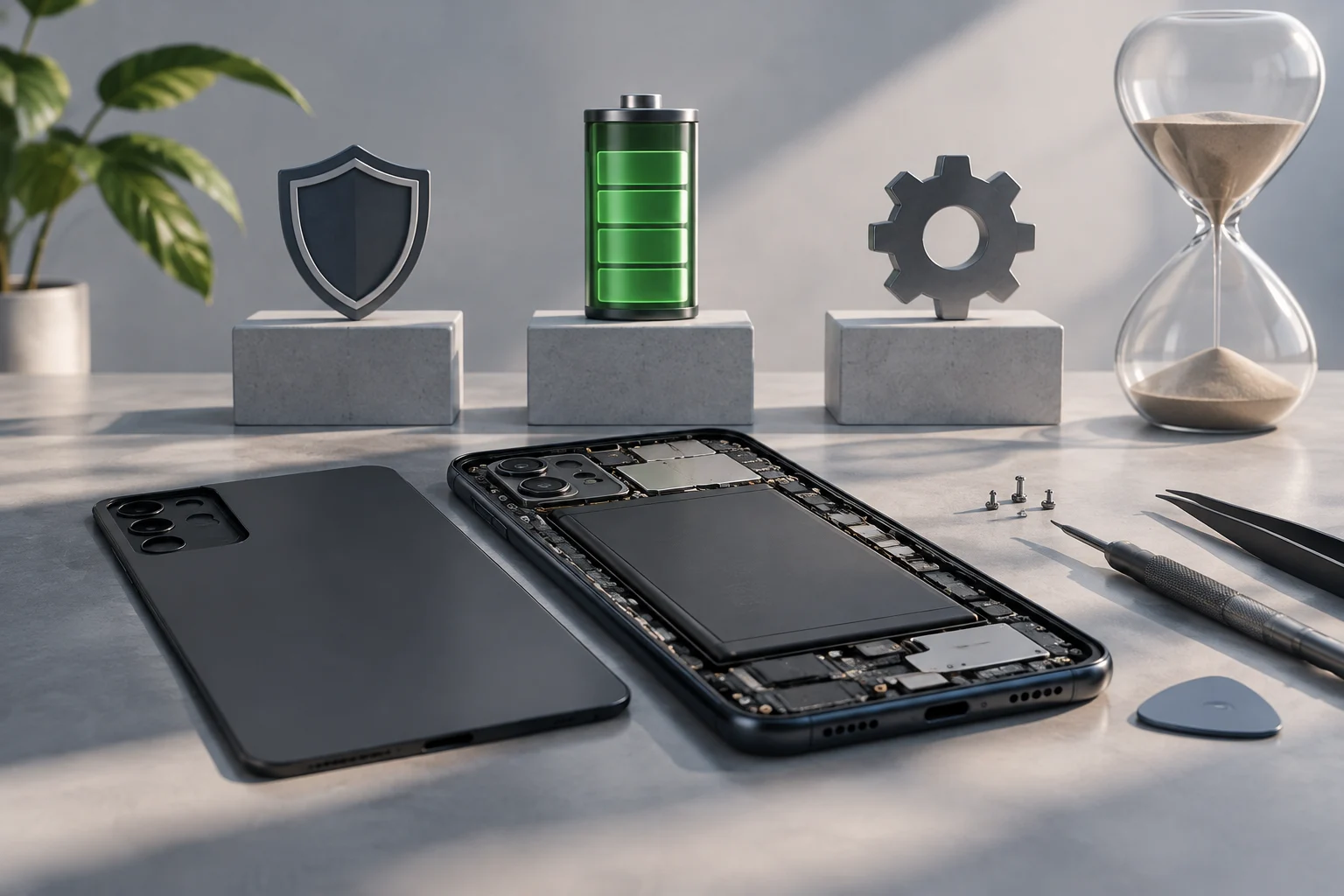
A large battery can reduce the need to recharge during the day, but it does not guarantee it will retain its capacity for longer. The total duration of the phone also depends on wear, repairability, app compatibility, and security updates. Software support is a separate data point from mAh: an update timeline helps value system maintenance, but it does not inform about the physical state of the battery.
A comparison by Te Ayudo con la Compra attributes seven years of updates to the Google Pixel 10a and six to the Samsung Galaxy A56 5G. These timelines refer to those specific models and should not be generalized to all Google or Samsung ranges. Before buying, it is advisable to verify the policy of the exact model and distinguish system updates from security patches, as well as check the conditions applicable to the market where it is sold.
A practical decision before replacing the phone
For those thinking about renewing, the prudent conclusion is not that they must keep any phone for three years, but that battery capacity is not enough to decide. If the current device covers routine tasks, remains compatible, and receives adequate maintenance, comparing the cost of a replacement battery or repair with a new phone can be more useful than chasing the highest mAh figure.
When evaluating a new model, prioritize data that answers your need: capacity and charging if you spend many hours away from a plug; performance if you run games or demanding tasks; and support if you want to keep the system up to date. Do not treat charging watts or nanometers as direct predictions of battery life. The specifications cited describe specific models; they do not replace independent duration tests or statistics on how long people keep their phones.