Robotics’ energy needs and the promise of a different cell
A mobile robot needs energy to move, process information and operate tools; on an autonomous platform, battery weight and volume compete with payload capacity and working time. Safety also matters when equipment operates near people or goes through frequent charging cycles. That is why solid-state batteries attract interest: they can replace a liquid electrolyte with a solid conductor, although that definition does not by itself establish greater range, absolute safety or commercial availability. Source
An academic perspective published in 2026 examines precisely how this technology might fit into robotics. It identifies potential attributes such as reduced reliance on flammable electrolytes, tolerance of a range of temperatures and geometric flexibility. This is an assessment of potential, not a report on industrial deployment: its arguments explain why these cells merit research, not how many robots use them or what performance they achieve in service. Source
The distinction matters especially because “solid-state” does not identify a single chemistry or standardized product. Electrolyte composition, electrodes, cell structure and pack design all affect performance; a figure reported for one particular cell therefore cannot automatically be applied to every robot or every battery sold under that label. Source
What the research evidence shows
The central academic source on this subject is a perspective on solid-state batteries and robotics, published in Frontiers in Batteries and Electrochemistry on June 12, 2026. It relates the demands of robotic systems to potential cell properties, including energy density and the possibility of less conventional shapes. A perspective can organize arguments and identify research directions; it is not equivalent to a comparative trial of several commercial batteries in the same robotic platform. Source
The article also estimates that a commercial robot with hot-swappable battery packs could accumulate battery-capacity consumption of 60–88 kWh over a 7–10-year service life. This figure offers a way to consider cumulative use and battery replacement, but it is not a universal measurement for robots: it depends on the equipment, duty cycle and service-life assumptions. Nor does it demonstrate that a solid-state battery would reduce that consumption or the total cost. Source
A practical reading should distinguish at least three levels of evidence: results from materials or laboratory cells; prototypes tested under specific conditions; and systems manufactured, certified and sold for a defined application. Each level answers a different question. An electrochemical advance can be scientifically valuable without showing that a cell withstands vibration, frequent cycling, changing temperatures or fleet maintenance in a group of robots. Context on manufacturing and interface limits
Robots, swappable packs and operational value
In robotics, a battery is not judged solely by its energy per kilogram. Available power, continuity of operation, charging or pack-swap time, thermal behavior, and mechanical and electrical compatibility with the system all matter. The academic perspective proposes that formats and characteristics attributed to SSBs could be relevant to mobile robots and designs with geometric constraints. It does not establish, however, that a commercial range of solid-state cells has already been adopted in humanoid or industrial robots. Source
Swappable packs offer a concrete example of why an improvement in the cell does not solve the whole problem. If a fleet cycles through several batteries to keep machines working, availability also depends on swap logistics, the charger, state-of-health monitoring and spare-parts inventory. The academic perspective’s estimate of cumulative consumption highlights that dimension, but it does not compare operating costs across chemistries or quantify the savings an SSB might produce. Source
To assess a claim of use in humanoid robots, indoor autonomous vehicles or industrial machinery, it is worth asking for data that identifies the technology’s maturity: which cell was used, what “solid-state” means in that configuration, how long the test lasted, the load and temperature at which it was conducted, and whether the result was verified in an operating robot. General references to future demand or sector interest do not replace those data. Robotics perspective
LFP, NMC and solid state: compare without conflating categories
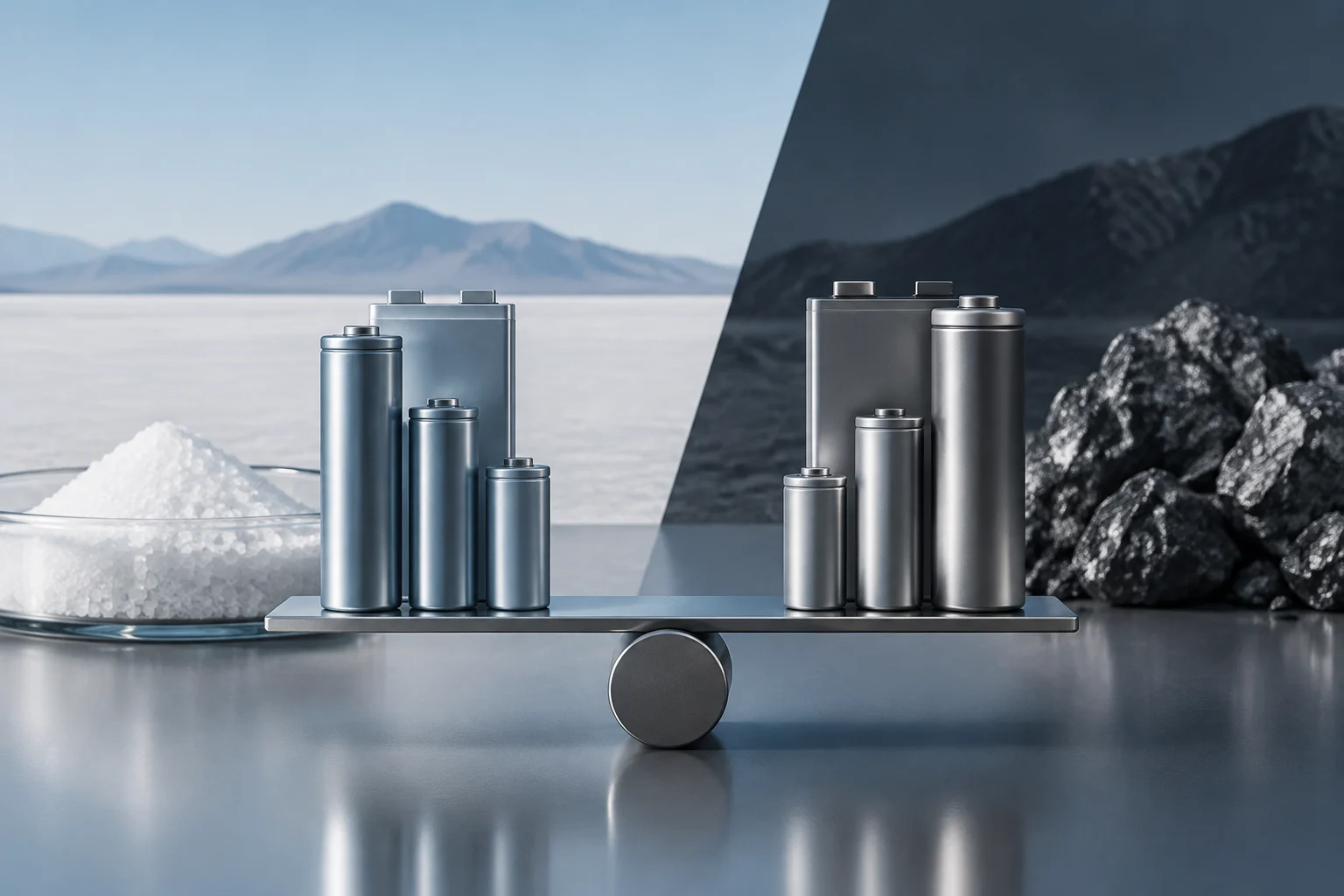
LFP and NMC name lithium-ion cathode-chemistry families; “solid-state” mainly describes the type of electrolyte and can be combined with different material choices. The comparison is therefore not fully symmetrical. Battery performance also depends on the specific cell and pack, so a general table is a framework for questions, not a technical specification or product ranking. Description of solid electrolytes and materials
| Aspect | LFP | NMC | Solid state |
|---|---|---|---|
| What it designates | Lithium-ion cathode chemistry | Lithium-ion cathode chemistry | Architecture using a solid electrolyte; not a single chemistry |
| Energy comparison | The cell or pack must be specified | The cell or pack must be specified | Benefits are potential and design-dependent; there is no universal comparable figure |
| Safety | Assess the cell, pack and system controls | Assess the cell, pack and system controls | Do not infer complete safety from the electrolyte alone; system testing is needed |
| Status in robotics | The available source does not provide a comparative adoption model | The available source does not provide a comparative adoption model | The academic perspective discusses applications; it does not establish widespread commercial deployment |
The available material supports the distinction between cathode families and electrolyte architecture, but does not provide standardized measurements of energy density, cost or service life for LFP, NMC and SSBs in the same robotic application. Conceptual source; robotics perspective
Safety calls for the same care. A solid electrolyte may reduce certain risks associated with flammable liquid electrolytes, but that does not mean the complete battery cannot fail or catch fire. Electrodes, separators, connections, thermal management and pack protection remain parts of the system. Safety is established through testing, not by a chemistry label alone. Source

From experimental cell to production
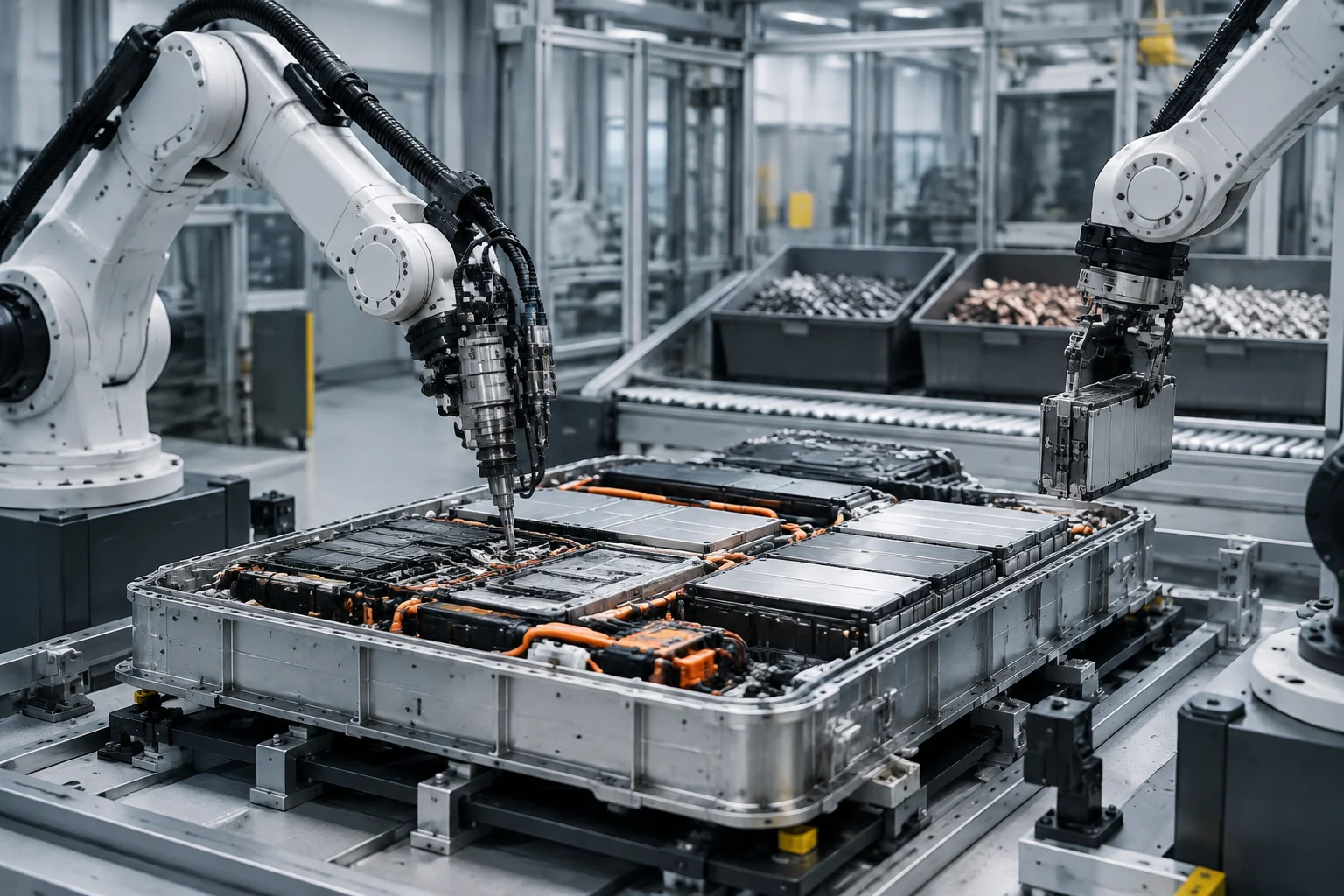
There are manufacturing and operational challenges between a promising cell and a reliable product. The technical source on solid-state batteries describes obstacles related to material integration and interfaces, as well as challenges that can affect cost and durability. The editorial implication is clear: it is not enough for a material to conduct ions in a laboratory; the process must produce repeatable cells that retain their performance and can be integrated into safe packs. Source
Industrialization should be assessed using verifiable indicators: pilot-line capacity and output, manufacturing yield, consistency between batches, test duration, degradation rate and warranty conditions. An investment announcement or roadmap may show business intent, but it is not the same as sustained production or sales. Robotics adds the need for formats, connectors and protocols compatible with each platform—issues that a chemistry advance alone does not resolve. Technical context
The sources assembled here do not include primary documentation from Toyota, Samsung SDI or QuantumScape that would let us verify robotics product specifications, availability dates or adoption by robot manufacturers. It is therefore not sound to assign them a market share, a confirmed energy density for a robotic pack or a definite arrival date. The absence of that documentation from this collection does not prove that no announcements exist elsewhere: it limits what can be claimed from this evidence.
What to watch in 2026–2028
The robotics perspective gives a reason to follow the field: mobile-operation requirements, cumulative battery use and shape constraints could make new architectures attractive. But it does not set a commercial timetable for 2026–2028. The prudent conclusion is not that robots will widely adopt SSBs by a particular date, but that their maturity should be assessed using industrial milestones and published test data. Source
To distinguish technical progress from promotion, professionals and buyers can check five indicators before considering the technology for a fleet:
- Precise identification: manufacturer, composition, format, and the distinction between fully solid cells and variants with liquid or gel components.
- Test data: energy density with its unit and measurement level, cycles, temperature, load and test protocol.
- System-level testing: results from an integrated pack and the relevant robot, not just an isolated cell.
- Manufacturing scale: evidence of repeatable production, quality control and line yield, in addition to announced nominal capacity.
- Commercial terms: verifiable availability, warranty, support, applicable certifications and total system cost.
These checks do not predict which company will succeed; they help prevent a laboratory demonstration from being mistaken for an industrial implementation. The evidence examined supports the view that solid state is an area of interest for robotics and that integration and scaling challenges remain, but does not support a claim of widespread commercial adoption in the sector. Any purchase decision should compare data for the actual robot, pack and operating regime. Academic perspective; technical limits