The challenge of comparing robotics results
Robotics research uses varied arms, cameras, end-effectors, and software stacks, which can make results from different laboratories difficult to compare directly. The jigsaw-benchmarking study describes this heterogeneity as a challenge and proposes a repeatable physical protocol for assessing spatial and temporal reasoning in robot manipulation.
Jigsaw-based benchmarking
The proposed method uses puzzle pieces to create a structured manipulation protocol that can be adapted to different task specifications. Its aim is to let researchers compare results at functional, task, and system levels, and to build an empirical reference for learning-based robotic manipulation.
The DeepClaw minimal cell
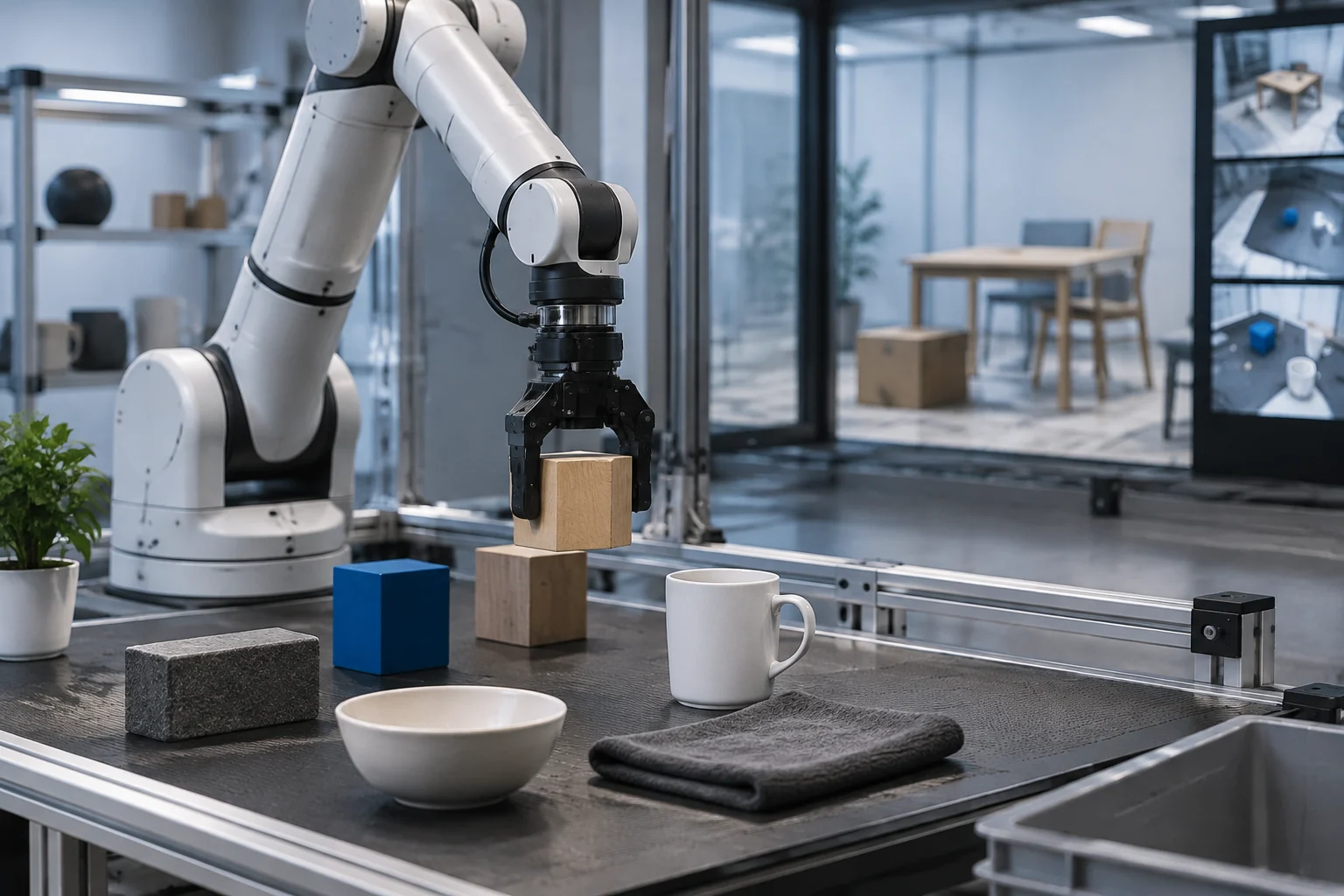
To support reproducibility, the study proposes DeepClaw, a minimal robotic cell intended as a hardware counterpart to a standardized software environment. It identifies five components for learning-based manipulation:
- Manipulator: A robotic arm, with UR5, UR10e, and Panda given as examples.
- Sensor: Typically a camera, such as an Intel RealSense.
- End-effector: A suction cup in the experiments described.
- Target objects: The puzzle pieces.
- Workspace: The physical table and surrounding environment.
The authors propose that laboratories can use this minimal setup to follow the same task protocol despite differences in hardware, making comparisons across configurations possible.
A customizable task description
The study uses jigsaws because they are accessible and can be varied. Its six-part code describes task characteristics:
- Base Frame (BF): Whether a base plate is used.
- Piece Placement (PP): Whether pieces are laid flat or disordered.
- Jigsaw Sets (JS): Whether one or multiple sets are used.
- Texture (TX): Standard or custom graphics.
- Geometry (GO): Standard or custom shapes.
- Material (MA): The physical material, such as wood, plastic, or metal.
These options let researchers specify tasks of different complexity, from pick-and-place to assembly requiring more precise physical interaction.
Task workflow and metrics
The protocol separates manipulation into four functional stages, each with a corresponding measure:
- Segmentation: Identify the pixels belonging to each piece. Metric: Intersection over Union (IoU).
- Recognition: Identify the piece being observed. Metric: Average Precision (AP).
- Pick planning: Select coordinates for grasping or suction. Metric: Success rate.
- Motion planning: Calculate a collision-free path. Metric: Time.
For the Mosaic Task, pieces must fit together without a base plate. The study defines a two-dimensional area rate for judging the completed arrangement; a result nearer to 1 represents a more precise assembly under that measure.
Reported hardware experiments
The study reports experiments on three platforms: UR5, UR10e, and Franka Emika Panda. The researchers used Single Shot Detection for vision and AlexNet for pick planning to compare performance across the tested configurations.
UR5 and UR10e comparison
For the UR5 and UR10e, the study reports that functional measures including IoU and AP were within 5% of one another. The overall task scores were also comparable in the tested tasks. These findings describe the configurations examined; they do not establish that results will transfer across other arms or tasks.
Camera and robot configuration
The Panda setup used a RealSense D435i, while the UR setups used a D435. The study reports lower vision metrics for the Panda configuration and relates this result to networks trained using D435 data. That comparison illustrates why sensor and training-data differences matter when interpreting benchmark results.
The Panda, a seven-axis robot, was faster in the reported motion-planning comparison than the six-axis UR arms. This is a result for the tested setups; it does not by itself isolate the reason for the speed difference.
Assembly and error compensation
The study's Assembly Task requires placing puzzle pieces on a base plate with a tolerance below 0.6 mm. It reports cumulative hardware errors of several millimeters, including errors associated with camera depth, suction-cup alignment, and arm precision.
The researchers compared direct pick-and-place, called Simple Assembly, with Manipulation Assembly, which adds a coded fine-tuning step to push a piece into place. Simple Assembly often failed in the reported tests, while Manipulation Assembly improved success. The result shows how the tested interaction strategy can compensate for imprecision in that assembly setup.
Simulation-based evaluation with SimplerEnv
Physical evaluations require robot hardware, while SimplerEnv (SIMPLER) is an open-source framework for evaluating real-world manipulation policies in simulation. Its stated purpose is to assess policies such as RT-1, RT-1-X, and Octo at scale without requiring a physical trial for every evaluation.
Built on SAPIEN and ManiSkill2, SimplerEnv provides simulated environments for Google Robot and WidowX configurations. It describes two evaluation approaches:
- Visual Matching: Uses real-world images as backgrounds in simulation and adjusts textures to reduce visual differences.
- Variant Aggregation: Evaluates policies across environment variations, including changes to backgrounds, lighting, and distractors.
The project reports validation across approximately 1,500 evaluation episodes and a strong correlation between simulated and real-world policy performance. SimplerEnv was developed by researchers from UC San Diego, Stanford, UC Berkeley, and Google DeepMind. It includes a Gym API, policy-inference code, and evaluation scripts. A GPU-accelerated version using ManiSkill3 is reported to run evaluation 10–15 times faster.
What the two approaches measure
The jigsaw protocol evaluates manipulation through physical puzzle tasks and separate functional and task-level measures. SimplerEnv evaluates policies in simulation and reports how simulated results relate to real-world performance. They offer different ways to study robotic manipulation; the findings described here apply to the particular protocols, platforms, and tests reported in each study.