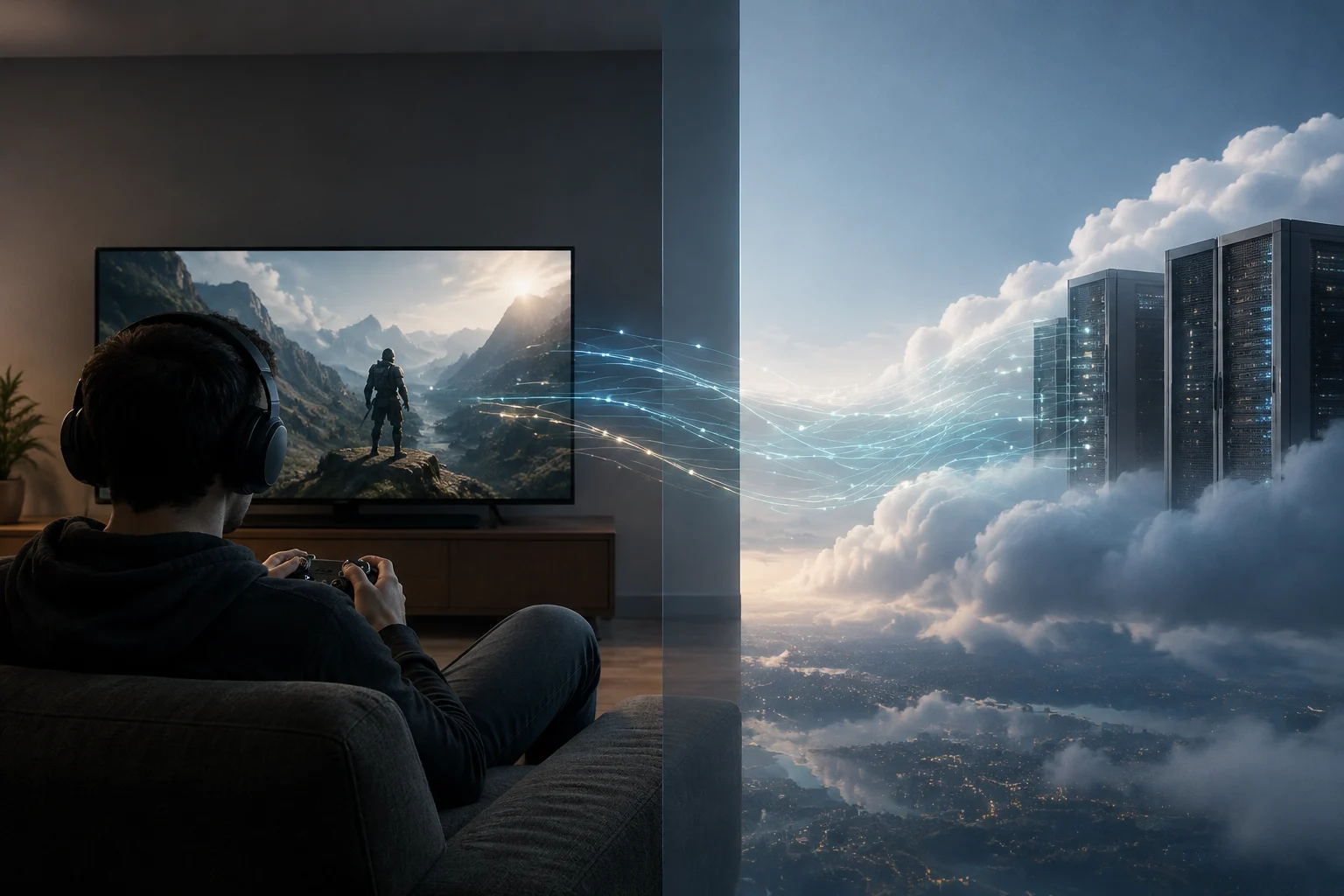
Fundamental Differences Between Local Execution and Streaming
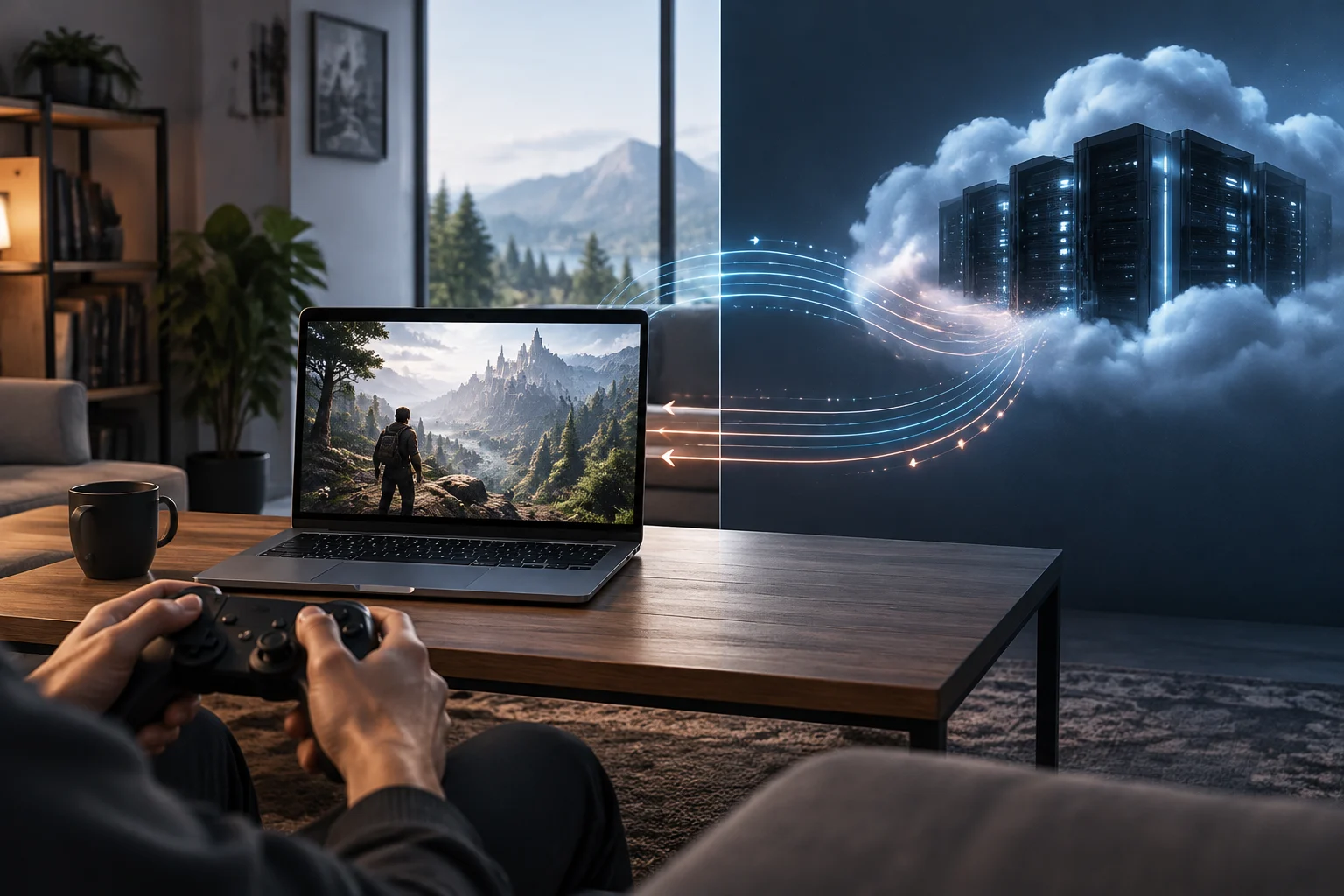
The central distinction between playing in the cloud and running a game locally lies in where the game logic is processed. In a local system, the console or PC calculates physics, AI, and rendering, then sends the video signal to the monitor. In streaming, however, remote servers perform the processing and transmit a compressed video stream to the user's device. This device decodes and displays the image while sending control inputs, meaning the player's hardware does not execute the game itself.
This architectural difference affects both the required resources and how the response to each action arrives. Locally, the device hardware performs calculations and generates the image; in the cloud, the device receives that processed image and returns the player's commands to the server. Consequently, the connection intervenes in a continuous cycle during gameplay, not just when downloading or starting the game.
This architecture makes the experience dependent on the quality of the Internet connection and the physical distance to the servers. Unlike local gaming, where performance is predictable once the software is installed and does not require constant bandwidth, streaming can be affected by network fluctuations, latency spikes, and service interruptions. These issues can immediately interrupt gameplay, even if the user's device has sufficient capacity to display the received video.
Anatomy of Latency in Cloud Gaming
Total latency, or end-to-end lag, is not limited to the time it takes a packet to travel over the network. According to academic models, it includes input latency, i.e., the device sampling time; server-side rendering latency; video encoding latency; network latency, expressed as RTT; and client-side decoding latency. Each stage adds milliseconds to the journey between the player's action and its visual response on screen.
These components form a chain: the device registers a command, the server processes it and generates a new frame, the video is encoded and transmitted, and the client decodes it for display. The delay perceived by the user corresponds to the combined effect of these stages, not a single isolated connection measurement. Therefore, a download speed figure alone does not describe the entire latency experienced during gaming.
In local games, network latency is nonexistent or minimal because processing occurs on the device itself, so the bottleneck is usually in the hardware. In the cloud, even with a fast connection, the distance to the server and the efficiency of video codecs influence smoothness. A study presented at the ISCA/DEGA Workshop 2016 showed that the effects of frame rate and simulation rate (tickrate) can mask or amplify the network's contribution to total delay.
Connection Requirements and Image Quality
Official services set minimum bandwidth thresholds for a session to function. PlayStation, for example, specifies a minimum of 5 Mbps to establish a cloud streaming session for PS Portal, 7 Mbps to stream at 720p, and 13 Mbps for 1080p. These are minimum values indicated by the service, not a guarantee that quality will remain constant on any network or throughout the session.
The difference between the access threshold and a stable experience matters because available bandwidth can vary. If the connection fluctuates, the service may reduce image quality or produce buffering. Thus, reaching the minimum in a single measurement does not rule out changes during gameplay, nor does it alone allow anticipating the network's response under specific usage conditions.
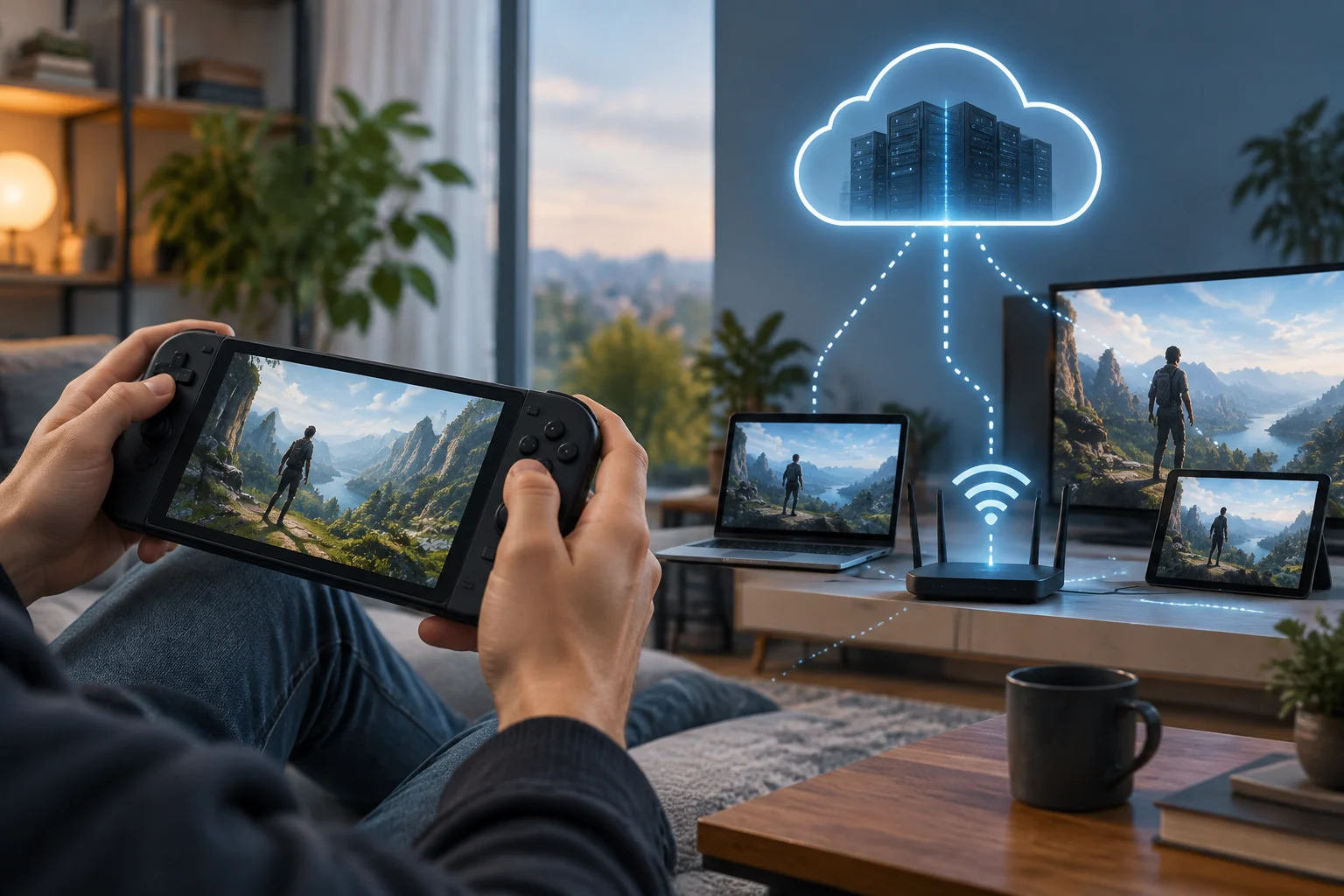
NVIDIA GeForce NOW recommends using routers with optimized QoS profiles to reduce latency and improve streaming stability. The company suggests specific devices that allow calibrating Wi-Fi coverage and prioritizing gaming traffic. This recommendation underscores that raw bandwidth is not the only factor: how the connection is distributed and managed within the home also influences performance.
Wireless coverage and the priority assigned to traffic can therefore be part of the diagnosis when a session shows variations. The QoS recommendation does not replace the service's connection requirements but points to another aspect of home infrastructure. Together, speed specifications and router guidelines describe different conditions that can impact streaming quality.
Title Availability and Access Conditions
Access to cloud gaming is conditioned by an active subscription and geographic region. PlayStation Plus Premium, for example, offers cloud streaming of PS5 games on PS Portal, but is only available in a specific list of countries, including Spain, the United States, Japan, and several EU countries. Overseas territories belonging to those countries do not have access to the service.
Location is not the only requirement: availability also depends on the account and service terms. In the case of PS Portal, cloud streaming of PS5 games requires an active PlayStation Plus Premium subscription and is not available for minor accounts. Therefore, checking that the service exists in a country is not enough to confirm that a specific account can use it.
Furthermore, not all games in the catalog are enabled for streaming. Availability depends on licensing agreements between the publisher and the cloud service. A title may be included in the subscription for local execution but not for streaming, or vice versa. This catalog fragmentation makes it necessary to verify the compatibility of each game before relying on the service for a specific selection.
The PlayStation Store explicitly indicates if certain games are compatible with PS5 and PS Portal cloud streaming, and notes that this feature requires a Premium subscription. This information allows checking the title's eligibility but does not eliminate catalog differences that may exist between local execution and streaming. Availability must be considered per game, in addition to region and account type.
Cost, Dependence, and Long-Term Sustainability
The cloud gaming business model relies on recurring subscription revenue, in contrast to the one-time purchase of a game and the use of local hardware. It can offer access to a broad catalog without an initial investment in high-end hardware, but it creates a continuous dependence on the service. If the subscription is canceled, access to cloud games is immediately interrupted, unlike local games that remain on the device.
The economic comparison is therefore not reduced to the monthly price versus the cost of the equipment. It also includes access conditions: the subscription keeps the service available while active, whereas local execution does not depend on a constant connection to process the installed game. The convenience of each option depends on how the user values the catalog, the initial investment, and that continuity of access.
The gaming industry has experienced significant growth and is projected to reach $397.21 billion in 2029. Diversification toward subscription and free-to-play models has driven player retention while making the offer more complex. The projected figure provides context on the sector's expansion but does not alone determine which of the two modalities is more convenient for each consumer.
For the user, choosing between cloud and local gaming involves balancing the monthly subscription cost with hardware investment and the freedom of access without network restrictions. It also implies considering that the streaming catalog may be subject to different conditions than local gaming. The practical conclusion is not that one modality is always superior, but that each ties the experience to different requirements and dependencies.
Limits of Documentary Evidence and Need for Practical Tests
Official specifications and technical documentation provide a framework for understanding the theoretical requirements of cloud gaming, but they do not guarantee a uniform experience. The variability of home networks, server congestion during peak hours, and geographic distance to the nearest data center introduce factors that a documentary analysis cannot fully capture. Published values describe conditions and capabilities, not the result of each individual session.
The distinction between published data and observed behavior is important when assessing latency and image quality. A minimum connection requirement, for example, does not by itself inform about the fluctuations of a specific network, and an architecture description does not measure the delay perceived by each player. Documentary evidence allows explaining the factors involved but does not replace a measurement in the environment where the game will be played.
To accurately assess latency and image quality under real conditions, practical tests in specific locations and networks would be needed. These should measure RTT, packet loss, and framerate stability during prolonged sessions, so that variations over time can be observed, not just a single reading.
Without those measurements, conclusions must be limited to what the available evidence allows inferring. There remains a margin of uncertainty regarding the player's subjective experience and the performance the service will have on a specific network. Thus, specifications, requirements, and technical documentation serve to guide the comparison, but the final decision also depends on real usage conditions.