The Leap to Digital Connectivity
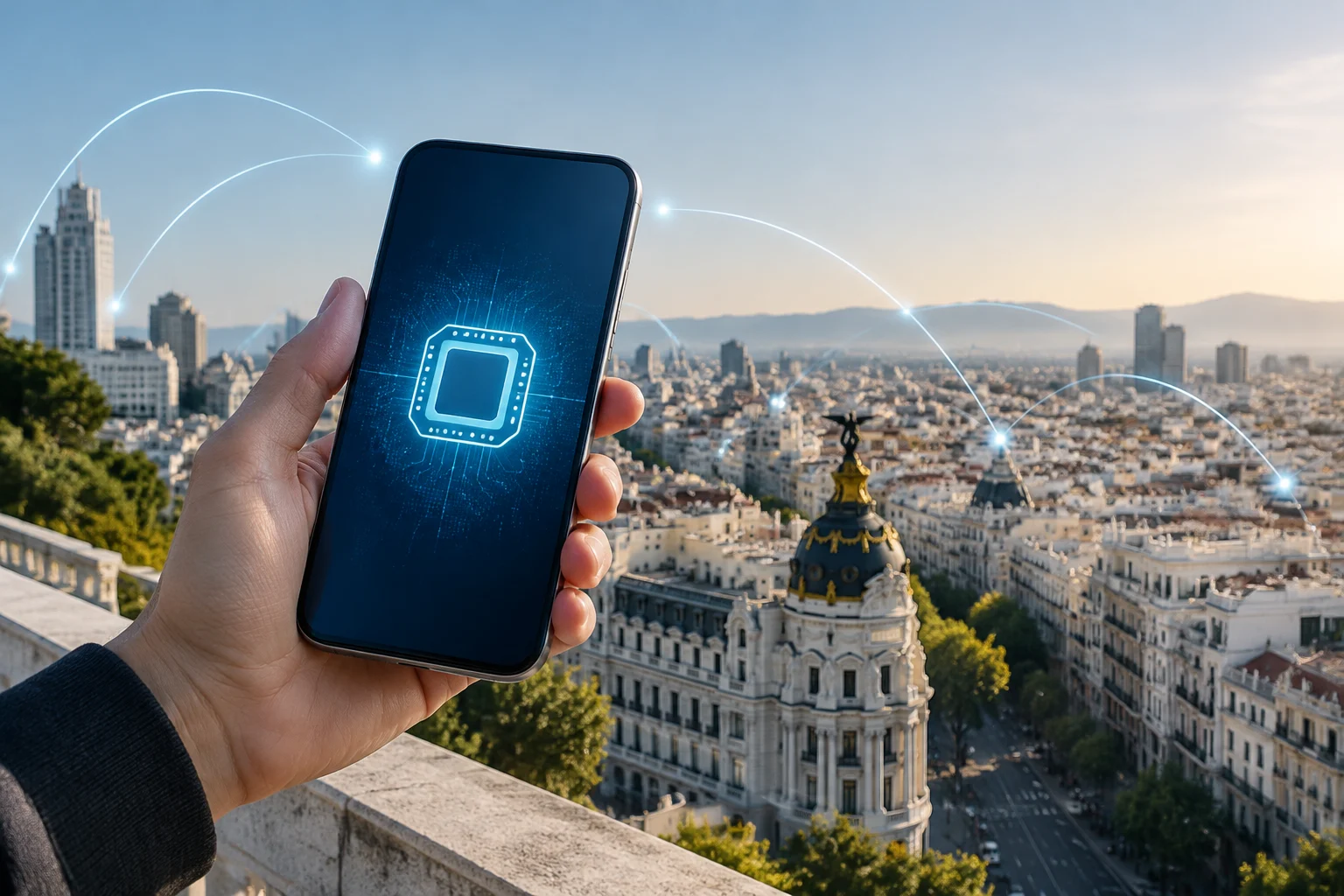
The eSIM has ceased to be a novelty to become the de facto standard in mobile telephony. According to GSMA data cited by Simology, by early 2026 there are over 2.4 billion active eSIM devices globally, a figure expected to exceed 3.4 billion in 2027. This growth is not only technical but economic: manufacturers gain internal space by eliminating the physical slot, and users obtain flexibility to change plans without handling cards.
In Spain, adoption has accelerated due to pressure from traditional operators and the arrival of mid-range devices integrating the chip. The practical advantage is immediate: activation in minutes via QR code or app, eliminating waiting for mail. For the buyer, this means eSIM compatibility must be a purchase criterion as important as the camera or battery.
Spanish Operators: Who Offers eSIM
The Spanish market is led by Movistar, Vodafone, and Orange, which account for over 70% of mobile contracts according to the CNMC. All of them already offer eSIM as a standard option in their contract plans and, in many cases, in prepaid. Vodafone, for example, allows activating eSIM on both contract and prepaid lines, sending the QR by email for instant activation. This eliminates the historical friction of having to visit a physical store to change lines.
Mobile Virtual Network Operators (MVNOs) like Pepephone, Yoigo, MásMóvil, and Digi have also incorporated the service, albeit with nuances. Some MVNOs allow direct portability to eSIM, while others still require a prior change or have restrictions on certain low-cost plans. The key for the user is to verify in the operator's app if the 'switch to eSIM' or 'activate eSIM' option appears without additional cost, as most operators do not charge for this change.
Hardware Compatibility: Beyond High-End
Until 2023, eSIM was exclusive to high-end smartphones. In 2026, the situation has changed radically. Most smartphones launched since 2020 are compatible, and the list includes mid-range models from Samsung, Xiaomi, Motorola, and Google. To verify compatibility, the user can dial *#06# on the dialer: if an EID (Embedded Identity Document) number appears next to the IMEI, the device supports eSIM. It can also be checked in network settings, looking for the 'Add Data Plan' or 'eSIM' option.
iPhones from the XS (2018) and Google Pixel from the 4 are compatible, but there is an important nuance: iPhones sold in the United States from model 14 onwards no longer include a physical slot, only eSIM. In Spain, most devices allow the coexistence of an eSIM and a physical nano-SIM, which is useful for maintaining a main line and a secondary travel or work line. Low-end devices launched before 2020 usually lack this chip, so buying a new phone is the most reliable way to access the technology.
Practical Limits and Adoption Barriers
Despite the expansion, limitations persist. The first is profile management: some devices only allow one active eSIM at a time, or have difficulties managing multiple profiles without restarting. The second is network dependency: a travel eSIM (like those from Holafly, Airalo, or Saily) works as a roaming SIM, meaning connection quality depends on the local network it connects to, not the original operator's. This can result in speeds lower than a local physical SIM.
Furthermore, not all MVNOs allow direct portability to eSIM without going through an intermediate physical SIM, adding an extra step to the process. It must also be considered that the eSIM is linked to the device hardware: if the phone is lost or damaged, line recovery can be more complex than with a physical SIM, although operators offer reactivation mechanisms. Security is a plus: the eSIM is harder to physically extract, reducing the risk of 'SIM swap' attacks.
Quick Guide to Verify Compatibility
Before buying a phone or changing plans, follow these steps to ensure eSIM will work for you: 1) Verify your operator offers eSIM in your current plan by consulting the app or official website. 2) Check your device has the EID chip by dialing *#06# or reviewing network settings. 3) If you plan to travel, decide whether to use your operator's eSIM (with roaming included in the EU) or a travel eSIM (cheaper outside the EU). 4) Keep in mind that within the European Union, roaming is free by law, so a travel eSIM is only advantageous outside the European Economic Area.
The practical decision is clear: if your phone is compatible and your operator allows it, eSIM offers superior flexibility without additional cost. If your device is old or your MVNO does not support it, the physical SIM remains the most reliable option. The trend is clearly towards eliminating the physical slot, so investing in an eSIM-compatible device is a medium-term decision that will avoid future compatibility issues.