Figure AI’s investment trajectory
Founded in 2022 by Brett Adcock in Sunnyvale, California, Figure AI has experienced unprecedented financial growth in the robotics sector. The company began with a $100 million seed investment from its founder, followed by a $70 million Series A announced in May 2023. Led by Parkway Venture Capital, this first institutional round was primarily intended to accelerate development of the autonomous Figure 01 robot and build the AI data infrastructure needed to commercialize it.
The leap to global scale came in February 2024 with a $675 million Series B, which valued the company at $2.6 billion. The most significant milestone, however, arrived in September 2025, when Figure closed a Series C of more than $1 billion at a post-money valuation of $39 billion. The round included top-tier strategic investors such as NVIDIA, Intel Capital, Brookfield Asset Management, and Qualcomm Ventures, cementing Figure’s position as the undisputed leader in the market for general-purpose humanoid robots.
The evolution of the BotQ manufacturing platform
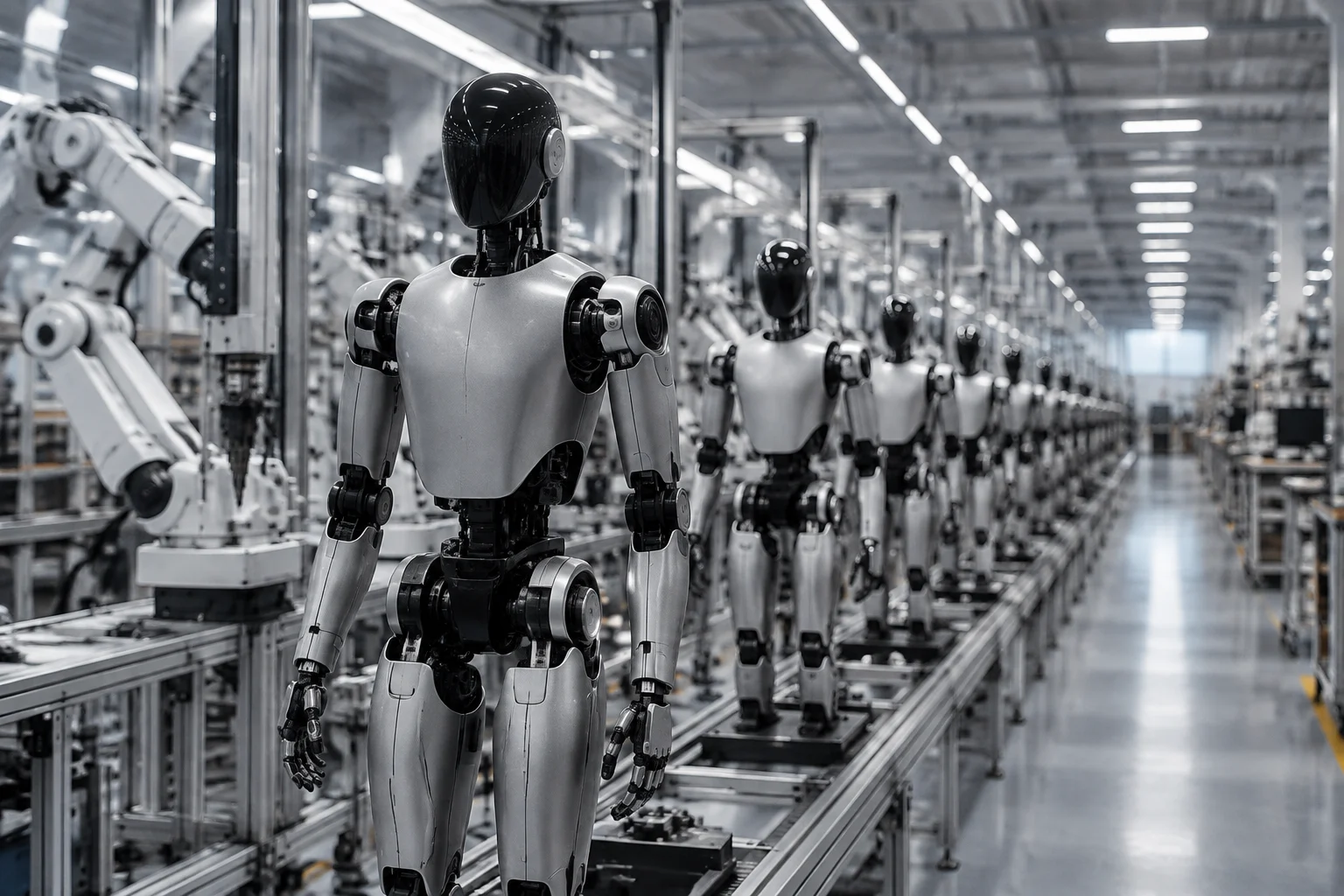
The ability to scale production is Figure AI’s key competitive differentiator today. The company has developed BotQ, a manufacturing platform designed specifically for mass-producing autonomous robots. According to figures published by the company, in just 120 days it increased its Figure 03 assembly rate 24-fold, going from producing one robot per day to making one per hour. This industrial advance has enabled the company to confirm production of 55 humanoid units in a single week, marking one of the sector’s fastest growth rates.
Figure’s production strategy is not limited to hardware manufacturing: it also brings together supply-chain optimization and the integration of artificial-intelligence components. The company plans to reach annual production capacity of 12,000 units by 2026, a target that reflects its intention to move from prototyping to large-scale commercial deployment. This transition is crucial to reducing unit costs and making these systems viable for adoption in domestic and commercial settings.
Technical specifications of the Figure 03
The Figure 03 is the company’s third-generation humanoid robot, designed specifically to adapt to domestic environments and personal assistance. Unlike its predecessors, which focused on industrial testing, this model incorporates an artificial-intelligence system called Helix, enabling smoother and safer interaction with people. The robot stands 1.75 meters tall and weighs 61 kilograms. It can carry a 20-kilogram payload while walking at a speed of 1.2 meters per second.
Autonomy is another technical pillar of the Figure 03. The device operates for five hours with a 2.3 kWh interchangeable battery pack that charges wirelessly through inductive plates placed on the floor, including through the robot’s feet. Its design also includes 16 degrees of freedom in its hands and a soft-fabric covering intended to make physical interaction safer. This eliminates the need for external cables that could pose a hazard in unstructured environments.
Industry context and trends for 2026
Investment in physical robotics has become a strategic priority for 2026, driven by the need to address labor shortages and an aging population. According to a Bain & Company study, development progress could mean that, before 2030, humanoid systems match human capabilities in intelligence, perception, and dexterity. In this context, companies such as Tesla, Agility Robotics, and UBTech are competing with Figure AI in a race that promises to reshape the world of work over the next decade.
Market consolidation depends on demonstrating a clear return on investment for businesses. Although current costs remain high, they are trending downward thanks to component standardization and more efficient manufacturing. Initial adoption is concentrated in industrial settings, but humanoid robots are expected to gain ground in sectors such as healthcare, construction, and services as technical and economic barriers diminish. Commercial viability will depend on both lower costs and measurable value in each deployment.
Implications for the market and investors
Figure AI’s market position is reinforced by its ability to attract capital from institutional and technology investors. Participation by companies such as NVIDIA and Qualcomm Ventures provides more than liquidity: it also secures access to next-generation GPU infrastructure needed to accelerate the training and simulation of its AI models. This strategic alliance is essential to maintaining a competitive edge in an industry where computing capacity is a critical bottleneck.
For technology professionals and investors, Figure AI’s trajectory offers a lesson in execution speed in advanced robotics. The transition from a stealth-mode startup to a company valued at $39 billion in less than three years demonstrates market confidence in the commercial viability of humanoid robots. For businesses considering these technologies, the practical decision is to assess the maturity of the Helix platform and BotQ’s ability to scale before committing to large-scale deployments. Execution and manufacturing capacity are central considerations alongside the technology itself.