
What it means to stream model output
In a conventional response, the application waits for the server to assemble the result and delivers it in full. With streaming, the server can send parts of the output while the model is still generating it. The practical difference is when the client starts receiving content; it does not mean the model processes each word separately or guarantees the response arrives earlier in all cases.
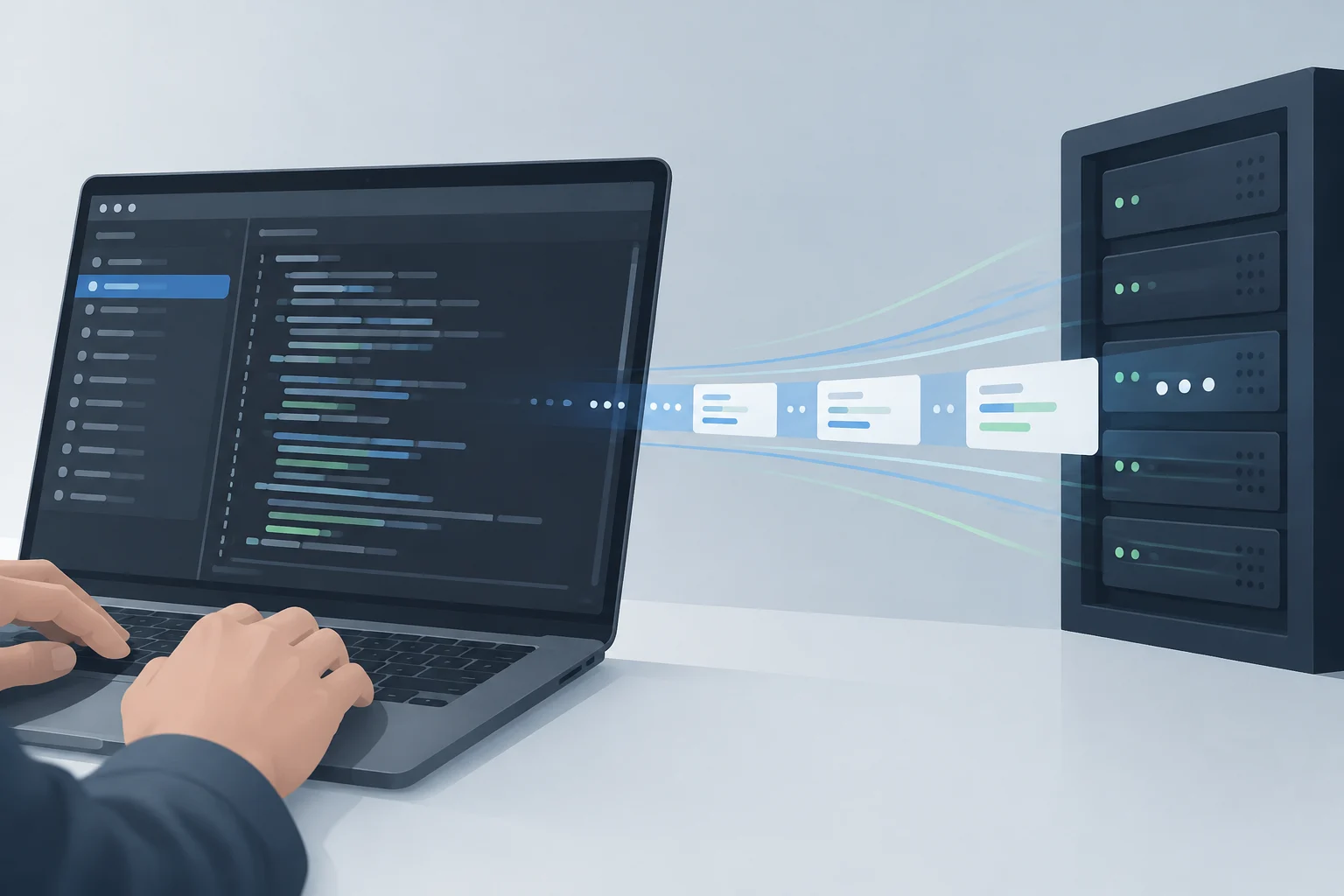
The interface can display partial text before generation finishes, reducing perceived wait time when the flow works correctly. However, an animated indicator or text appearing letter by letter does not by itself prove incremental transmission exists: an application can also simulate that effect after receiving a complete response. To verify this, one must observe the network response during the request, not just the visual presentation.
It is useful to separate three parts: the browser, an intermediate application endpoint, and the service or server running the model. Microsoft's documentation describes this separation as a general schema for chat applications and presents the protocol as a way to facilitate consumption from the frontend. The protocol organizes the exchange between compatible components; it does not replace the model or guarantee backend configuration, authentication, or data management on its own.
What Microsoft's AI Chat Protocol covers
Microsoft announced a JavaScript library and an API specification for the AI Chat Protocol, aimed at building AI frontends. In the announcement, the library was in public preview and the associated specification was available on GitHub. This is a starting point for evaluating an integration, not evidence that any inference endpoint automatically implements the protocol.
Microsoft's series on JavaScript includes an episode dedicated to streaming generative output. Its description indicates it covers implementation options, inference servers, the protocol, code examples, and integration with existing services. This credits the educational purpose of the material, but the episode page does not by itself contain enough details to assert a specific endpoint, JSON body, event schema, or completion marker.
For that reason, before writing a test request, consult the current specification and the example linked from the project documentation. Check the route, HTTP method, the format the endpoint expects, required fields, and the exact schema of events. Do not infer the network contract from the protocol name or a general guide on SSE: conventions can vary between implementations.
Preparing a test that allows verifying the flow
Start in a development environment with an endpoint your team controls or is authorized to use. Record which client sends the request, to which route, and with which method; also confirm how it authenticates. The available research package does not specify a universal configuration or test credentials, so those values must come from the specific service documentation, not a generic recipe.
Send a small, non-sensitive input, and keep the request body to compare it with the documented contract. If the application sends conversational history or other fields, note which are necessary for that test. Avoid real personal data: verifying transport does not require exposing private information or testing with user conversations.
Next, execute a request and observe both the HTTP status and the response headers and body. If you expect an event format, confirm the content type and verify that the body is delivered progressively, rather than appearing in full at the end. The general SSE guide describes an HTTP response that remains open and uses text/event-stream, but that does not credit that a Microsoft-protocol-compatible endpoint uses exactly that representation in all its modes.
Inspecting fragments without confusing them with the protocol
In the browser's developer tools, open the network tab, select the relevant request, and observe the response while it is still active. Look for whether data arrives before the operation ends, if the connection remains open, and if the interface updates the text as it receives information. Observation must be temporal: looking only at the final body, once the connection is closed, does not allow confirming when its parts arrived.
If the service uses SSE, its format consists of text lines organized as events; an HTTP connection remains open while the server sends those events. You can inspect the raw content in network tools or log in the client the messages the application has parsed. An SSE event does not necessarily equal a word or a semantic unit: it can carry fragments of different sizes or control data.
Do not assume the last event carries [DONE], that there is a field called data with plain text, or that each event represents a text fragment. The exact format depends on the endpoint contract, and available evidence does not document the event schema of Microsoft's protocol. Compare each observed element with the corresponding specification. If the contract does not define a final marker, record the completion using the mechanism that is documented, such as the response closure or a typed event, without inventing conventions.
Diagnosing interruptions and a bulk-delivered response
If the connection closes before completing the response, save the HTTP status, headers, and available partial data; then review the endpoint and inference service logs. A cut can be due to several points in the route, so observing the browser helps locate the symptom but does not always identify the cause. Design the interface state to distinguish a complete output from an incomplete one and offer a retry option that does not duplicate previous content.
A request that seems to take a long time and then delivers everything at once may indicate that streaming is not active or that an intermediate component is accumulating the response. Check, by comparing the configuration and logs of both ends, if the generation produces parts and when the server sends them. Do not automatically attribute the cause to compression, a proxy, or the model: those hypotheses require tests of the specific deployment.
For a disconnection, it is also not enough to assume the browser will resume generation from the exact cut point. The general SSE guide describes automatic reconnection of EventSource, but that does not guarantee the server will replay previous events or that the AI chat protocol will recover an ongoing generation. Retrying is not resuming: treat a new request as a distinct operation, unless your service's specification documents identifiers and event recovery.
Privacy, security, and deployment decision
Before enabling the feature for users, inspect what content leaves the browser and what each component retains: messages, history, identifiers, metadata, and debug logs. The transport protocol does not by itself determine retention policies or access to that data. Define what is sent, who can consult it, and how long it is stored, and do not include provider secrets in browser-accessible code.
Apply the protections corresponding to your service: authentication, access controls, encrypted transport, and a logging policy that avoids retaining unnecessary conversations. These are deployment decisions that must be verified with real configuration and applicable obligations; they are not properties resolved solely by adopting SSE or a frontend library. Review the full flow, from the form to the inference provider and observability systems.
Finally, fix the version of the library and specification you are integrating, and re-run the checks when updating. The public preview status documented by Microsoft is a reason to check changes, not proof that a specific implementation is insecure or unstable. The useful decision is simple: if the endpoint and client meet the contract, fragments arrive before closure, and errors are presented as such, you have evidence of real streaming; privacy and resumption capability require separate verifications.