The Computational Bottleneck in Modern Robotics
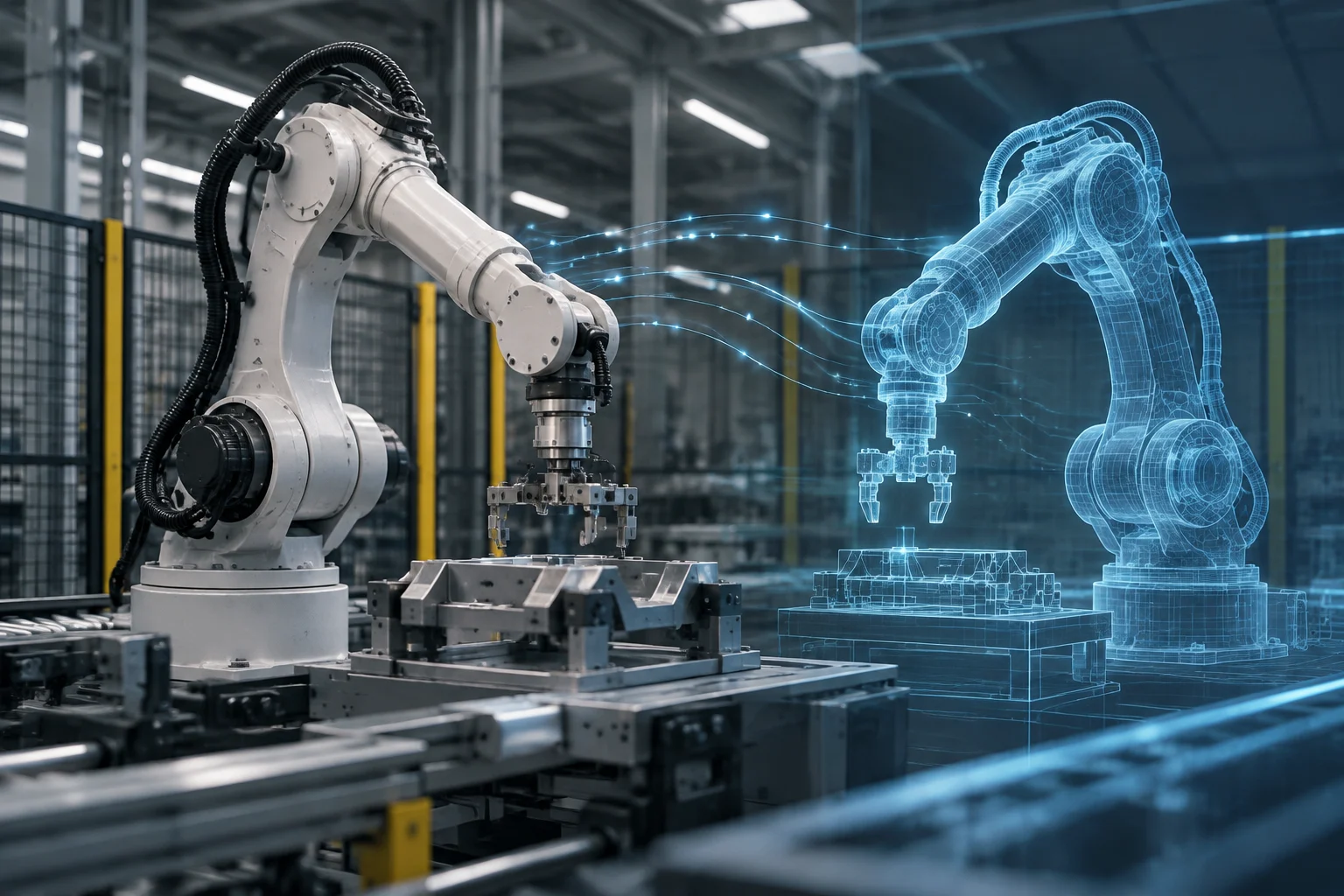
The transition from fixed industrial robotics to physical artificial intelligence requires robots to process large volumes of sensor data in real time. Unlike data centers, robots operate under strict size, weight, and power (SWaP) constraints, which limit thermal dissipation capacity and battery autonomy. In this context, computer vision model inference and trajectory planning become the primary consumers of energy resources.
According to Gartner projections cited by QNV Solutions, Edge computing will process 75% of the data generated by industrial applications by 2025. This migration to the network edge forces engineers to abandon exclusive reliance on the cloud and optimize local hardware. A robot's ability to react in milliseconds to an obstacle or a change in the production line depends directly on the efficiency of its compute substrate, not just the quality of its algorithms.
Hybrid Architecture: The RobotCore Proposal
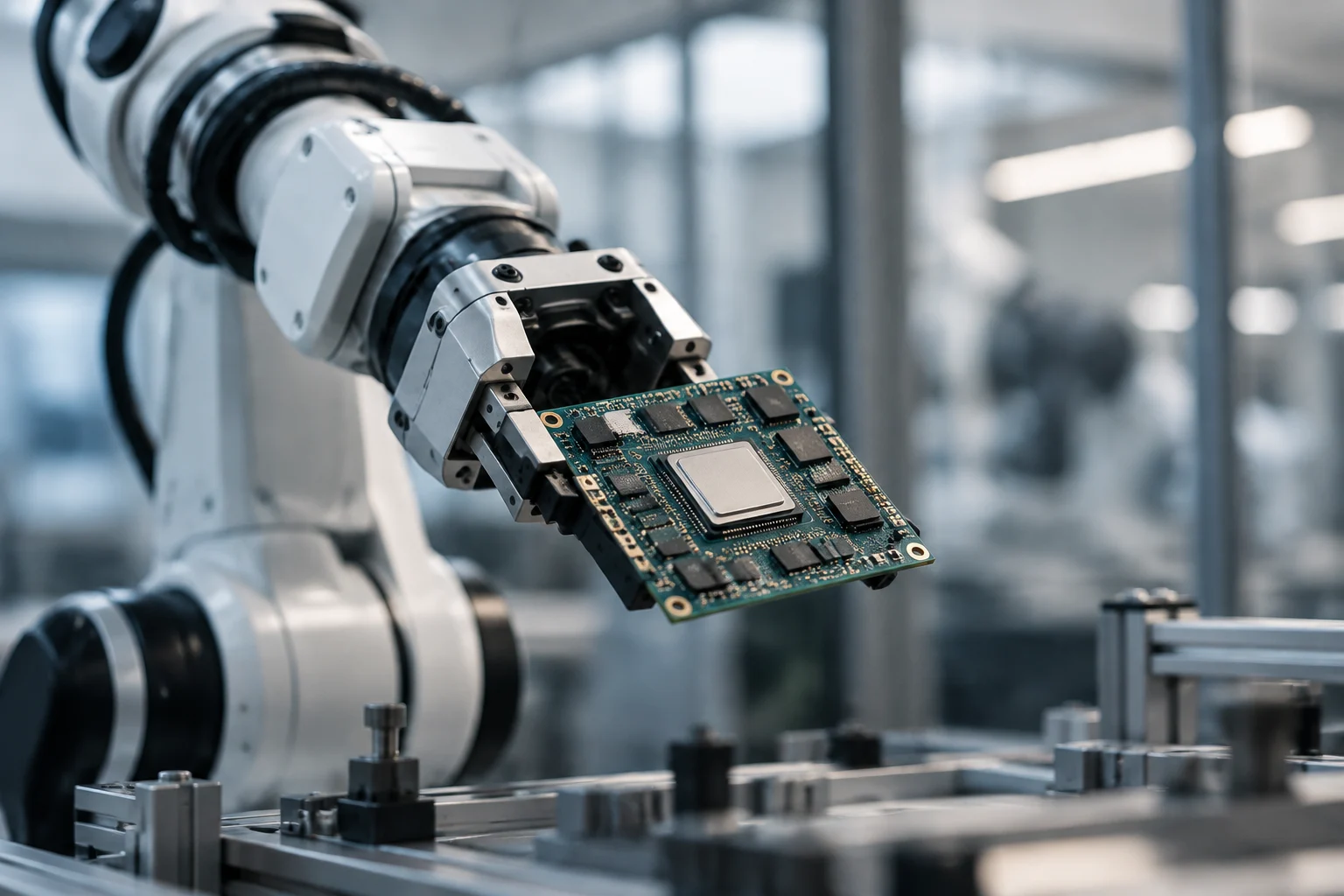
In September 2022, the Basque company Acceleration Robotics presented RobotCore, a robot processing unit (RPU) designed entirely in Spain. Unlike generic development boards, this architecture is specialized in accelerating workloads for the Robot Operating System (ROS 2). The design integrates 16 CPU cores, a GPU, and an FPGA-based acceleration system, seeking a balance between the raw power of parallel processing and the flexibility of programmable logic.
Collaboration with Professor Vijay Janapa Reddi from Harvard University and the Harvard Edge Computing Lab has been key to defining an open architecture independent of any vendor. The stated goal is to democratize access to hardware acceleration, allowing robotics developers not to depend on a single silicon ecosystem. This independence is crucial to avoid vendor lock-in and facilitate the integration of new sensors or algorithms without redesigning the entire baseboard.
FPGA vs. GPU: Determinism vs. Power
The choice to include an FPGA in the architecture responds to a specific technical need: temporal determinism. While a GPU offers superior raw performance for model training and massive inference, its latency can vary depending on the workload. In critical robotic applications, such as drone stability control or autonomous vehicle braking, latency variability is unacceptable. The FPGA allows configuring specific hardware for concrete data flows, guaranteeing constant response times.
Academic research, such as that published in Robotic Computing on FPGAs, highlights that FPGAs offer a unique combination of low energy consumption, high reconfigurability, and reliability. For workloads with predictable memory access patterns, the regular architecture of GPUs is efficient; however, for unstructured data or custom communication protocols, custom FPGA design is often superior. RobotCore's hybrid architecture attempts to capture the best of both worlds: the GPU for neural network inference and the FPGA for real-time control and sensor interfacing.
Market Context and Global Competition
The field-programmable gate array (FPGA) market was valued at $13.8 billion in 2025, with a projected growth to $41.1 billion by 2035, according to Global Market Insights. This growth is driven by the demand for edge computing and the need for specific acceleration in sectors like automotive and robotics. In this scenario, commercial solutions from NVIDIA (such as the Jetson series) and AMD (with its Kria platform) dominate the market for physical AI development boards.
Competition is not only technological but also geopolitical. Asia, particularly China, Japan, and South Korea, is accelerating the race to move robots from exhibition to factories. China installed 295,000 industrial robots in 2024, representing 54% of the global total. In this context, the Spanish RobotCore proposal positions itself as a European alternative seeking to offer industrial-grade support and detailed documentation, differentiating itself from general-purpose solutions that often require a huge investment in integration by the end customer.
Technological Maturity and Adoption Barriers
Despite theoretical advantages, the mass adoption of hybrid accelerators faces integration barriers. Software development for FPGAs is more complex than for GPUs, requiring specialized knowledge in hardware description languages (HDL) or high-level tools like OpenCL. The learning curve for robotics engineers, accustomed to pure software environments, can be a significant friction. Additionally, industrial scalability requires robustness certifications (temperature, vibration, humidity) that lab boards do not always possess.
The maturity of the software ecosystem is another critical factor. ROS 2 is in constant evolution, and maintaining hardware driver compatibility with new operating system versions requires continuous engineering effort. Acceleration Robotics' promise to offer industrial-grade support is a key competitive advantage, but its long-term validation will depend on the company's ability to maintain an active user base and solve integration problems in real production environments, beyond demonstration use cases.
Impact on the Value Chain and Validation Signals
The real impact of national innovation on the robotics value chain will be measured by its ability to reduce the total cost of ownership (TCO) of autonomous robots. If the hybrid architecture allows for greater operational autonomy or a reduction in energy consumption, this will translate into greater economic viability for operators. The reduction of mechanical wear and the improvement in movement precision, facilitated by the FPGA's deterministic control, can extend the useful life of equipment, a decisive factor in industrial investment decisions.
For R&D managers, verifiable success signals include the availability of exhaustive technical documentation, the existence of an active developer community, and the presence of use cases in regulated sectors like defense or aerospace. Collaboration with prestigious institutions like Harvard and presentations at international forums such as the October 2022 conference in Japan are positive indicators of the project's technical solidity. However, the transition from technical demonstration to large-scale commercialization remains the main challenge to consolidate RobotCore's position in a highly competitive global market.