A report measuring the pulse of the first half
Nielsen published its semi-annual report Streaming Landscape 2026: Trends from the First Half of the Year in August 2026, analyzing audiovisual consumption from late December 2025 to late June 2026. This document is not a prediction but a retrospective measurement of what viewers actually watched during those six months, providing a solid database to understand current sector dynamics.
The relevance of this analysis lies in its ability to distinguish between real consumption trends and market speculation. By mid-year, data shows that the five most-watched titles totaled 108 billion minutes, a figure slightly higher than the 103 billion recorded in the same period last year. This moderate growth suggests a mature market where competition for attention has intensified.
Streaming share clearly surpasses cable for the first time
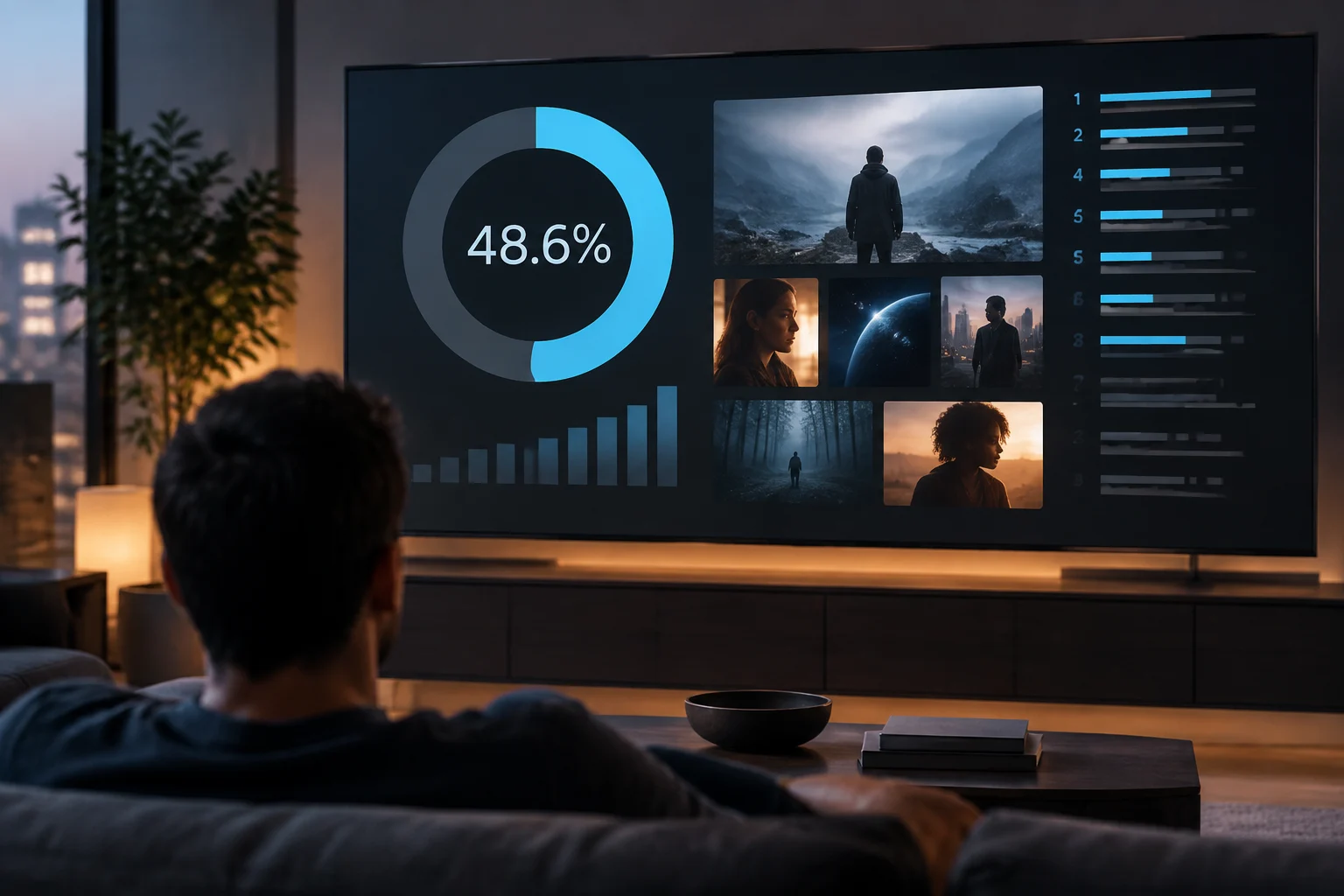
One of the most compelling findings of the period is the consolidation of streaming as the dominant channel. According to Nielsen's monthly The Gauge reports, streaming reached 48.6% of total television time in May 2026, significantly outpacing cable television, which stood at around 21.6% in April. This gap of over 26 percentage points marks a historic inflection point in audiovisual distribution in the United States.
Growth is not uniform across platforms. YouTube led the media distributors category with a 13.8% viewing share in May, while Amazon Prime Video hit its best-ever record at 4.5%, driven by live sports events and the finale of its original series The Boys. These data indicate that format diversification (on-demand video, live, and social) is key to retaining audiences.
The dominance of originals in the top 10
The report highlights a structural change in the composition of the top 10 most-watched titles. While only one original series held a spot in the top 10 in the first half of 2025, in 2026 three original series managed to enter that select group. This shift reflects the platforms' ability to generate exclusive content that competes directly with traditional television productions.
Netflix's Stranger Things remained the most-watched title of the half with 23.26 billion minutes, followed by Bluey on Disney+ with 22.81 billion and The Pitt on HBO Max with 21.12 billion. The presence of The Pitt is particularly relevant because it demonstrates that medical and adult drama series still have a massive audience on paid platforms, challenging the idea that streaming only works with youth or niche content.
Unscripted series and original films: new growth engines
Beyond fiction series, Nielsen identifies a rise in the unscripted series category, which is gaining screen time at the expense of traditional formats. This type of content, including reality shows and documentaries, offers platforms a flexible tool to keep subscribers engaged with production costs generally lower than high-budget fiction series.
In the film sector, streaming original films had a solid first half, even in a context of a box office rebound in cinemas. Titles like Zootopia 2 on Disney+ led the children's category, while Netflix's The Rip topped general audience films. This coexistence between cinema and streaming suggests that audiences do not choose one over the other but complement their habits of consumption depending on the type of experience they seek.
Methodological limitations and scope of the analysis
It is important to note that Nielsen's data focuses primarily on the US market and uses a measurement methodology combining audience panels with platform data. This means the figures may not be directly extrapolable to other geographic markets, where platform penetration and consumption habits can vary significantly.
Furthermore, the report measures viewing time but not necessarily viewer satisfaction or long-term retention. A title can accumulate billions of minutes thanks to a viral premiere, but that does not guarantee the audience will continue subscribing to the platform. Therefore, these data should be interpreted as a snapshot of immediate consumption, not a brand loyalty metric.
Implications for platforms and advertisers
For platforms, the key is investment in original content that can generate massive cultural events, as demonstrated by the finale of Stranger Things. For advertisers, the growth in streaming share opens the door to more segmented and measurable advertising formats, especially on platforms offering ad-supported plans. Programmatic advertising in CTV (Connected TV) is becoming a viable alternative to linear television, allowing advertisers to reach specific audiences with greater precision.
In summary, the first half of 2026 confirms that streaming is no longer an alternative to television but its dominant form. Companies wanting to compete in this space must prioritize the quality of original content, format diversification, and the ability to measure the impact of their investments in an increasingly fragmented environment.