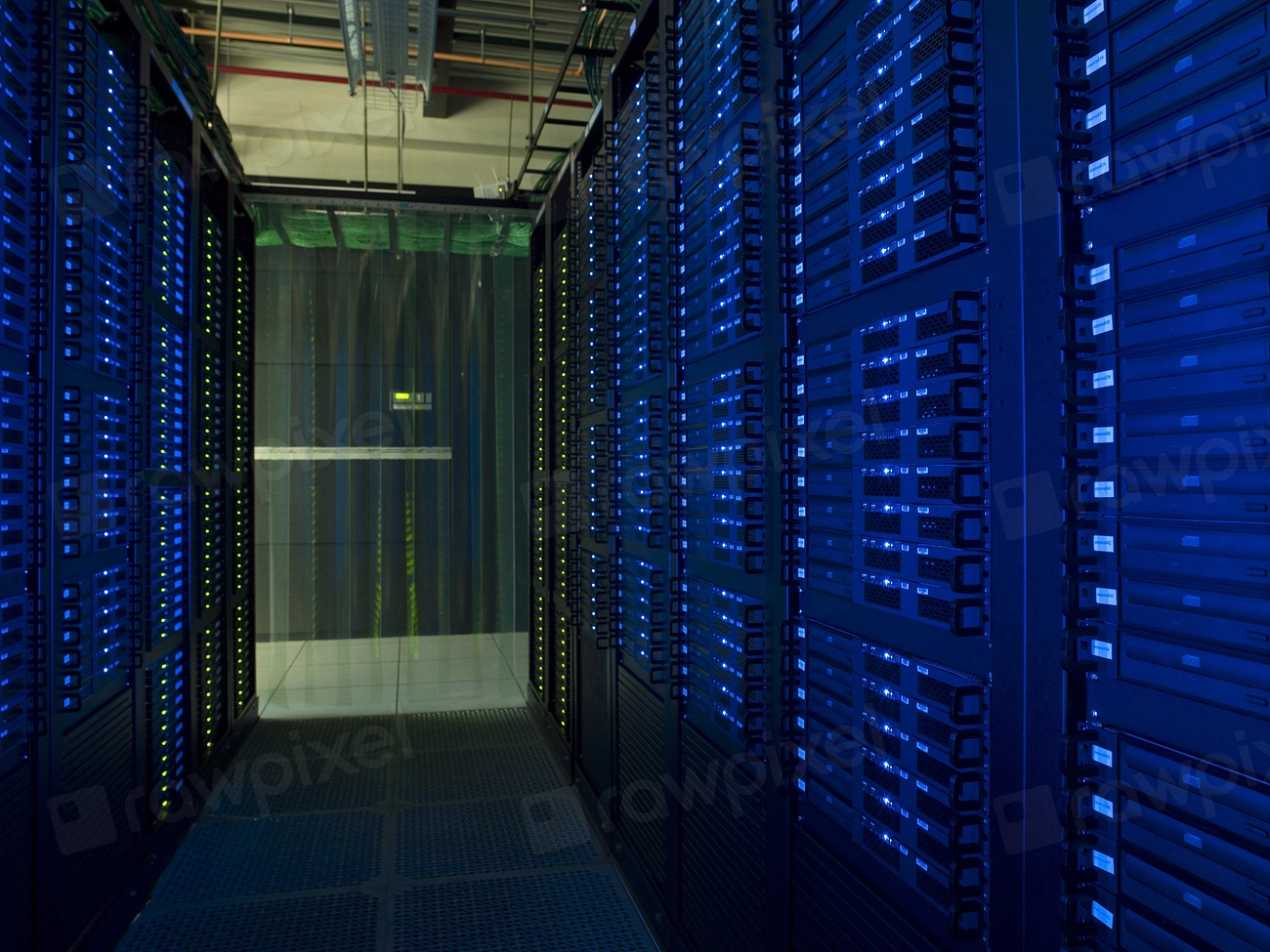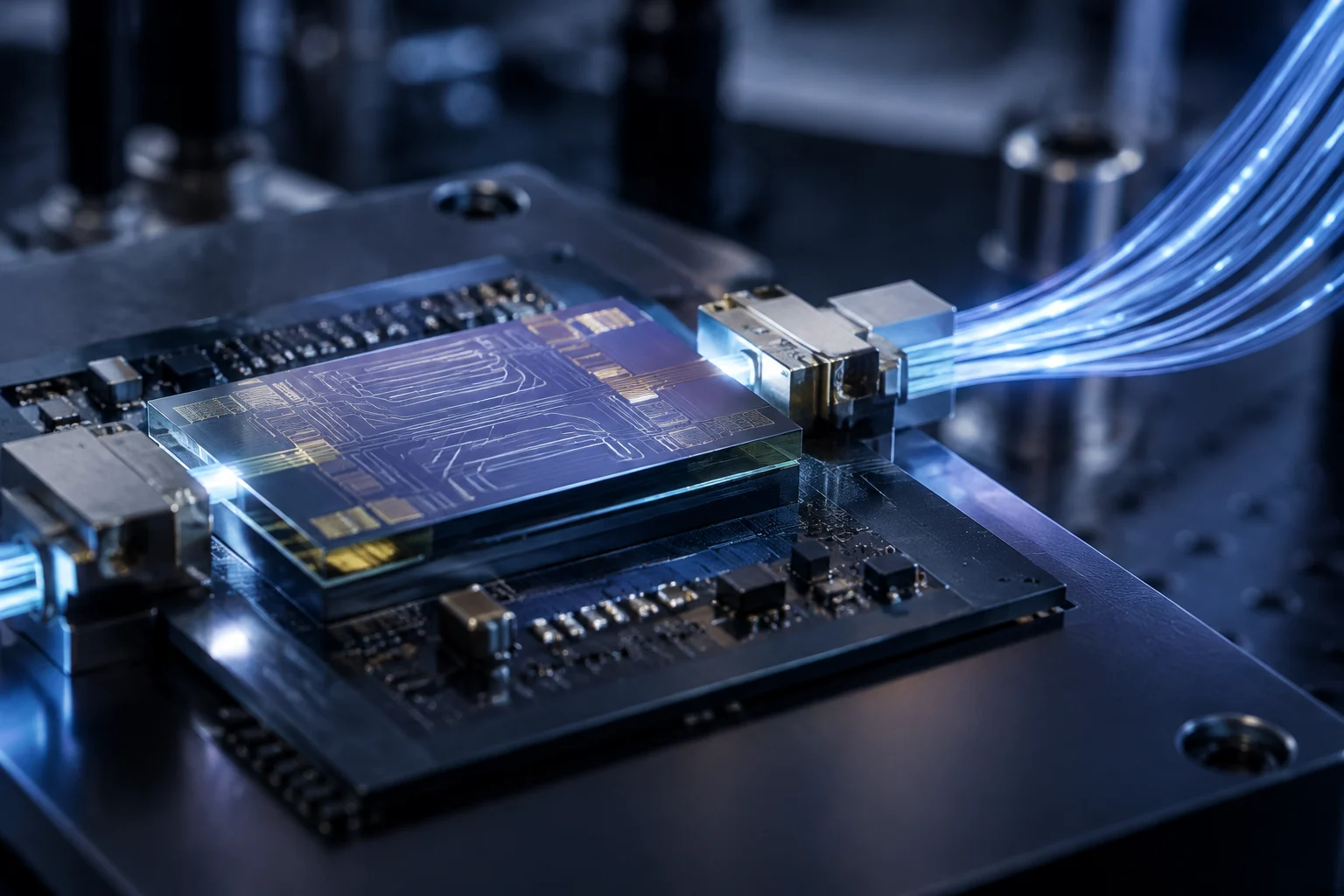
The problem is not just computing, but moving data
In data centers and high-performance computing systems, processors, memory, and network equipment must exchange large volumes of information. As computing capacity grows, communication between components can become a bottleneck for performance and power consumption. Integrated photonics aims to transport signals using light in compact optical circuits, often alongside conventional electronics. The proposal refers to data movement, not to light completely replacing electronic processing.
Scale matters. A connection within a chip, a link between chips in the same package, a connection between servers, and a link between data centers have different distances, power requirements, and designs. A demonstration valid for one level does not automatically prove utility at another: transmitters, receivers, optical waveguides, fibers, control circuits, and coupling losses all change. Therefore, before comparing results, one must identify which link was measured and in what system.
Optical integration can also describe different configurations: photonics on a separate chip, hybrid integration with electronics, or a co-packaged optics solution next to the processor. Each poses different trade-offs in assembly, input/output density, cooling, and repair. The term integrated photonics is too broad to function, on its own, as a product specification or proof of maturity.
Four metrics to compare links
Energy per bit is a useful metric, but it requires an explicit measurement boundary. A figure might cover only the modulator or include the laser, controller, receiver, electrical-optical conversion, correction circuitry, and clock distribution. If two results account for different blocks, presenting them as a direct comparison is misleading. The power consumption of the complete link is more informative than that of a single component, provided its limits are detailed.
Bandwidth must be accompanied by the configuration that produces it: number of channels, rate per channel, modulation, coding, and whether the figure expresses aggregate capacity or useful data. In a 2025 preprint on a silicon microdisk transmitter, its authors report 1.2 Tb/s of off-die bandwidth in a 64-modulator system, and 29 fJ/bit. These are results attributed to that specific demonstration, not a performance guarantee for any photonic link nor standalone evidence of commercial availability.
Reach and latency also count. Optics can be attractive for transporting signals to distances where electrical interconnects face loss or power limits, but a faster link does not necessarily reduce end-to-end latency: coding, processing, buffers, and network architecture all intervene. A rigorous comparison specifies the physical distance and the functional path measured, rather than using “faster” as a conclusion without conditions.
| Metric | What must be clarified | Why it matters |
|---|---|---|
| Energy per bit | Included blocks and operating conditions | Avoids comparing component with system |
| Bandwidth | Rate per channel, channels, and useful or raw data | Allows interpreting aggregate capacity |
| Distance | Length and type of link | Delimits the application the result refers to |
| Latency | Start point, end point, and traffic load | Separates link speed from system behavior |
Read the experimental conditions, not just the headline
Every efficiency figure depends on how it was obtained. To evaluate a result, one needs the operating conditions, the measurement method, the equipment included, and the variability between samples. In an optical link, wavelength, thermal state, input power, and connection losses also matter. Without that data, it may be possible to describe a demonstration, but not to reproduce it or transfer its figure to another architecture. A single isolated figure does not define performance.
It is advisable to distinguish between the capacity of a device and the effective capacity of a complete connection. A modulator operating at high speed is part of the link; the system still requires light generation and coupling, electrical control, reception, and, depending on the design, error correction. A component result can be technically important without demonstrating that all those blocks operate together with equal performance.
One must also review what “demonstration” means. It could be a simulation, a component measurement, a multi-channel test, or a system evaluation under traffic and representative conditions. These are not interchangeable steps. A claim about commercial deployment requires broader evidence than that needed to conclude that a device works in an experiment.
Integration and packaging can decide the outcome
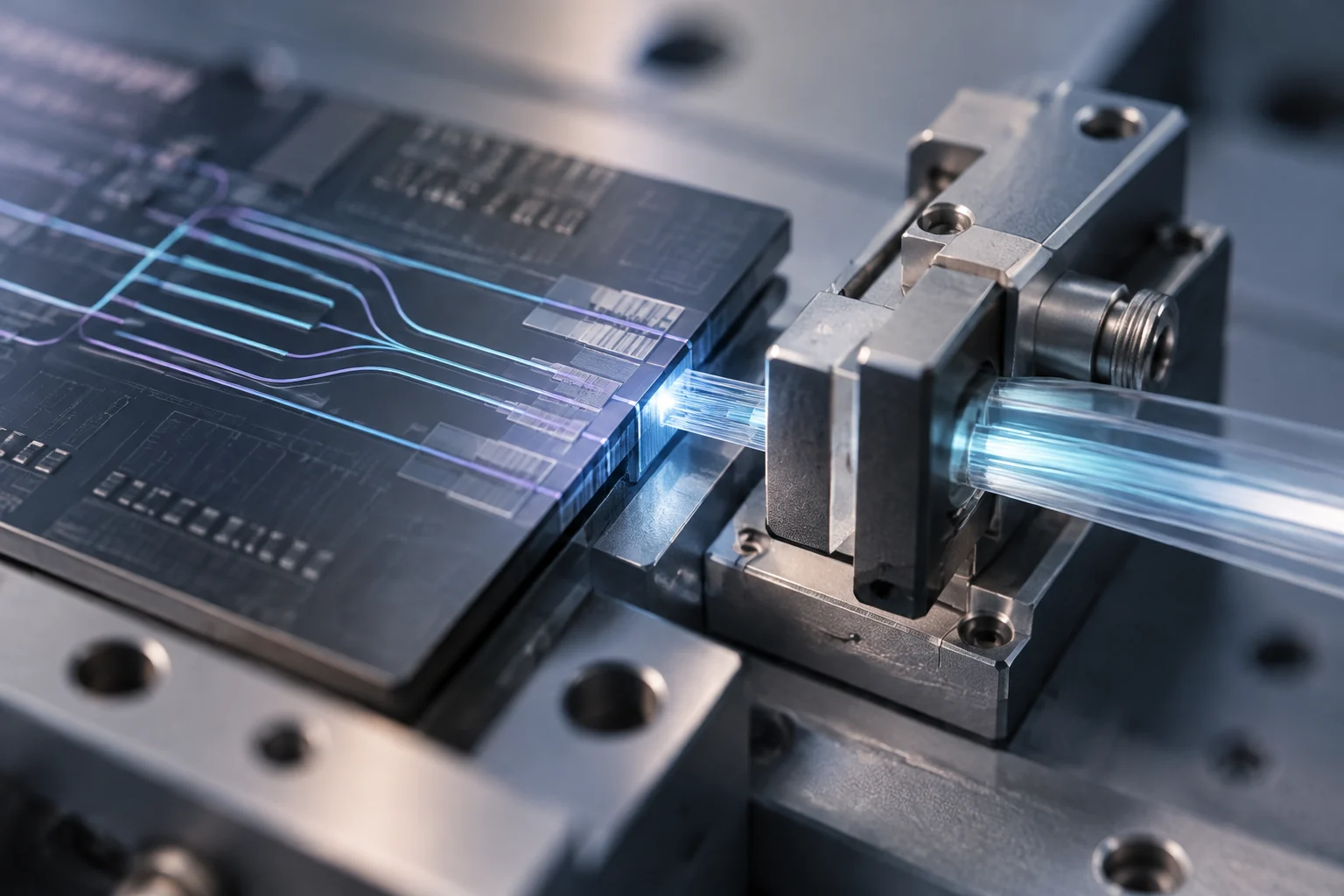
Optical communication does not end at the waveguide. To connect photonic circuits with fibers, interfaces are needed that align and couple light; the higher the connection density, the more demanding the assembly and its tolerances may be. imec describes, in a technical article on high-density co-packaged optics, fiber coupling, optical loss, operating band, and polarization tolerance as requirements, along with assembly yield and scalability. Packaging is part of the technology, not a subsequent detail.
Integration with electronics raises another question: what is integrated, in what process, and with what consequences for performance, cost, and manufacturing. Intel described in 2020 advances toward the integration of photonics with CMOS silicon and pointed to technological blocks developed on a silicon platform. That corporate communication serves as evidence of the company's direction and claims at that time; it should not be read as proof that all production or deployment obstacles have been resolved.
The thermal aspect requires an equally careful reading. A result may depend on temperature adjustments to keep the wavelengths of resonators or channels aligned. In the 2025 preprint cited earlier, the authors report a permanent tuning technique that reduces by 33% the energy required for the thermal tuning of the microdisk wavelength. This is an improvement described for that technique and that system; it does not equate to a 33% reduction in the total power consumption of a data center.
What tests are needed to discuss manufacturing and reliability
A laboratory demonstration does not establish that a process has adequate manufacturing yield. To value that transition, one must look for data on repeatability between devices, variation between lots, assembly yield, and production tolerances. If public evidence does not provide those figures, the correct conclusion is that that aspect is not demonstrated by the available source; not that industrial performance is necessarily good or bad.
Reliability also requires tests under specified conditions: prolonged operation, thermal cycles, and interface behavior, among others. The method and duration matter, just as the definition of failure does. Without reliability protocols and data, an announcement of integrated components is not enough to claim that the system is ready to operate continuously in data centers.
For a purchase or planning evaluation, product signals are also needed: maintained technical documentation, operating limits, compatibility, support, availability, and supply conditions. Research materials and corporate communications can help understand the technical direction, but they do not replace a product datasheet or evidence of use. In the sources gathered here, there is not enough documentation to identify an exact commercial product, price, or availability associated with the analyzed figures.
Conclusion: separate technical advance from system advantage
The available evidence supports a bounded conclusion: integrated photonics is an investigated path for data interconnects, and the selected sources describe both integration advances and specific experimental results. They do not allow concluding, without additional tests, that the technology always reduces power consumption, that it outperforms electrical connections at all distances, or that it is widely deployed. The advantage depends on the link and its complete system.
Faced with a new claim, it is advisable to first check what was measured and at what scale; then, which blocks enter the energy and bandwidth figures; finally, whether there are tests of integration, manufacturing, and sustained operation. If those data are missing, there may still be a valuable technical contribution, but its scope must be expressed with precision.
The decisive point is not that the signal travels as light, but whether the complete solution offers a measurable improvement under comparable conditions and whether it can be integrated and manufactured with the required reliability. That distinction allows recognizing advances without turning a component measurement into a system promise.