Confirmation of the December 2026 rollout
According to Bloomberg reports cited by multiple media outlets, Apple plans to launch Apple Intelligence in mainland China as part of the iOS 27.3 update, scheduled for December 2026. This announcement marks the end of a waiting period of more than two years, during which the company could not activate its artificial intelligence features in one of its most important markets due to local regulatory requirements.
The date has not been officially confirmed by Apple, but the convergence of high-level sources and the obtaining of preliminary permits in July 2026 reinforce the likelihood that the rollout will occur within the indicated timeframe. The company has held recent conversations with China's Ministry of Industry and Information Technology to finalize the network access permits necessary for specific iPhone models.
Features included and excluded in the initial version
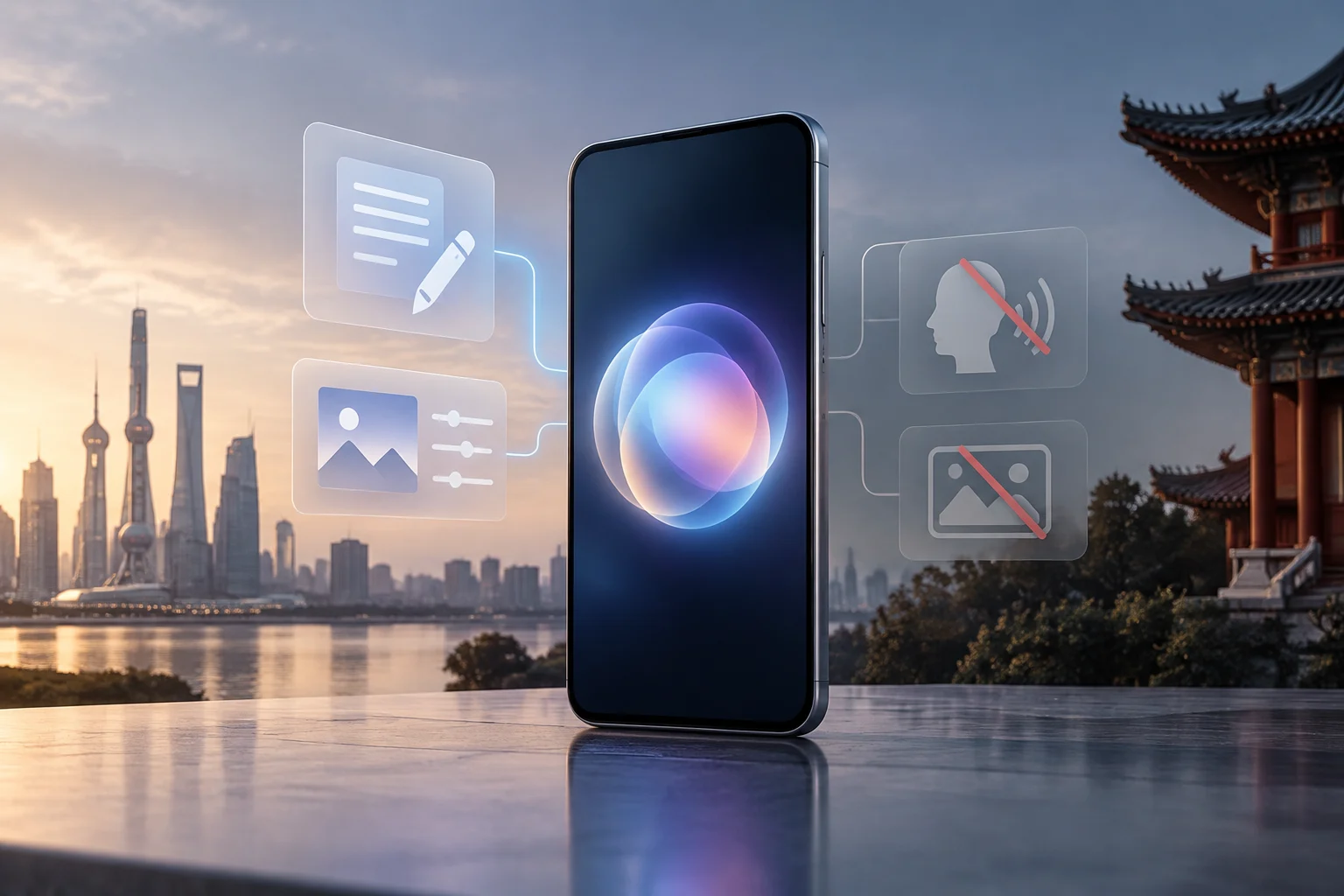
The initial rollout will be deliberately limited. The features that will be activated include Writing Tools, notification summaries, Genmoji, and the Clean Up function in Photos, which allows users to remove unwanted objects from images. These capabilities were introduced globally in 2024 and represent the foundation of the Apple Intelligence experience.
In contrast, the version for China will not include Siri AI, the next-generation assistant announced with iOS 27, nor Apple's proprietary image generation tools (Image Playground). Mark Gurman, a Bloomberg columnist, noted that Apple executives have little hope that Siri AI will reach China in the short term, although he believes the updated version of Apple Intelligence will eventually be completed.
Regulatory restrictions and reliance on local models
China restricts foreign-origin generative AI technology, which forced Apple to establish alliances with local companies. Alibaba Group and Baidu are the partners providing the large language models (LLMs) integrated into Apple Intelligence for Chinese devices. Alibaba's models, Tongyi Qwen and Tongyi Wanxiang, are designed to comply with local data and content regulations.
The Chinese regulatory framework, including the Interim Measures for the Management of Generative Artificial Intelligence Services in effect since August 2023, requires security assessments and algorithm registrations for all generative AI services. The Personal Information Protection Law (PIPL) imposes strict requirements on automated decision-making and biometric data processing, limiting the implementation of certain AI features that rely on sensitive data.
Context of delays and Apple's strategy
The launch of Apple Intelligence in China has suffered several delays. Initially, Apple expected a rollout in May 2025, then postponed it to late 2025, and finally to the spring of 2026 while awaiting government approval. The obtaining of preliminary approval in July 2026 was a key milestone, but additional permits for network access on specific iPhone models were still required.
This strategy reflects Apple's approach to compete with local manufacturers like Huawei and Xiaomi, which offer smartphones with integrated AI. By adapting its features to Chinese regulations, Apple seeks to maintain its presence in the world's largest smartphone market, although with a less complete AI experience than that available in other markets.
Practical consequences for users
For iPhone users in China, the rollout of Apple Intelligence will mean access to productivity and photo editing tools, but with significant limitations in voice assistant interaction. The absence of Siri AI implies that advanced conversational AI features will not be available, which could affect the user experience compared to devices from other brands.
Privacy and performance will also be impacted by the reliance on local models. Data processed by AI features will be handled in accordance with Chinese data sovereignty regulations, which may differ from Apple's global privacy practices. Users should be aware that the AI experience in China will be an adapted version, not an exact replica of the global offering.