Definition and Scope of Soft Robotics
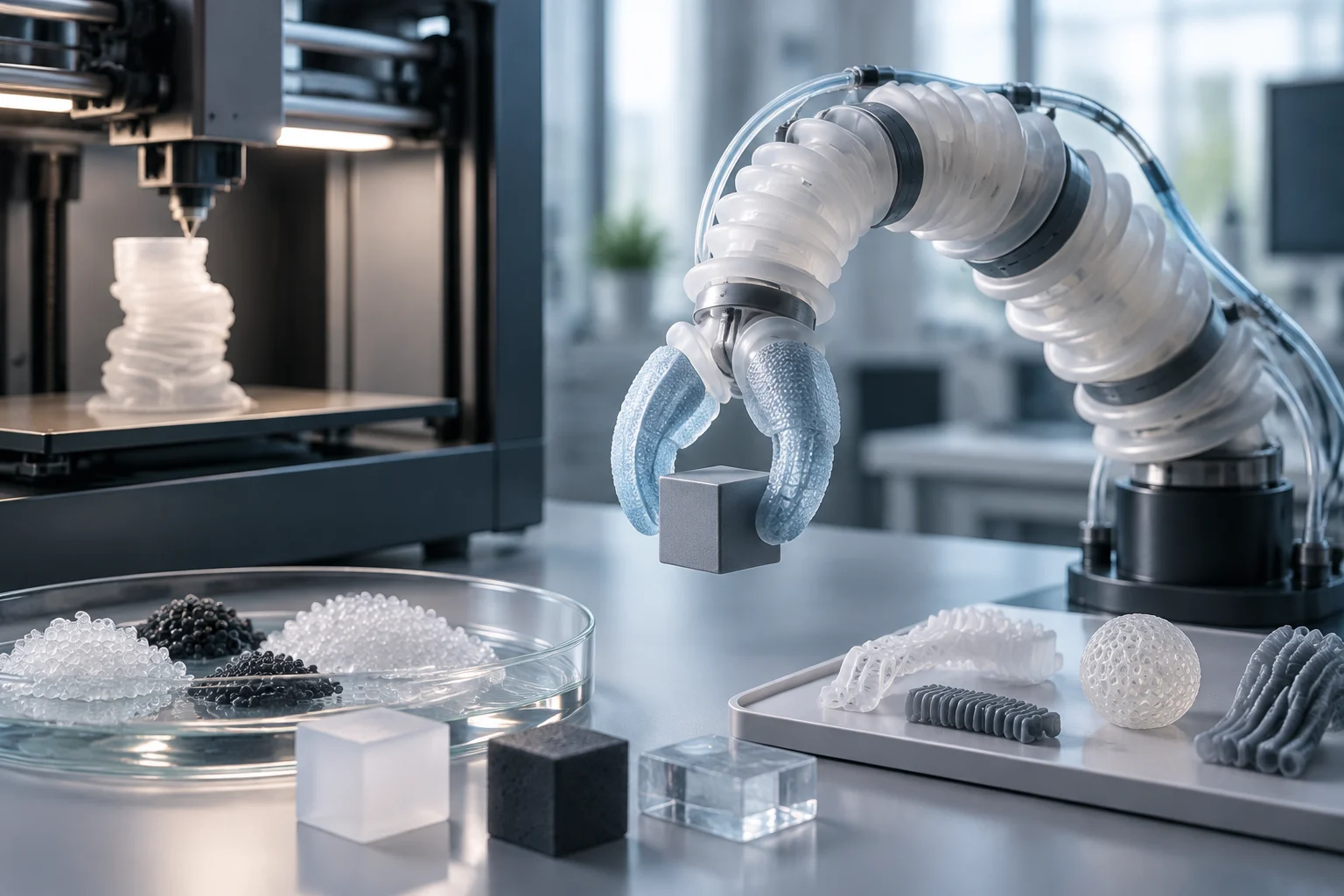
Soft robotics is defined as a rapidly growing field where robots are fundamentally soft and elastically deformable. Unlike rigid-structure robotics, these systems do not rely on complex mechanical joints but on the controlled deformation of their materials to interact with the environment. This characteristic allows for safer human-robot interaction designs and adaptation capabilities to irregular geometries that rigid structures cannot offer. The distinction is crucial: it is not about rigid robots with soft coatings, but entire structures designed to flex.
The manufacturing of these robots has historically been a challenge due to the intensive labor and time required to assemble complex components. The transition towards direct manufacturing via 3D printing seeks to resolve this limitation, allowing the creation of sophisticated designs and functions more efficiently. However, it is crucial to distinguish between the theoretical viability of the concept and the reality of current manufacturing processes, which still face significant limitations in repeatability and durability. The promise of 3D printing is not just speed, but the ability to integrate structural and actuator functionality into a single piece.
Interest in this technology is not new, but its specific application to soft robotics has gained traction in recent years thanks to advances in polymeric materials. While traditional industrial robotics uses 3D printing to manufacture rigid and lightweight parts, soft robotics requires the material itself to be the functional element. This paradigm shift implies that the mechanical properties of the polymer are as important as the geometry of the printed part.
Extrusion Processes and Material Families
Recent academic research, such as that published in the Journal of Modern Plastics in 2024, focuses primarily on material extrusion (EM) processes as the key technology for manufacturing soft robots. This approach is due to the availability of soft polymeric materials and the ability to work with multiple materials in a single part. Extrusion allows depositing layers of thermoplastic polymers or elastomers that, upon solidifying, form the elastic structure of the robot. The choice of this process is not accidental: it is the most accessible and best suited to the complex geometry of soft actuators.
The materials used in these processes include high-performance polymers and compounds specifically designed to offer particular mechanical properties, such as tensile strength or elastic recovery capacity. Material selection is critical, as it must withstand deformation cycles without degrading. Although there are advances in the formulation of new compounds, most documented applications are in the prototyping phase, where optimization of printing parameters is still an active area of research. Compatibility between the material and sterilization processes, if applicable, is another determining factor in selection.
Materials and Compatibility
The doctoral thesis by Fuentes Fuentes (2022) highlights that material extrusion additive manufacturing (MEX) is the most used process due to its low cost and ease of access to materials. This is especially relevant for soft robotics, where elastomers and low-melting-point thermoplastic polymers are common. The ability to print with multiple materials in a single pass allows creating stiffness gradients within the same structure, something impossible with traditional manufacturing methods.
Evaluation Methods and Durability Tests
To validate a 3D-printed robot, it is not enough for the part to print correctly; it is necessary to evaluate its behavior under repeated operation cycles. Laboratory tests usually measure maximum deformation, movement repeatability, and material fatigue resistance. These parameters determine whether the robot can perform its function consistently over time or if it suffers rapid degradation of its mechanical properties. The lack of quantitative data on useful life is one of the main limitations of the current literature.
The integration of sensors and actuators into the printed structure adds a layer of complexity to the evaluation. Not only is the structural material tested, but also the functionality of the complete system. In many cases, laboratory demonstrations show correct operation under controlled conditions, but data on performance in real environments or after thousands of use cycles are missing. This gap between initial demonstration and long-term validation is one of the main obstacles to industrial adoption. Material fatigue is a phenomenon that does not manifest in initial tests, but after prolonged use.
Validation Criteria
- Maximum Deformation: The robot's ability to reach the desired position without failing.
- Repeatability: Consistency of movement in successive cycles.
- Fatigue Resistance: Degradation of mechanical properties after thousands of cycles.
- Environmental Compatibility: Resistance to humidity, temperature, and chemicals.
Integration of Functional Components
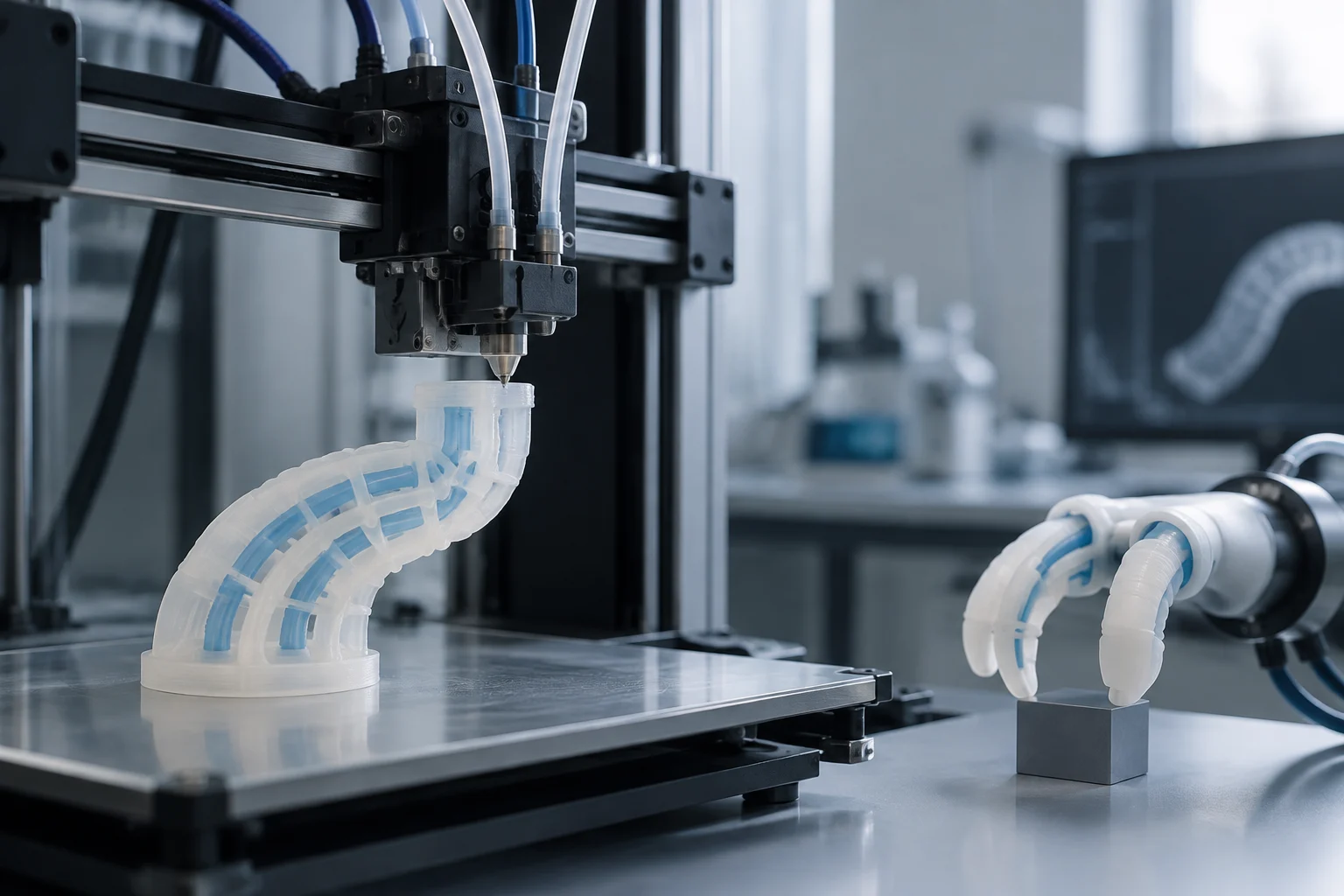
A significant technical challenge is the integration of actuators and sensors within the printed structure. In soft robotics, actuators are often an integral part of the design, such as printed pneumatic chambers or artificial muscles. Multimaterial 3D printing allows creating these complex geometries in a single operation, reducing the need for manual assembly. However, the precision required for these functional components to align correctly remains a challenge for current extrusion technologies. The alignment of air chambers, for example, is critical for actuator operation.
Furthermore, compatibility between different printed materials is a determining factor. If an actuator is made of an elastomer and the support structure of a stiffer polymer, the joint between both must withstand mechanical stresses without failing. Current research explores how to improve adhesion between layers and different materials, but there is not yet a universal standard that guarantees the reliability of these joints in high-demand applications. The lack of design standards for printed soft robotics is an important barrier to standardization.
MiniFactory, for example, highlights how 3D printing of high-performance polymers allows manufacturing lighter and more durable robotic tools. Although its focus is industrial robotics, the principles of lightweight and resistant design are applicable to soft robotics, where weight reduction is crucial for maneuverability. The ability to print parts that function in extreme conditions is an advance that could be transferred to soft robots destined for hostile environments.
From Laboratory Demonstration to Production
To move from research prototypes to sustainable production, evidence is required that printed robots can be manufactured in a scalable manner with consistent quality control. This implies not only the availability of materials but also the standardization of printing parameters and the validation of post-processing processes. The lack of data on the real useful life of these devices under continuous use conditions limits their application in sectors requiring high availability, such as medicine or the food industry. Scalability is a greater challenge than technical viability.
Industrial maturity also depends on cost reduction and design simplification. While 3D printing offers design freedom, optimization for mass production requires balancing geometric complexity with process efficiency. At this moment, most 3D-printed soft robotics applications are in the research or advanced prototyping phase, without clear consolidation in the final product market. R&D investment is high, but the return at industrial scale has not yet materialized.
Barriers to Production
- Material Cost: High-quality elastomers are more expensive than standard thermoplastics.
- Printing Time: The complex geometry of soft robots requires long printing times.
- Quality Control: The lack of inspection standards for elastic parts prevents industrial certification.
- Scalability: Mass production of printed parts is slower than plastic injection.
Limits of Available Evidence
It is fundamental to maintain a critical perspective on available sources. Many descriptions of 3D printing in robotics come from promotional contexts or technical blogs that do not detail the methodological limits of the experiments. For example, a demonstration of a robot moving correctly in a video does not imply that it is capable of performing thousands of cycles without failing. The absence of quantitative data on material fatigue or long-term dimensional drift is a common limitation in the current literature. Evidence must be interpreted with caution.
Furthermore, confusion between traditional industrial robotics (where 3D printing is used to manufacture rigid and lightweight parts) and soft robotics (where the entire robot is elastic) can lead to erroneous conclusions about the state of the technology. While the manufacturing of rigid parts for industrial robots is more mature, the printing of complete soft robots remains an emerging field with many technical questions to resolve. The maturity of one does not imply the maturity of the other.
CSIC research, such as that by González Henríquez et al., is an example of how academia is addressing these challenges. However, the transfer of these results to the market is slow and requires industry collaboration. The lack of an ecosystem of suppliers of specific materials for soft robotics is another obstacle. Until there is a consolidated supply of materials and processes, the production of printed soft robots will remain a research niche.