The IMB-CNM Proposal and Source Claims
The news driving this analysis is not recent: the CSIC published the IMB-CNM's technology offer on February 27, 2025. It describes a method for manufacturing semiconductor qubits based on block copolymer technologies, presenting it as more accessible and economical than higher-cost alternatives. This is an institutional claim about the proposal, not an independent comparison accompanied by cost or performance figures.
The distinction matters. The source confirms that the team communicated a method and a potential manufacturing advantage; by itself, it does not demonstrate a quantified cost reduction, industrial production, or that the resulting devices have achieved competitive performance. Therefore, the useful question is not whether the technique has already changed the market, but what process is being attempted to enable and what tests would be needed to support a broader conclusion.
The institute's own documentation places the work within Pilot4Qutech, whose title proposes evaluating the feasibility of a CMOS-compatible line based on the self-assembly of block copolymers for nanoelectronic devices. The key word is feasibility: it describes the project's objective, not a confirmation of a deployed production line or a validated quantum computer built with it.
What Block Copolymers Bring to Nanofabrication
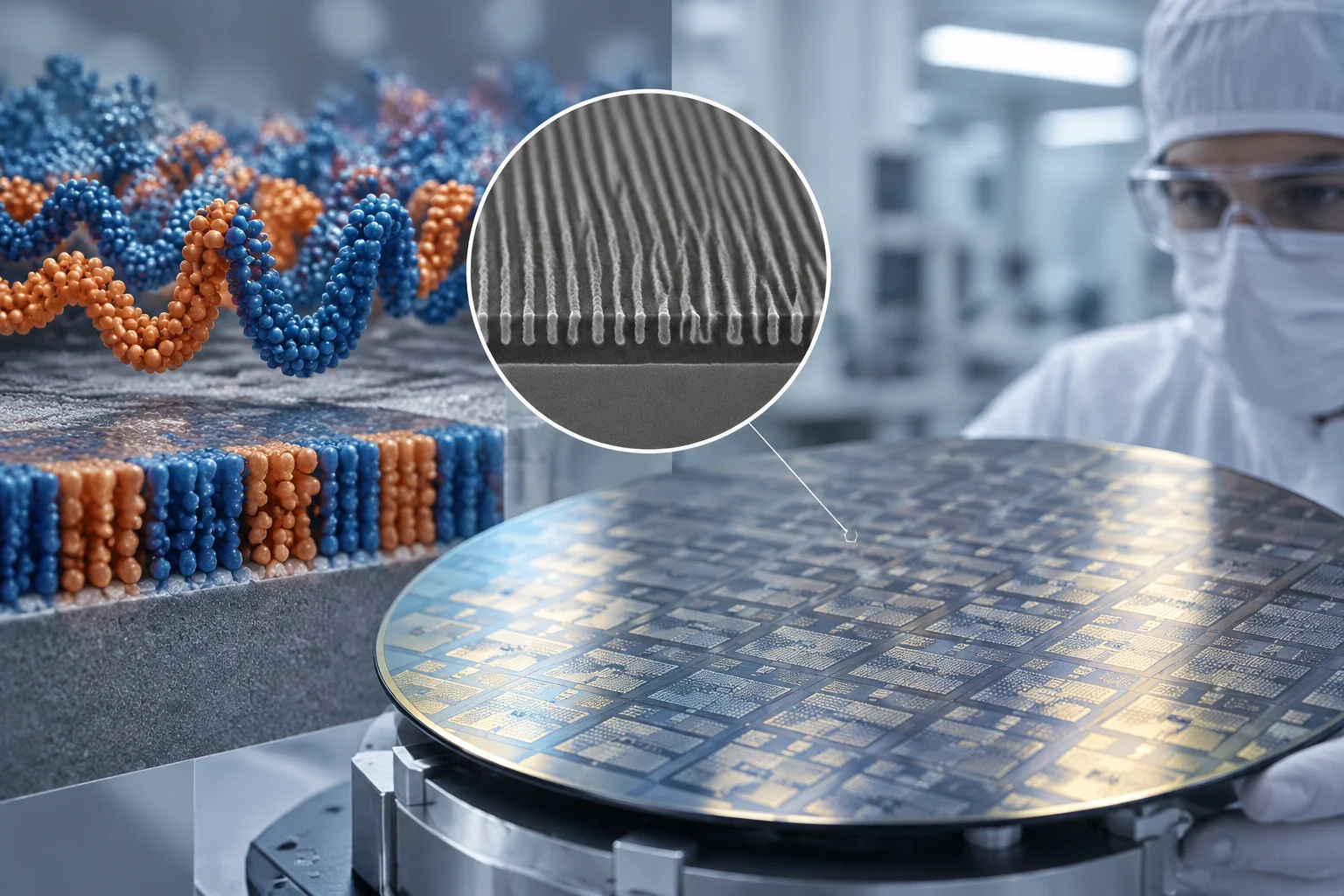
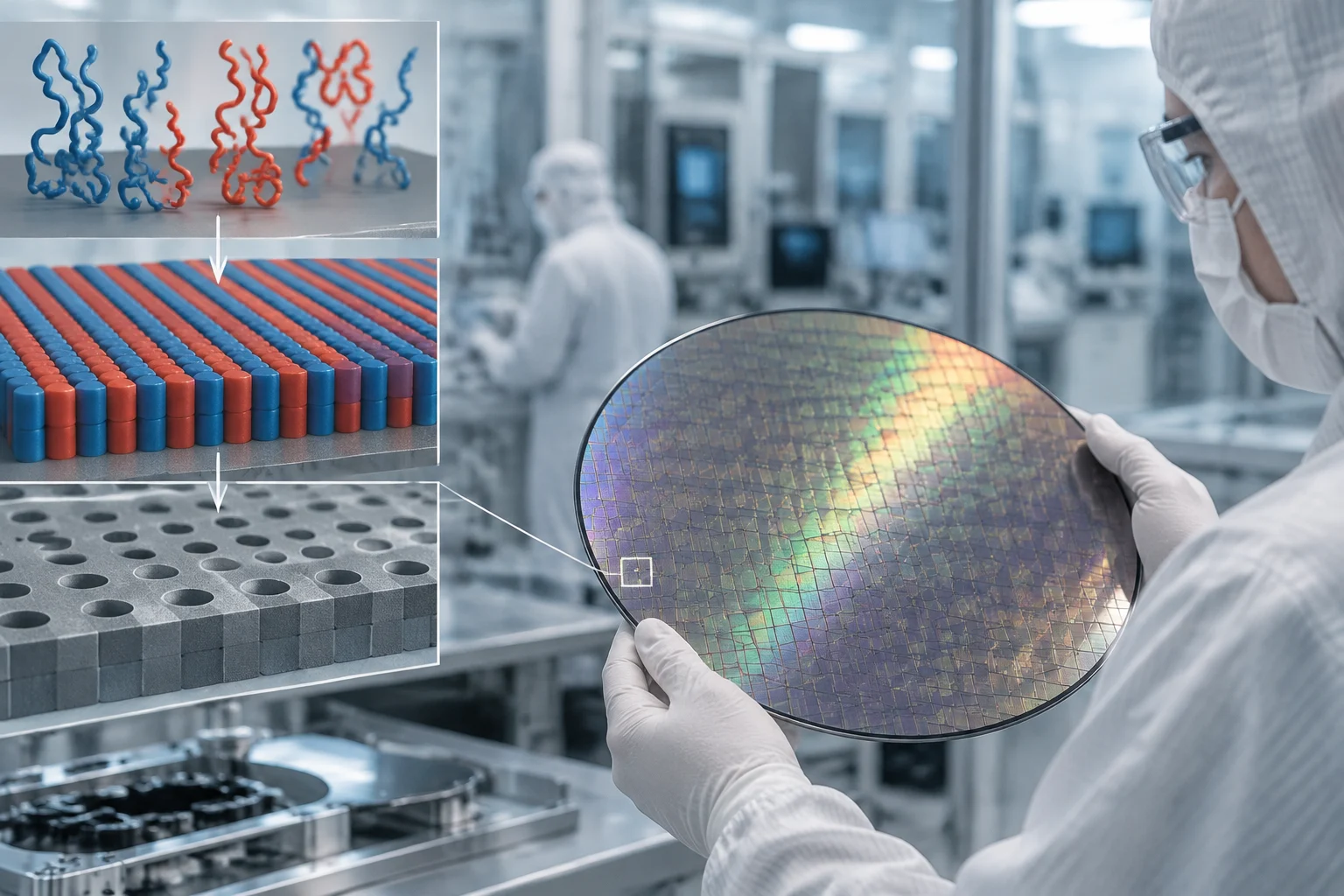
Block copolymers are polymers formed by segments of different chemical composition that can spontaneously organize into patterns at the nanoscale. The potential utility for fabricating small structures lies in leveraging that self-assembly as a patterning tool, rather than defining each feature solely through direct lithographic exposure. The existence of this general behavior is documented in studies of self-assembled morphologies and structures, but it is not enough to establish what specific geometry has been produced in the IMB-CNM project.
In a manufacturing chain, a self-organized pattern could serve as part of a structure definition or transfer process. However, this does not mean the polymer is itself a qubit: the qubit depends on a semiconductor device and the physics that allows confining and controlling quantum states. Fabricating the pattern and demonstrating a functional qubit are distinct milestones, with different characterization requirements.
The CSIC communication frames the technique as an advanced manufacturing pathway, but the available documentation here does not detail the process recipe, specific materials, dimensions achieved, statistical uniformity, or device performance. It is advisable not to fill these gaps with generic characteristics of polymer self-organization: they describe the technological category, not necessarily the specific implementation of Pilot4Qutech.
Pilot4Qutech: A Feasibility Project, Not a Confirmed Industrial Line
The IMB-CNM sheet identifies Pilot4Qutech as a project on the feasibility of establishing a CMOS-compatible technology line based on the self-assembly of block copolymers. It indicates the reference PDC2023-145930-I00, funding from MCIN/AEI and the European Union via Next Generation EU, and a planned period from January 1, 2024, to December 31, 2025. It also names Joan Bausells Roigé and Francesc Pérez-Murano as principal investigators.
CMOS is the dominant manufacturing technology in many integrated circuits. In this context, stating that a route is CMOS-compatible expresses a goal of integration with existing microfabrication processes and practices; it does not automatically prove it is interchangeable with a commercial foundry, that it satisfies all its contamination and performance controls, or that qubits can be integrated without modifications. The project sheet proposes evaluating that feasibility, not crediting all those results by itself.
As of this analysis, the project's published period has ended, but the provided sources do not include a final report with detailed experimental results. This does not allow concluding that the project has failed or met all its objectives. The prudent reading is more limited: there is a formal initiative with that objective and a CSIC communication attributing a method to the team; the degree of maturity and quantitative results require additional documentation.
Positioning the Technique Against Other Platforms
Semiconductor spin qubits exploit electronic states confined in structures such as quantum dots. One reason for interest in silicon is its relationship with microelectronic technology and the possibility of leveraging manufacturing knowledge accumulated in the industry. A Basque Quantum outreach talk summarizes arguments about the integration and scalability of silicon quantum circuits, but those platform advantages do not prove the performance of the IMB-CNM's copolymer method.
The variety of quantum technologies also prevents a simple 'better' or 'worse' comparison. Silicon, III-V semiconductors, superconducting materials, and other platforms have different components, manufacturing processes, and challenges. The copolymer technique is presented as a nanofabrication strategy linked to semiconductor devices; not as a complete quantum architecture that directly competes, for example, with a trapped ion system.
The most useful comparison, when sufficient data appears, will be between processes that manufacture comparable devices: resolution and uniformity of structures, variation between devices, manufacturing yield, process steps, compatibility with subsequent stages, and cost measured with a defined scope. Without common metrics, 'more economical' remains a qualitative description and does not allow deciding how much a manufacturer could save or at what production volume.
What Evidence Is Missing to Assess the Advance
Available evidence supports the existence of the proposal and the objective of Pilot4Qutech, but not a complete evaluation of its results. In particular, the sources in this package do not offer measurements of devices manufactured using this technique regarding gate fidelity, coherence times, qubit density, yield per wafer, or variability between batches. The absence of these data in the consulted sources limits the evaluation; it does not demonstrate that they have never been measured or published elsewhere.
To value the process as a manufacturing technology, results describing, at minimum, the obtained geometry and its distribution, the repeatability of self-assembly, defects, and functional device performance would be useful. To value its quantum importance, tests of qubit control and characterization would also be needed, with clear protocols and experimental conditions. These are related levels of evidence, but not substitutable for each other.
A practical criterion for readers, investors, or engineering teams is to seek documents that separate three questions: what structure was manufactured, what device functioned, and what quantitative advantage was observed compared to a comparable reference. An institutional news item serves to identify a line of work; a technical article or report with methods and results allows judging its reproducibility and maturity with greater precision.
Practical Implications and Conclusion
For those working in microfabrication, the proposal deserves attention as a possible pathway to define nanometric patterns via self-assembly and explore its fit in a CMOS-compatible line. The reasonable decision today is not to replace consolidated processes, but to follow the publication of process parameters, device results, and cost comparisons with an explicit scope. Industrial potential depends on that route solving real problems of performance, integration, and repeatability.
For researchers and students, the case illustrates that the scalability of qubits is not decided solely by the physics of the quantum state. Structure fabrication, variation control, and integration with readout and control electronics also count. The CSIC also maintains training initiatives in quantum technologies, but that educational activity is ecosystem context, not evidence of Pilot4Qutech's experimental success.
The most solid conclusion is bounded: the IMB-CNM communicated in February 2025 a method for manufacturing semiconductor qubits based on block copolymers, and its Pilot4Qutech project proposed evaluating a CMOS-compatible line. The promise of lower cost is not quantified in the available sources, and no metrics are provided here to affirm that the technique has produced qubits with validated performance or is ready for commercial manufacturing. The next informational step is a publication of verifiable results, not an extrapolation from the project's objective.