Technical definitions: panel, backlight and dimming
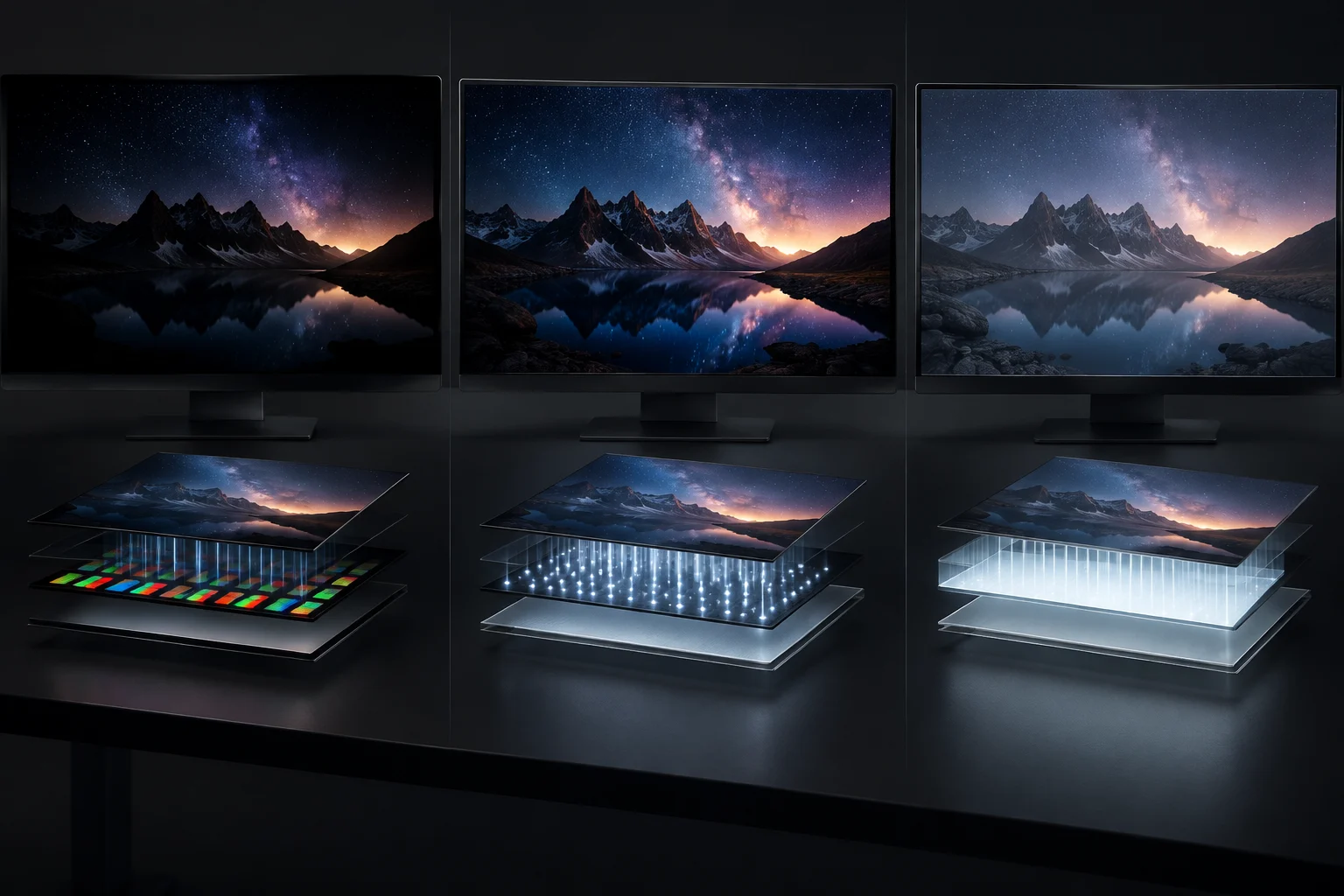
To compare monitors rigorously, first distinguish three technological layers that marketing often conflates. The panel type (LCD, OLED, QD-OLED) defines how light is modulated at the pixel level. The backlight (standard LED or Mini LED) is the light source in liquid-crystal technologies. The dimming system (global or local) determines how that light is controlled to produce contrast.
An LCD panel does not emit its own light; it relies on an LED backlight that shines through the liquid crystal. An OLED panel, by contrast, emits light directly from each pixel, allowing individual pixels to switch off completely and produce absolute blacks. Mini LED is not a panel type but an improvement to an LCD’s backlight: it uses thousands of tiny LEDs to enable much more precise local dimming.
This distinction matters because a monitor can be an LCD with a Mini LED backlight and advanced local dimming, or an LCD with a standard LED backlight and global dimming. The label “Mini LED” says nothing about the underlying panel type, while “OLED” says nothing about a backlight—because OLED has none. Understanding these separate layers is essential to interpreting specifications rather than treating a product label as a full description of how the screen works. A monitor’s picture quality depends on how its components work together, not simply on one term printed on the box.
Measurable parameters: contrast, luminance and uniformity
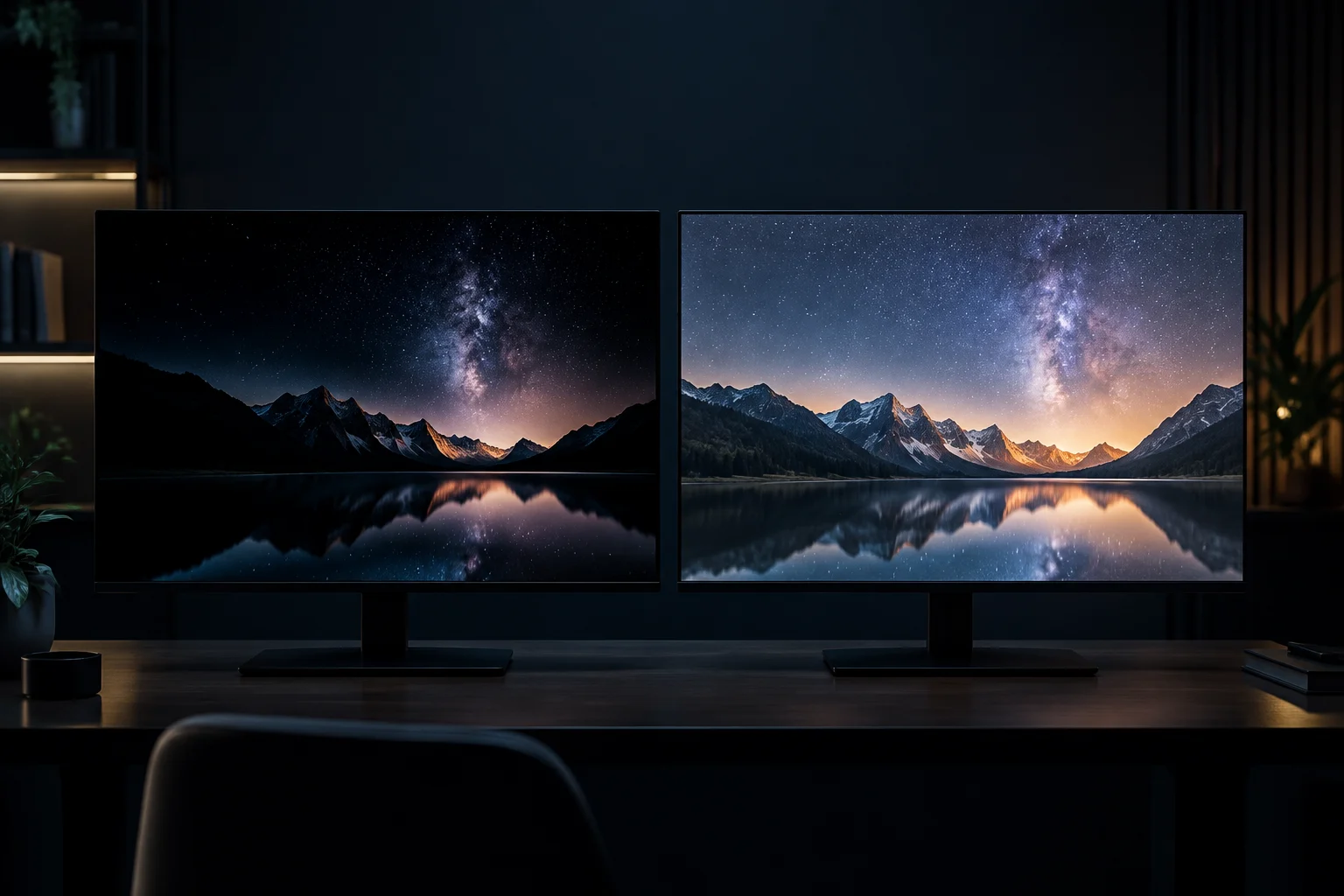
Differences between technologies can only be verified by measuring them under controlled conditions. The four key parameters are static contrast (the ratio between the brightest white and darkest black in a fixed scene), peak luminance (maximum brightness in a small area), uniformity (brightness variation across a uniform image), and blooming (a light halo around bright objects on a dark background).
A typical LCD panel has a static contrast ratio of 1000:1, regardless of its backlight. An OLED panel can exceed 1,000,000:1 because black pixels emit no light. A Mini LED monitor can reach a peak luminance of 1000–2000 nits, while OLED commonly sustains 400–800 nits, although it can exceed those levels in small areas. These figures describe different aspects of performance: peak brightness does not by itself determine HDR quality, and contrast figures need to be understood in relation to how a display handles dark and bright parts of the same scene.
Uniformity is an area where local dimming can help: a Mini LED with 500 zones can maintain better uniformity than an LCD with global dimming, although not as good as OLED. Blooming is Mini LED’s main drawback: more zones mean less haloing, but the effect never disappears completely. OLED does not have this particular issue because it has no backlight. The relationship between zone count and blooming is therefore important when comparing LCD-based monitors, but it does not replace measurements of luminance, contrast and uniformity.
Why HDR cannot be inferred from a panel name
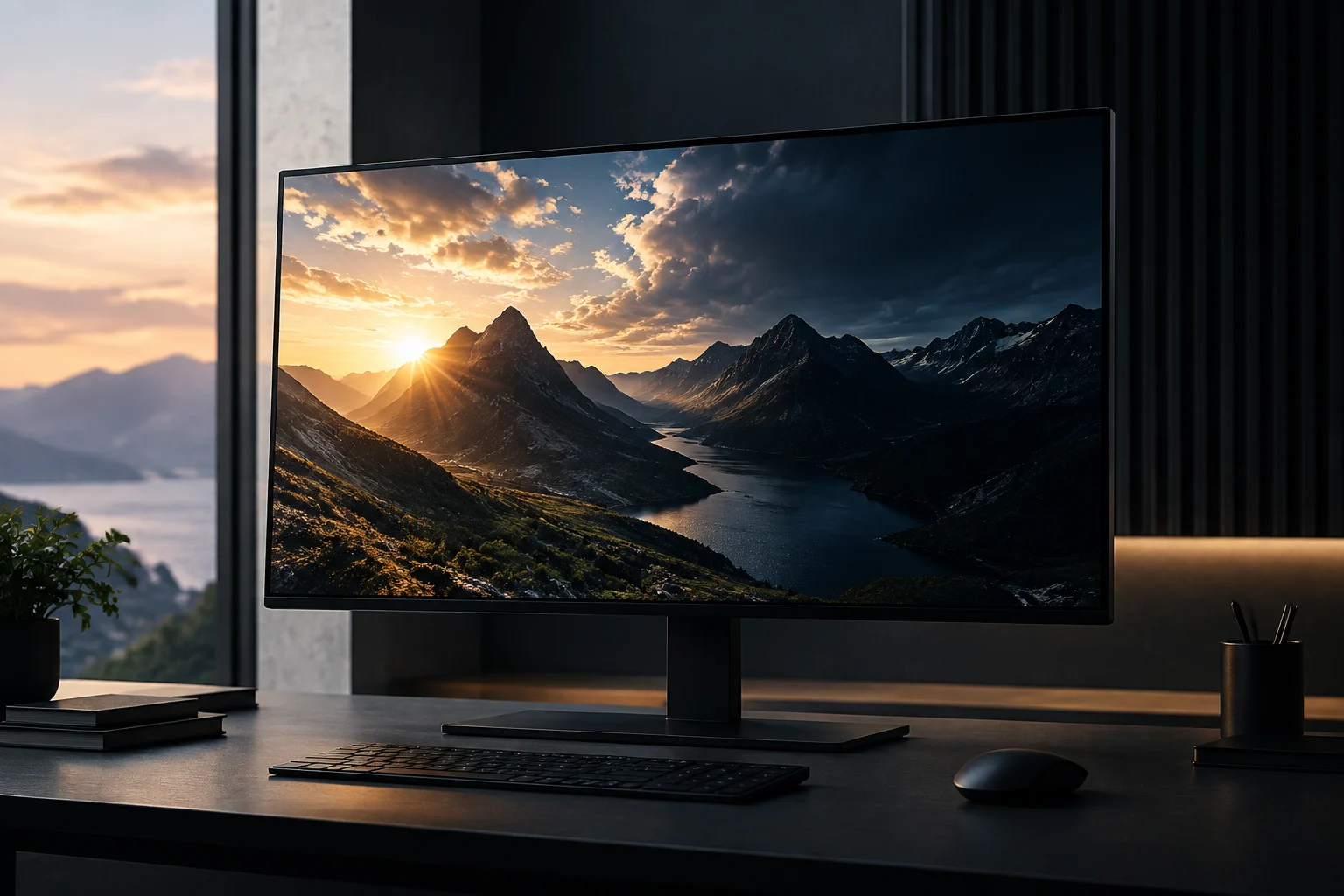
The term “HDR” (High Dynamic Range) has become a marketing label with no guaranteed technical meaning. A monitor can say “HDR” on its box without meeting any quality standard. The only way to verify that a monitor genuinely supports HDR is to look for VESA DisplayHDR certification, which specifies measurable, auditable performance levels.
VESA has established a certification scale: DisplayHDR 400, 600, 1000 and 1400, as well as DisplayHDR True Black 400/600/1000/1400. Each level sets minimum peak luminance and a specific color range; higher tiers also require a minimum number of local-dimming zones. A monitor labelled “DisplayHDR 1000” must reach 1000 nits peak brightness and have at least 1000 local-dimming zones.
DisplayHDR True Black certification is exclusive to OLED and QD-OLED panels because it requires absolute blacks (0 nits) as well as a minimum peak luminance. Even a highly advanced Mini LED monitor cannot earn True Black certification: its backlight always emits some light, however faint. This distinction offers an objective way to separate HDR performance claims across these technologies. The certification tiers provide defined targets, whereas the generic HDR label alone does not establish that a monitor has passed a measurable performance threshold.
Differences within each category: implementation and model
There can be huge differences between models within the same technology category. A Mini LED monitor with 50 local-dimming zones will have much weaker HDR performance than one with 2000 zones, even though both are “Mini LED”. A 27-inch OLED panel may have a peak luminance of 400 nits, while a 32-inch model may reach 800 nits, depending on panel technology and thermal design. This is why the technology name alone cannot tell buyers what performance to expect from a particular monitor.
For Mini LED, zone density is the most important factor: more zones mean better local dimming, less blooming and higher effective contrast. A monitor with 1000 zones can have an effective contrast ratio of 50,000:1, while one with 100 zones may remain at 5,000:1. This difference is not conveyed by the “Mini LED” label; it has to be found in the detailed technical specifications. Zone count should therefore be considered alongside the monitor’s measured luminance and its performance in dark scenes.
For OLED, the main variations are peak luminance and refresh rate. A 120 Hz OLED panel may have lower peak luminance than a 240 Hz panel because of current and heat-dissipation limits. OLED panels can also degrade over time, particularly in areas displaying static content, an important consideration for users who work with fixed interfaces. These distinctions do not make one category universally better: they indicate that the model’s implementation matters as much as its underlying display technology. Buyers comparing OLED monitors should consider brightness, refresh rate and usage patterns together.
Manufacturer documentation versus independent testing
Manufacturers often publish specifications that are optimistic or ambiguous. A monitor may list “HDR” without naming a certification level, or “Mini LED” without stating how many zones it has. Independent tests, such as those from RTINGS.com, measure these parameters under controlled conditions and provide data that can be compared across models.
DisplayHDR certification is a meeting point between manufacturer documentation and independent verification. VESA requires certified monitors to pass tests in authorized laboratories, helping ensure that published specifications are genuine. A monitor without DisplayHDR certification may deliver weaker HDR performance than its marketing suggests. The absence of a certification does not, on its own, specify the exact performance of a monitor, but it means the buyer cannot rely on that certification as evidence that the product has met its requirements.
Independent tests also reveal limitations manufacturers may not mention, such as Mini LED blooming, OLED degradation or poor uniformity in LCDs with global dimming. These findings are important for making an informed decision because factory specifications do not always reflect the experience a user will have in practice. Reviewing test conditions and results alongside the manufacturer’s figures gives a more useful basis for comparison than relying on the product description alone. Measurements help expose trade-offs that broad technology labels leave out.
Practical conclusion: how to read a specification sheet
When evaluating a monitor, do not rely on generic labels. Look for DisplayHDR certification and the number of local-dimming zones if it is Mini LED. For an OLED, check peak luminance and refresh rate. For a standard LCD, assume HDR performance will be limited, regardless of what the marketing says. Where available, compare these details with independent measurements rather than treating a single listed value as the whole story.
Comparing OLED, Mini LED and LCD is not a matter of deciding which is simply “better” or “worse”; it is a matter of priorities. OLED offers the best blacks and highest contrast, but may have lower peak luminance and a risk of degradation. Mini LED offers high luminance and good contrast, but suffers from blooming. Standard LCD is the least expensive, but has the most limited HDR performance. Each technology involves different trade-offs, so the most suitable choice depends on which characteristics matter to the user.
The only rigorous way to compare monitors is to use measurable parameters and verifiable certifications. Panel labels are a starting point, not a conclusion. Take time to read detailed technical specifications and independent tests before deciding, and do not be swayed by marketing alone. A careful comparison should account for the monitor’s panel, backlight and dimming system, and should consider how its measurable performance relates to the intended use. That approach makes it possible to distinguish genuine capabilities from broad claims.