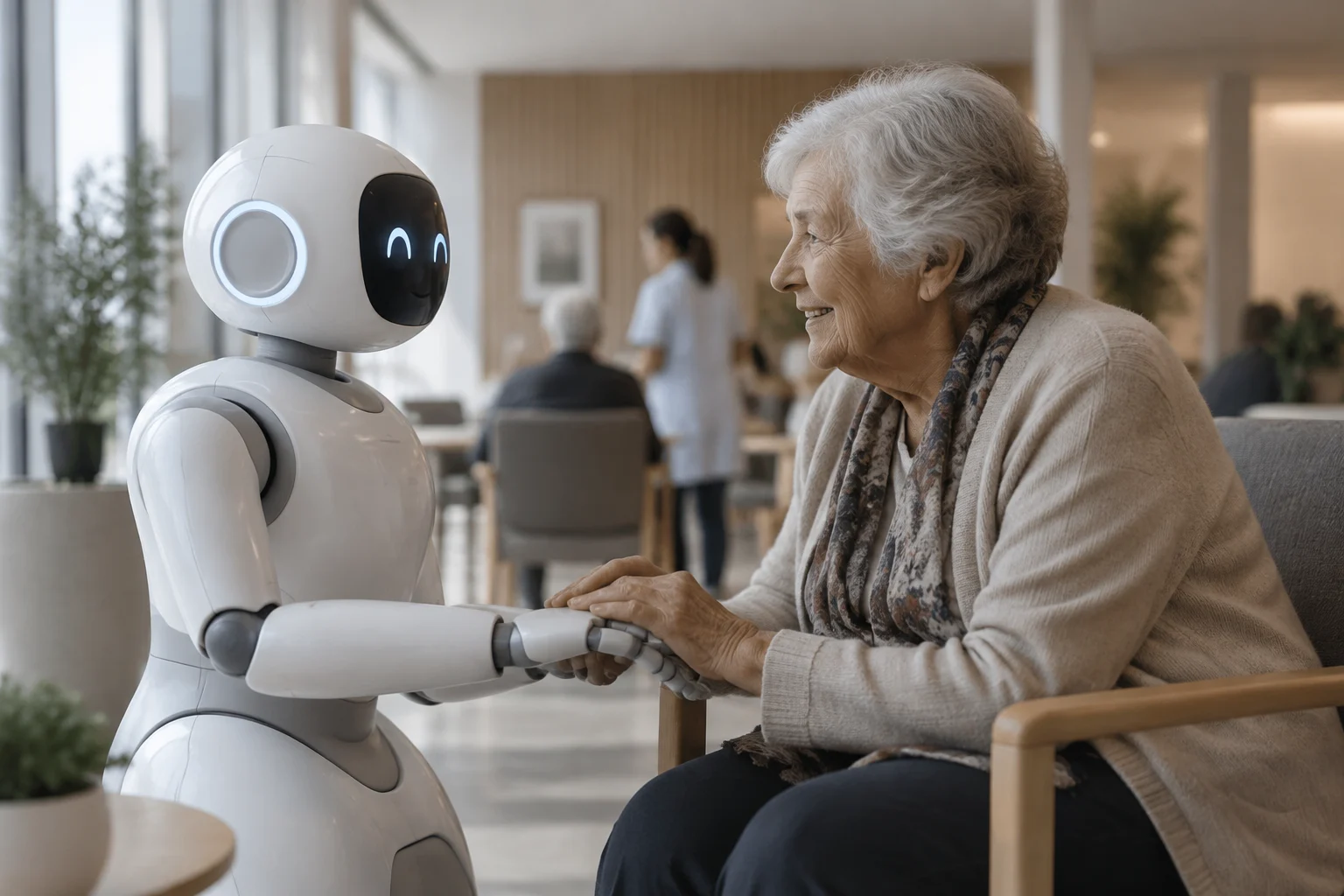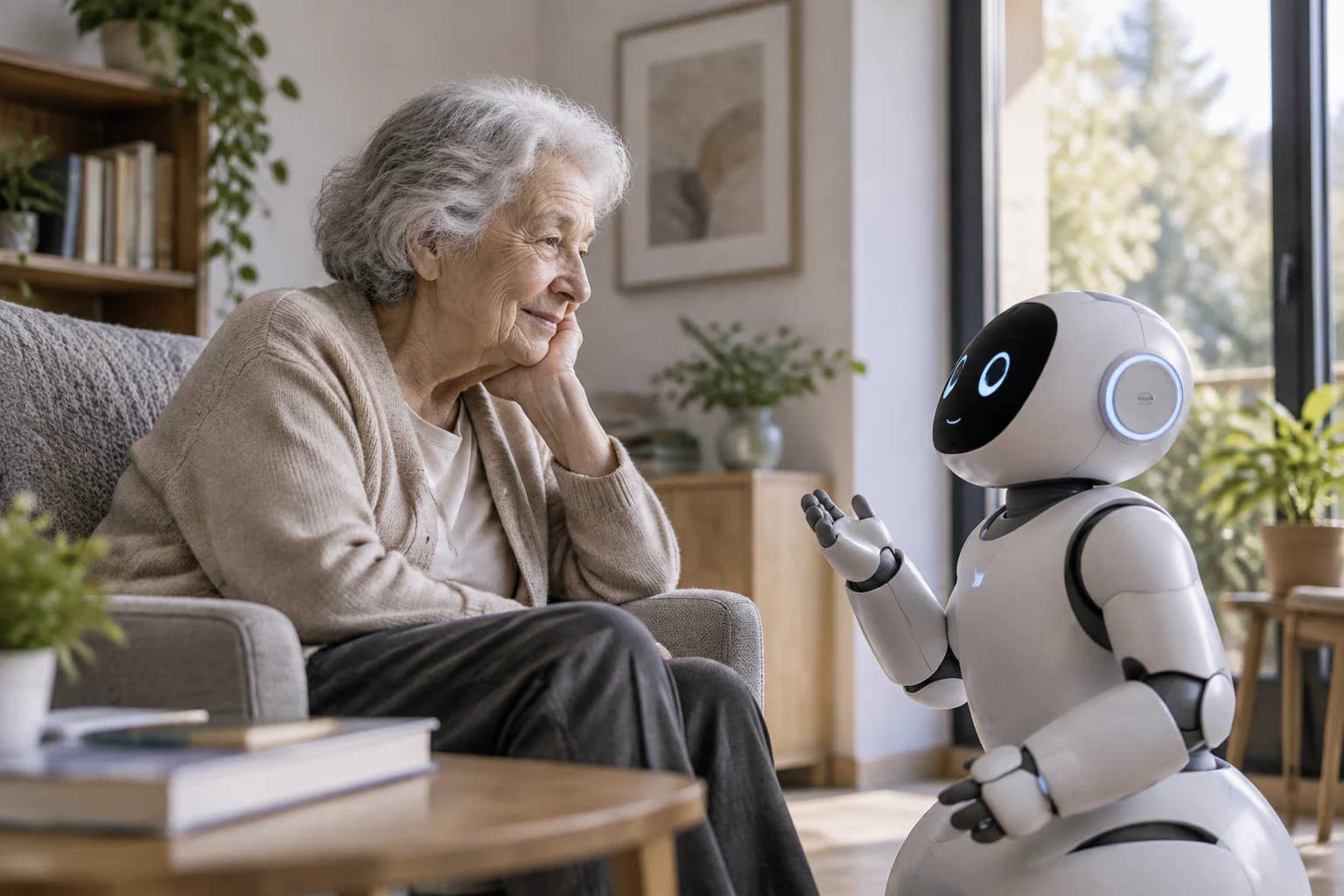
Delimitation: Social Robots and Assistive Technology Are Not a Single Intervention
Social robotics focuses on the interaction between people and robots. UNED lists uses including education, companionship, and applications linked to Alzheimer's disease or autism spectrum disorder; it also describes the goal of natural and adaptable interaction. This definition characterizes a field, not the efficacy of a specific device.
Confusing the category with a specific intervention leads to comparing non-equivalent objectives. A robot designed to converse, a tool to support exercises, and a system that alerts to risk situations raise different questions. Daily autonomy, social participation, and care burden require specific indicators and a defined population. First, one must specify what the system does and for whom.
Assistive technology is broader than social robotics. Therefore, it is not advisable to attribute to a robot functions that have not been documented for that product or program, nor to assume that the ability to interact equals a clinical improvement. The unit that must be evaluated is the specific intervention: device, activity, context of use, and the human support that accompanies it.
What Available Sources Allow to Affirm
The consulted sources serve to describe applications and debates, but they do not offer a homogeneous basis to calculate effects on users. UNED provides a general explanation of the field; a publication by the Fundación Innovación Bankinter summarizes debates on trust, ethics, and supervision. None of these descriptions, by itself, establishes that social robots generally improve well-being in care.
An opinion article published in IT User in June 2026 presents assistive robotics as a possible complementary support against loneliness and for autonomy. It is an exposition of a perspective, not a comparative evaluation of results. A usage proposal is not equivalent to a measured effect: to sustain the latter, data on who participated, what intervention they received, and what changed compared to a pertinent comparison are needed.
Consequently, it is not rigorous to transfer promises of companionship, detection, or personalization to conclusions about health. The available sources do not provide verifiable quantitative results here that allow affirming a reduction in isolation, a sustained improvement in autonomy, or a decrease in the caregiver's burden. This limit does not prove the effect is impossible; it indicates that it is not demonstrated by the consulted material.
Located Academic Research and Its Verification Limits
Among the reviewed records, a paper titled “Managing Cognitive Decline Through a Social Robot” appears in PubMed. The record allows identifying a publication related to the topic, but the accessible information in the research package does not include verifiable details of methods, sample, duration, or results. It must not be presented as proof of efficacy without consulting and contrasting the text and its data.
The reference, by itself, does not allow knowing which population participated, what the robot's role was, or how changes were measured. It also does not allow concluding that autonomy, well-being, isolation, or care burden were studied as primary outcomes. Therefore, it is not possible to attribute a specific effect to it nor to judge if its findings can be applied to other groups or environments.
This is a limitation of the available verification, not a negative evaluation of the study. The appropriate editorial decision is not to fill the gaps with assumptions and not to call it “2025 research” as if its date and results were confirmed in the consulted material. To value the work, the full text or a sufficient academic summary, along with the unequivocal identification of the publication, would be needed.
How to Distinguish Interaction, Results, and Promises
An observed interaction can be a relevant data point, but it does not automatically answer whether a person is less isolated, gains autonomy, or needs less support. It is advisable to distinguish between what the robot can do, what users do during a session, and the changes that persist in their daily life. These are different levels of evidence and require different measures.
Outreach notes and opinion articles help understand expectations, use cases, and concerns. They do not replace studies that describe participants, intervention, comparator, measures, and follow-up. Similarly, a source recommending human supervision does not demonstrate a clinical result: it expresses a consideration about responsible use, not an efficacy measurement.
When reviewing a claim, readers, families, and professionals can ask:
- What outcome was measured: interaction, mood, autonomy, safety, or caregiver burden?
- In which people and in what environment was it evaluated?
- How long was the follow-up and was it compared with an alternative?
- Who funded or produced the evaluation, and are its methods published?
- Is the reported result an observation, an opinion, or a conclusion backed by data?
What Is Missing to Evaluate Effects in Care
To sustain that a robot improves well-being or reduces the assistive burden, studies are needed that clearly define those outcomes and explain how they were measured. It is also important to know the duration of use, dropouts, and differences between contexts. Without that information, one cannot distinguish an initial response to a novel technology from a change that is maintained over time.
Care burden is also not summarized in saved minutes. A useful evaluation should clarify which tasks are modified, if human attention time changes, and how the user and those who support them perceive the intervention. The benefit for a group should not be assumed from a technical function or an isolated experience.
Risks and responsibilities must also be identified: what happens if the system misinterprets a response, who reviews its alerts, and what data it collects. The Bankinter source raises issues of trust and supervision, but the available material does not allow quantifying those risks nor establishing their frequency. The evaluation must keep separate the questions of safety, acceptance, and efficacy.
Editorial Balance: Deciding Without Confusing Potential with Result
Accessible evidence allows describing social robotics as a field oriented to interaction between people and robots and recognizing that assistive uses are proposed. It does not allow affirming generalized improvements in well-being, autonomy, or care burden. The prudent conclusion is limited: those possibilities require specific evaluation and should not be communicated as results demonstrated by the sources verified here.
For a family or an institution, the useful question is not whether “robots work” in the abstract, but what specific objective is sought, what evidence supports that application, and what human support will still be necessary. Before adopting a solution, it is advisable to request information on evaluation, privacy, costs, maintenance, and supervision; the source package does not allow resolving those aspects for a specific product.
Responsible communication does not require discarding the technology nor anticipating benefits. It requires naming what is documented, what is proposed, and what is missing to be checked. The absence of sufficient evidence in these sources limits the conclusions of this analysis; it does not demonstrate that no system can be useful in any context.